The current administration is following the path of no return in its running of the government. There are many norms and accepted practices that no longer apply. The so-called American Dream has become a Nightmare without a “wake up”. The vengeful child has control of the country via the weak GOP who once was a powerful force for American values. This politically powerful group has forgotten the oath of office taken when elected and ceded its power to the “child”. At this time there appears to be no control in government as the founders had put in place. The real control of government has been quietly usurped by groups or a group of powerful people who saw a way to put their hands deeply in government through a “useful tools” ego.
It is sad that so many voters have been led to believe what is being done to other Americans (or other nations for that matter) is somehow other worldly and will not affect them. It is sad that so many forget the lessons of the past and still rely on the words of shady charismatic characters who offer words with no substance. The evidence is clear that the resident is a loose cannon being used as a” “useful idiot” by his own party and his “handpicked” Whitehouse staff and cabinet. Even “jar Jar Binks” recognized his limitations not so with the current “Nerolistic” occupant of the “peoples house”! It only requires a cursory glance at history to understand that a mistake was made in electing a “nihilist” as leader of one the most powerful countries in the world. The machinations of this regime is based on ego and past or current “hurt” feelings!
For the folks who read and understand the current politics or have the ability to see through the fog of lies and deceit the Franklin quote should be a wakeup call.
The story: As delegates left the Constitutional Convention, a woman asked Franklin if the new government was a republic or a monarchy. Franklin famously replied, “A republic, madam, if you can keep it,” implying that maintaining the new form of government would be a continuous challenge requiring civic engagement.
The meaning: The quote suggests that a republic is not a permanent state but something that must be actively protected and maintained by its people. It underscores the importance of vigilance, civic duty, and the people’s role in holding the government accountable.
Historical context: The quote has become a well-known and relevant statement, particularly during times of political division, serving as a reminder of the framers’ intentions and the responsibilities of citizenship.
Comments Off on Obamacare 2010-present: GOP addressed no issues!
The GOP has decried “Obamacare” since its passage. Instead of putting in time to correct or amend it, they have railed against it in all its forms. The Congressional detractors have taken the parts they like and incorporated it into their own “Cadillac” health plan,while decrying how terrible it is for the people. According to public information many more millions of Americans were and are able to get affordable healthcare. There have been glitches sure enough but overall, no more than any public program. Social security didn’t hit the ground running! The Current administration is using any largely incorrect information to debase the program enjoyed by millions, including the detractors. This has become typical of this “occupier of the office” who has essentially usurped the power of the people and their elected representatives.
The country is being bombarded by illogical and dangerous rhetoric which makes no attempt at hiding the weakness of the Congress against the usurper.
Comments Off on Characteristics Report by USDA Provides Insights Into Who Participates in SNAP
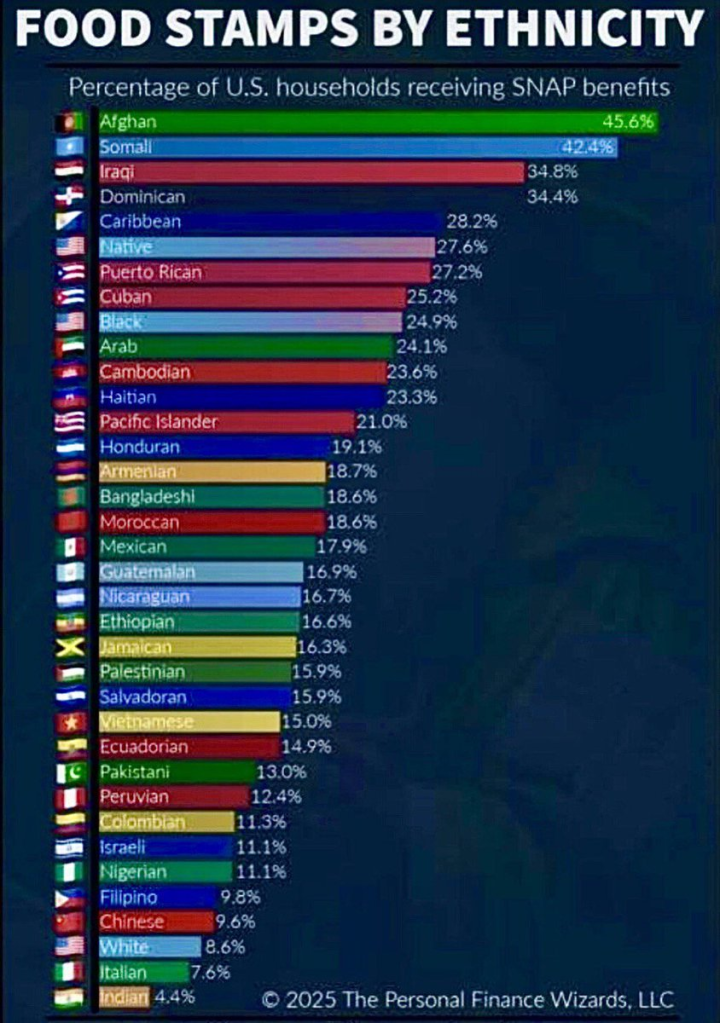
Correct information authored by: By Lauren Walcott and James Ziegeweid,Published June 27, 2025 Congressional Hunger Center Emerson Fellows begins below Fake chart shown on X.
Madeup chart below put out on X totally misleading about SNAP recipents-possible cause of attack on SNAP recipents.
Published June 27, 2025
Annually, the U.S. Department of Agriculture (USDA) issues a report on the characteristics of households and individuals participating in the Supplemental Nutrition Assistance Program (SNAP). The most recent report released in April provides details about fiscal year 2023 program participants, and critical insights for lawmakers, advocates, and stakeholders, while simultaneously pushing back against harmful narratives that have been perpetuated about households participating in SNAP.
Key Takeaways
SNAP provides food assistance to the most vulnerable. The vast majority of individuals participating in the program are children, older adults, or individuals with a disability. The report highlights that 39 percent of participants were children, 20 percent were older adults, and 10 percent were individuals with disabilities. Additionally, 73 percent of households participating in SNAP had a gross monthly income at or below the federal poverty line. In fiscal year 2023, the income level for a family of four at the federal poverty line was $27,750.
SNAP serves people of all racial and ethnic backgrounds. Among program participants, over 35 percent identified as White, nearly 26 percent as African American, nearly 16 percent as Hispanic, 4 percent as Asian, and a little over 1 percent as Native American. It should be noted that 17 percent of participants are listed as “race unknown.”
SNAP helps workers make ends meet. Nearly one-third of SNAP households have earned income. For SNAP households with children, 55 percent had earned income. The average SNAP household’s gross monthly income is $1,059 and net income is $527.
Most SNAP households do not receive cash welfare benefits. Only 3 percent of all SNAP households, and only 7.8 percent of SNAP households with children, receive benefits through the Temporary Assistance for Needy Families (TANF) program.
SNAP lifts households out of poverty. Among households participating in SNAP, 17 percent moved above the federal poverty line when SNAP benefits were included in gross income, and 10 percent of the lowest-income SNAP households moved out of deep poverty.
Despite the many benefits of the program, SNAP benefit levels continue to be woefully inadequate. About 36 percent of SNAP households receive the maximum allotment. The other 64 percent of participating households receive less than the maximum. The average benefit is just $6 per person per day. As described in a prior FRAC analysis, the greatest shortcoming of SNAP is that benefits for most households are not enough to get them through the entire month without hunger or being forced to sacrifice nutrition quality.
Time and again, SNAP has been found to be a profoundly important program with well-documented benefits for participants and their communities. As shown in this report from USDA, SNAP targets households that are struggling the most, reducing hunger and poverty for millions of people annually.
For more information about SNAP, visit the SNAP section of FRAC’s website.
This misadministration has blatantly shown the variety of ways to dip into the National funds under the guise of governing. (This also could be a snapshot as to the business failures of Trumplelstilskin). First you fill the government offices with sycophants and unqualified seat fillers. Then you create a crisis with trading partners then backdown calling it “a deal”. Next you make unsubstantiated claims of uncommitted crimes to assassinate unproven “drug runners” on the high seas without authorization from Congress. Then you reveal our nuclear arsenal to the world using threats to dictators who are smarter than you. At the end of this term, there will be at minimum 4-8 years to correct the mistakes of 4 years but only if we clean up Congress and the courts. This is a long-term project.
Comments Off on How will a fed rate drop impact me?
Economy built by Trumplestilskin.ma
A Federal Reserve rate drop can have several impacts on your finances, depending on your financial situation and the types of loans or savings you have. Here’s a breakdown of how it might affect you:
1. Borrowing Costs Decrease 📉
Mortgages: If you’re looking to buy a home or refinance, a rate cut can lead to lower mortgage rates. For instance, the average 30-year fixed mortgage rate recently dropped to around 6.27%, down from higher levels earlier in the year. This can make home buying more affordable 12.
Auto Loans and Personal Loans: Rates for car loans and personal loans may also decrease, making it cheaper to finance a vehicle or other purchases 34.
2. Credit Card Rates May Not Change Much 💳
Unfortunately, credit card rates tend to be sticky and may not drop significantly. The average credit card interest rate is around 20%, and a quarter-point cut might not provide much relief for those carrying balances 23.
3. Savings Accounts Yield May Decline 💰
If you have money in high-yield savings accounts or CDs, you might see lower interest rates as banks adjust to the Fed’s rate cut. This means your savings could earn less over time 34.
4. Economic Growth Potential 🌱
Lower rates are intended to stimulate economic growth by encouraging spending and investment. This could lead to job creation and a more robust economy, which benefits everyone in the long run 15.
In summary, if you’re a borrower, you might benefit from lower rates on loans, but if you’re a saver, you could see reduced returns on your savings. It’s a mixed bag, but overall, the goal of the Fed’s rate cut is to support economic growth and stability.
Comments Off on House Democrat Declares, ‘Mike Johnson Has Effectively Dissolved the United States House of Representatives’
Mediaite
Fri, October 24, 2025 at 8:11 PM CDT
200
Rep. Adam Smith (D-WA) said Speaker Mike Johnson (R-LA) has “effectively dissolved” the House.
The House remains out of session amid the ongoing shutdown that began on Oct. 1. Ahead of the shutdown, the House passed a continuing resolution to fund the government beyond that date, but the legislation stalled in the Senate, where it failed to notch the necessary 60-vote procedural threshold. Seven votes are needed from Democrats, who are demanding an extension of healthcare premium subsidies for Obamacare recipients. So far, congressional Republicans have not budged.
Johnson said on Thursday that bringing the House back into session until an agreement is reached this can “be a waste of our time.”
On Friday, Smith appeared on MSNBC, where Jason Johnson asked about the Trump administration’s ongoing bombing of Venezuelan boats in international waters. Trump officials allege the boats were carrying drugs. The administration has provided no evidence to justify the bombings, which are legally suspect, according to experts.
“Once you start just randomly killing people from other countries and coming up with a crime to throw on them later, doesn’t that destabilize our relationships with the rest of South America? Doesn’t it make business more difficult?” the host asked. “What are some of the ripple effects of this current insane foreign policy by the administration?”
Smith used the question to pivot to House oversight, which is currently nonexistent, thanks to the speaker keeping the chamber out of session.
“It does all of those things, and it tells everyone in the world that this is perfectly ok,” Smith said. “You decide you want to kill somebody, go ahead and do it. And you don’t have to justify it either. It makes us more vulnerable.”
The lawmaker then accused the speaker of dissolving the House:
We are losing our constitutional republic. And meanwhile, the House of Representatives, Mike Johnson has effectively dissolved the United States House of Representatives. I spoke with several Republicans, including Chairman Mike Rogers today to talk about, “Ok, we need to have hearings on this. You know, the House Armed Services needs to exercise oversight.”
And there are many Republicans, including Mike Rogers, who agree with that. But we’re not in session. So we can’t do it. So we’re gonna do it. So, the president just gets to do what he wants.
I mean, look. The whole Nazi Germany analogies are always troubling, but, you know, that was one of the steps is the parliament or the Reichstag or whatever it was, was sort of pushed out of existence and didn’t have any oversight.
Comment from pass through poster: “lest we forget” and we have!!
Last updated 2 weeks ago. Our resources are updated regularly but please keep in mind that links, programs, policies, and contact information do change.
The government-operated website will not directly sell or distribute medications. Instead, it’s designed to function as a search portal. Consumers can use the site to look up their prescriptions and, if a drug is part of the program, they will be redirected to the pharmaceutical manufacturer’s own direct-to-consumer platform to complete the purchase. This portal model keeps the government out of the complex logistics of the pharmaceutical supply chain.
TrumpRx is the public-facing component of a broader policy known as “Most-Favored-Nation” (MFN) pricing. This underlying doctrine aims to align the prices Americans pay for brand-name drugs with the lowest prices paid in other developed countries.
The name “TrumpRx” is a political branding strategy, directly tying the initiative’s perceived success or failure to the president. This creates high political stakes and has led some experts to caution that the branding could backfire if U.S. drug prices remain high for most consumers.
This represents a form of external reference pricing, a tool used by many countries to control pharmaceutical costs by benchmarking their prices against those in other markets.
The administration’s central argument for implementing MFN pricing is to end what it terms “global freeloading”. The theory posits that the United States disproportionately finances global pharmaceutical innovation.
According to this view, other developed nations use their centralized, single-payer health systems to impose artificially low price controls on drugs. This forces pharmaceutical manufacturers to recoup their research and development costs and generate profits by charging significantly higher prices in the less-regulated U.S. system.
President Trump articulated this position directly, stating, “The United States is done subsidizing the health care of the rest of the world”. This framing positions the issue as a matter of international trade fairness rather than purely as a domestic healthcare cost problem, which justifies the use of trade-based leverage, such as tariffs, to achieve policy goals.
Policy History and Legal Precedent
The 2025 announcement of TrumpRx was not the administration’s first attempt to implement an MFN policy. The effort has a complex history rooted in a previous executive order and subsequent legal battles.
To implement the 2020 order, the administration issued an Interim Final Rule (IFR) that bypassed the standard public notice-and-comment period required by the Administrative Procedure Act. The administration claimed it had “good cause” to expedite the rule due to rising drug prices and the economic strains of the COVID-19 pandemic.
MFN Pricing for Medicaid: Pfizer committed to offer its entire portfolio of drugs, including all new medicines it brings to market, to every state Medicaid program at MFN prices. This new pricing structure is scheduled to begin in early 2026.
This structure suggests the agreement is less a pure healthcare policy and more a strategic negotiation rooted in trade and industrial policy. The drug price concessions can be seen as the cost Pfizer was willing to pay to avoid a potentially more damaging trade penalty and to gain regulatory predictability, which CEO Albert Bourla stated provides “the certainty and stability we need”.
This confidentiality makes it impossible for independent analysts to verify the administration’s claims of savings or for other companies to accurately model a similar agreement. It particularly obscures whether the new MFN price for Medicaid will be substantially lower than the already-discounted “best price” that Medicaid is entitled to under existing federal law.
Provision
Details
Stated Goal / Rationale
MFN for Medicaid
All Pfizer drugs, including new launches, to be offered to state Medicaid programs at the lowest price paid in a basket of peer nations, starting early 2026.
Lower costs for state and federal taxpayers; strengthen Medicaid for the most vulnerable.
TrumpRx.gov Discounts
Select drugs like Eucrisa and Xeljanz offered at 40-85% discounts off list price via a direct-to-consumer platform.
Provide direct savings to cash-paying American consumers by bypassing middlemen.
Tariff Exemption for Pfizer
Pfizer receives a 3-year grace period from the administration’s threatened 100% tariffs on imported branded drugs.
Incentivize voluntary compliance with MFN policy and reward the first mover.
Domestic Investment
Pfizer pledges $70 billion for U.S.-based manufacturing and R&D.
Onshore pharmaceutical manufacturing, create American jobs, and secure domestic supply chains.
A defining feature of the TrumpRx model is that all purchases are cash-pay, out-of-pocket transactions. The system is explicitly designed to “bypass middlemen” such as health insurers and Pharmacy Benefit Managers (PBMs), the third-party administrators that manage prescription drug benefits for health plans.
This creates a potential “two-track” system for drug purchasing that could lead to complex financial trade-offs for consumers. For example, a patient with a high-deductible plan might face a difficult choice: pay a lower immediate cash price for a drug via TrumpRx, or pay a higher price through their insurance to make progress toward meeting their annual deductible.
The latter option could save them more money in the long run if they anticipate significant other healthcare costs during the year. Because TrumpRx purchases exist outside the insurance system, the program could inadvertently increase a patient’s total annual healthcare spending even if it lowers the cost of a single prescription.
Comparison to Existing Platforms
The direct-to-consumer model leveraged by TrumpRx is not entirely new and shares conceptual similarities with private-sector platforms that also operate largely outside the traditional insurance framework. These include:
Discount Card Programs like GoodRx: These services provide consumers with coupons that offer cash-price discounts at traditional retail pharmacies.
TrumpRx is distinct from these models because it is a government-branded portal that will feature primarily brand-name drugs from specific manufacturers at prices purportedly based on federally facilitated MFN agreements.
Who Wins, Who Loses, and Who is Unaffected
The practical impact of the TrumpRx initiative and the underlying MFN policy is likely to be unevenly distributed across the American population. The benefits and drawbacks vary significantly depending on an individual’s insurance status and healthcare needs.
Potential Beneficiaries
The Uninsured: This segment stands to benefit the most from the TrumpRx platform. Without any insurance coverage, these individuals currently face the full, undiscounted retail price for prescription drugs and possess little to no negotiating power. TrumpRx offers them a direct pathway to potentially significant discounts on certain brand-name medications, provided they can afford the final cash price.
The Underinsured (High-Deductible Health Plans): Patients enrolled in high-deductible health plans (HDHPs) who have not yet met their annual deductible may also find value in TrumpRx. Before the deductible is met, these patients are responsible for the full, insurer-negotiated price of their drugs. In some cases, the discounted cash price on TrumpRx could be lower than this pre-deductible price.
However, the true scale of these savings is difficult to assess. Federal law already requires drug manufacturers to provide Medicaid with substantial rebates, ensuring the program receives the “best price” offered to any other purchaser in the U.S. Without access to the confidential terms of the Pfizer deal, it is unclear how much lower the MFN price will be compared to the already-low prices Medicaid currently pays.
A History of U.S. Drug Pricing Reform Efforts
The TrumpRx initiative and its MFN foundation are part of a long and ongoing debate over how to address the high cost of prescription drugs in the United States. Understanding this context requires comparing the MFN approach to other major reform proposals, both past and present.
Predecessor Policy: The International Pricing Index (IPI) Model
Mechanism: The IPI was envisioned as a mandatory payment model for Medicare Part B, which covers physician-administered drugs like infusions for cancer or rheumatoid arthritis. It would have gradually phased down Medicare’s reimbursement for these drugs to align with an index of prices paid in other developed countries.
A key feature was its plan to replace the traditional “buy and bill” system—where physicians purchase drugs and are then reimbursed by Medicare—with a new model where private-sector vendors would acquire and distribute the drugs, taking on the financial risk.
Status: The IPI was introduced via an Advance Notice of Proposed Rulemaking, soliciting public comment, but it was never finalized into a formal rule. It faced strong opposition from physician groups and the pharmaceutical industry and was eventually superseded by the MFN executive order.
Comparison with the Inflation Reduction Act (IRA) Medicare Negotiation
The Biden administration’s landmark drug pricing reform, enacted through the Inflation Reduction Act (IRA) of 2022, offers a fundamentally different approach to cost control.
Mechanism: The IRA empowers the Secretary of HHS to directly negotiate a “Maximum Fair Price” with manufacturers for a select list of high-cost drugs. This is a process of active negotiation, backed by a severe excise tax for non-compliance, rather than the passive adoption of a foreign reference price as seen in the MFN model.
The MFN policy, as articulated in the 2025 executive order, is envisioned to be much broader, calling for MFN prices across all brand products for Medicaid and on all new drug launches.
Sets U.S. price based on the lowest net price in a basket of peer nations.
Initially Medicaid and DTC cash-paying consumers; potentially all brand drugs.
Based on Executive Order; one voluntary deal with Pfizer; legal authority for mandatory imposition is questionable.
IRA Medicare Negotiation
Direct negotiation between HHS and manufacturers to set a “Maximum Fair Price.”
Select high-spend, single-source drugs in Medicare Parts D and B.
Enacted into law by Congress; currently being implemented.
International Pricing Index (IPI)
Phased-in price alignment with an international index for Part B drugs.
Medicare Part B physician-administered drugs.
Proposed during first Trump term; never finalized.
Drug Importation
Allows pharmacies and wholesalers to import FDA-approved drugs from other countries.
All prescription drugs, particularly from Canada.
Authorized by law but implementation has been limited due to logistical and regulatory hurdles.
The Debate: Perspectives from Stakeholders and Experts
The announcement of TrumpRx and the MFN policy has ignited a robust debate among key stakeholders, including the administration, the pharmaceutical industry, patient advocates, and independent policy experts.
Broader Industry (PhRMA): The Pharmaceutical Research and Manufacturers of America (PhRMA), the industry’s main lobbying group, is staunchly opposed to the MFN concept. PhRMA has characterized the policy as the importation of “foreign price controls” from “socialist countries”. The group argues that such policies will stifle innovation, drastically reduce investment in R&D, lead to fewer new cures, and ultimately harm patient access to the next generation of medicines.
AARP: The influential seniors’ advocacy group has praised the MFN executive order. AARP thanked the administration for “standing up to the big drug companies to disrupt the status quo”. Their support is rooted in the belief that high drug costs force seniors to make impossible choices between affording life-saving medications and paying for other necessities like food.
Independent Policy Analysis (Skeptics)
Many independent health economists and policy experts have expressed significant skepticism about the TrumpRx initiative.
Potential Negative Consequences: Some conservative and market-oriented think tanks, such as the American Action Forum, have argued that imposing MFN pricing across Medicare Part D would be its “death knell”. They contend it would destroy the market-based negotiation structure that has successfully controlled costs in the program, effectively turning it into a restrictive, government-run, single-payer system with diminished access to medicines.
Stakeholder
Position
Key Argument
Primary Concern
The Trump Administration
Strongly Supportive
Ends “global freeloading” and brings fairness and lower prices to U.S. patients.
High drug prices are politically unpopular and economically unsustainable for consumers and government programs.
Pfizer
Cooperative Participant
Provides regulatory certainty on pricing and avoids punitive tariffs, which is good for business stability.
An unpredictable regulatory environment and the financial impact of tariffs.
PhRMA (Industry)
Strongly Opposed
MFN is a form of government price control that will stifle innovation, reduce R&D, and harm patient access.
Loss of revenue, reduced ability to fund R&D for new medicines, and government overreach into the market.
AARP (Patient Advocates)
Supportive
A necessary action to control exorbitant drug prices that harm seniors.
Members’ inability to afford life-saving medications due to high out-of-pocket costs.
Independent Policy Analysts
Skeptical
The program’s scope is too limited to affect most Americans; lacks transparency and may be more political than substantive.
Policy may be more political theater than effective reform; could have unintended financial consequences for patients.
Frequently Asked Questions
Is TrumpRx a pharmacy?
No. TrumpRx.gov is a government-run website that will function as a search portal. It will not sell, dispense, or ship medicine. Its purpose is to direct consumers to the drug manufacturer’s own website, where a direct purchase can be made.
How is TrumpRx different from GoodRx or Mark Cuban’s Cost Plus Drugs?
While all three aim to lower out-of-pocket drug costs, they operate differently. GoodRx is a private company that provides consumers with discount coupons that can be used at traditional retail pharmacies. Mark Cuban’s Cost Plus Drugs is a licensed mail-order pharmacy that acquires primarily generic drugs and sells them to consumers with a transparent, fixed markup. TrumpRx is a government-operated portal for purchasing brand-name drugs directly from specific manufacturers at prices based on the federally-driven “Most-Favored-Nation” principle.
Will my insurance cover drugs bought through TrumpRx?
Our articles make government information more accessible. Please consult a qualified professional for financial, legal, or health advice specific to your circumstances.
Comments Off on Trump targets states that voted for Harris in shutdown fight
Aaron Pellish-Politico
To be clear, the so-called “Grifter in Chief” is punishing everyone under the pretense of targeting Democrats, which is absurd on its own. Cuts affect everyone indiscriminately. This deliberate targeting of states and cities borders on fascism. MA.
Wed, October 1, 2025 at 2:48 PM CDT·2 min read
The White House is targeting Democratic states with its first wave of cuts to federal projects following the government shutdown, impacting billions of dollars in funding for energy and infrastructure in New York, California and elsewhere.
Russ Vought, director of the Office of Management and Budget, said Wednesday the Trump administration is cancelling nearly $8 billion in funding for energy programs he characterized as part of “the Left’s climate agenda.”
The cuts will impact 16 states — all of which voted for former Vice President Kamala Harris in last year’s presidential election. Vought did not identify exactly which programs would be cut in the social media announcement.
Earlier Wednesday, Vought said the White House is withholding $18 billion in funds from New York City’s Second Ave. subway and Gateway tunnel projects, the latter which connects New Jersey and New York.
New York-area lawmakers reacted with fury to the infrastructure cuts earlier Wednesday.
“Political revenge. Clearly outlined by Trump, time and again. He sees the U.S. as Blue and Red, and Blue states are enemies,” George Latimer (D-N.Y.), who represents the New York City suburbs in Westchester County, wrote in a text message to POLITICO. “As he has said many times, he hates his enemies; he is the retribution. Has he announced any rescission of any projects in Florida or Texas?”
Vought has not publicly announced cuts that affected a state that backed Trump in 2024.
The moves reflect Trump’s intent to undermine programs benefiting Americans in blue-leaning states, while leaders from both parties work to negotiate a government funding agreement. Trump has suggested the shutdown could offer a pretense to cut programs he doesn’t like.
“We can get rid of a lot of things that we didn’t want, and they’d be Democrat things,” Trump told reporters on Tuesday ahead of the shutdown.
Top Trump allies have also indicated the strategy could serve as leverage to bring Democrats back to the negotiating table. Vice President JD Vance told reporters during Wednesday’s White House briefing that the administration is prioritizing funding for essential services and argued that programs like the New York infrastructure projects may suffer as a consequence.
“We want to do everything that we can to help the American people but when the Democrats shut down the government, we have to actually do a little triage to make sure the most critical and most essential services are provided,” Vance said.
When asked for comment on the cuts targeting blue-leaning states, a White House spokesperson pointed to press secretary Karoline Leavitt’s comments during Wednesday’s briefing.
“There are unfortunate consequences to a government shutdown, and the federal government is not receiving any cash at the moment,” Leavitt said. “The Office of Management and Budget has been tasked with looking over the receipts and looking over the budget of the entire federal bureaucracy.”
Comments Off on The Republican Shutdown Argument is a Giant Lie
No, Democrats aren’t trying to fund health care for “illegal aliens.”
Jonathan Cohn
Sep 30
Hey, guys. Earlier today, my colleague Mona Charen and I talked about President Trump’s speech before the generals and admirals, as well as the politics of the government-shutdown fight.
In today’s newsletter, I write about the likely shutdown and the main argument about health care that Trump and his allies are making. I am calling it a “lie,” which is not a phrase I typically use. I reserve it for instances when a claim seems fundamentally untrue and when the people making the claim know better—or, at least, should know better. I think this instance qualifies. Let me know in the comments if you agree.
THE REPUBLICAN PARTY’S CLOSING ARGUMENT heading into the government shutdown is a big, brazen lie.
The lie is so big and so brazen that it’s almost not worth addressing, because doing so gives the claim far more credibility than it deserves.
But it’s become ubiquitous in Republican talking points, from the president on down. There’s also a chance some people will believe it, because it feeds into some common misconceptions about health care and immigration policy, as well as preconceptions of how the parties operate. And in a standoff that has been all about political leverage and public opinion, setting the record straight matters.
So let’s get to it.The claim is about what Democrats are demanding in exchange for their support on a spending bill that would keep the government open past midnight tonight, when funding runs out. Remember, Republicans control both the White House and Congress, but need Democratic votes in the Senate to approve a new spending measure.
The central Democratic demand is about health care: They want Republicans to extend a temporary Biden-era program that has lowered health insurance costs for more than 20 million Americans buying coverage through the Affordable Care Act. And they want Republicans to undo at least some of the dramatic Medicaid cuts that the GOP enacted over the summer, as part of Donald Trump’s “One Big Beautiful Bill.”
Trump and Republican leaders have refused to negotiate. And after flailing about with a few different arguments—including a preposterous claim that Democrats just want to pad the profits of insurance companies—they have settled on a new line: that Democrats want to fund health care for “illegal aliens.”
I put the phrase in quotes because it’s the phrase Republican officials have used over and over again—literally eight times by Vice President JD Vance in one recent Fox News interview, as my Bulwark colleague Will Saletan observed the other day.
Vance made the claim yet again on Monday while standing outside the White House, following a failed negotiation session between GOP and Democratic leaders. At his side was House Speaker Mike Johnson, who’s been putting out the same message, including in a Sunday tweet saying that Democrats “want to give free health care to ILLEGAL ALIENS paid by hardworking Americans.”
And then there is Trump, who has been using the same line in conversations with reporters and on his own social media feeds. On Monday night, he even reposted an AI fake of a press appearance by the Democratic congressional leaders in which the fake Sen. Chuck Schumer says: “If we give all these illegal aliens free health care, we might be able to get them on our side so they can vote for us.” A digitally animated, sombrero-wearing, mustachioed Rep. Hakeem Jeffries looks on as mariachi music plays in the background.
If you’re not too busy gasping at what it says about the president’s state of mind that he’d post this, you might be wondering what on earth he and the Republicans are talking about when they claim Democrats want to fund health care for illegal aliens.
It’s a very good question, because people who are in the United States unlawfully cannot get federally funded health insurance. They cannot sign up for Medicaid. They cannot get federally subsidized coverage through the Affordable Care Act’s online marketplaces.
In other words, what Trump, Vance and the other Republicans are saying is just not true.
SO WHAT COULD THEY HAVE IN MIND with this claim?
It’s hard to be sure, because neither the White House nor Johnson’s office has put out material to substantiate their arguments, or responded to my queries asking for evidence. And when a reporter finally asked the president about it, during a press appearance in the Oval Office on Tuesday, Trump gave a rambling non-response that quickly veered into other immigration-related topics.
In the same press appearance, he said of the Democrats “they want to give incredible Medicare—the Cadillac Medicare—to illegal immigrants.” That’s also not true, in case you were wondering.
As best as I can tell, the Republicans who actually know what they are talking about are zeroing in on a small portion of federal health spending that’s in play as part of the shutdown debate. It’s funding connected either to the Affordable Care Act subsidies Democrats want to extend or to the GOP Medicaid cuts they want to roll back. And they are leaning heavily on a set of two flimsy assertions that appeared in an early September GOP press release and echo claims made by the Paragon Health Institute, an influential conservative think tank.
One of those assertions is about rules that opened up “Obamacare” subsidies to a small number of non-citizens, including some who are in the country because they have protected status. Republicans might not want these people to be eligible for those subsidies. But these people are not “illegal aliens.” They have permission to be in the United States.
The other main assertion is that people here unlawfully are tricking the system, and getting coverage even though they are not eligible. It’s an extension of another highly questionable argument Republicans have made repeatedly over the past few months, which is that many millions of people have been signing up for either Medicaid or subsidized Affordable Care Act insurance fraudulently.
The evidence for that claim is awfully shaky, for reasons you can read here and here and here and here. But even if it were true that millions of Americans were getting Affordable Care Act insurance through deception or error, there’s no reason to think that large numbers of undocumented immigrants would be among them.
For one thing, enrollment systems check citizenship status pretty carefully, by cross-referencing Social Security numbers with data from the Department of Homeland Security. People who apply as non-citizens—say, because they have protected status—must supply other forms of documentation to prove that they have permission to be here and that they qualify for one of the special exemptions allowing them to get coverage.¹
The system isn’t foolproof; no system is. Maybe some undocumented immigrants are going to the trouble of faking data, and maybe DHS is missing them. But most people in the United States unlawfully steer clear of government programs, precisely because they fear triggering deportation for themselves or loved ones.
“People who are immigrants are afraid, they’re not going to risk exposure,” Shelby Gonzales, vice president for immigration policy at the Center on Budget and Policy Priorities, told me in a phone interview. “We’ve got problems getting people who are fully eligible, people who have been eligible for a long time, to trust that they can provide their information.”
That last part is well known to researchers and analysts. Immigrants legally eligible for federally funded benefit programs like Medicaid are actually less likely to get them than U.S. citizens. And during the first Trump administration, immigrants repeatedly told pollsters and journalists they were afraid to seek out public services—or even, in some cases, basic health care.
IF YOU REALLY WANT to give Vance and the Republicans the benefit of the doubt in a way they never do for their political adversaries—if you want to consider the most defensible part of their claim, for the sake of intellectual honesty—you could zero in on a single provision of the One Big Beautiful Bill (OBBB).
It’s a cut tied to a program called “Emergency Medicaid.”
Emergency Medicaid reimburses hospitals for emergency care they provide to immigrants not entitled to federally funded insurance. This includes people who are here lawfully but not eligible for federal programs. It also includes undocumented immigrants.
The OBBB reduces the federal contribution to Emergency Medicaid, saving about $28 billion in federal spending over ten years. If you squint hard enough, you could argue this is an example of the Republicans cutting funds that had been paying for health care of undocumented immigrants—and that Democrats want to restore that money, insofar as they have said they want to undo the legislation’s Medicaid cuts.
But here are a few other things to keep in mind:
That $28 billion over ten years represents less than 3 percent of the health care cuts within the OBBB and less than 1 percent of total Medicaid spending, according to data from the Urban Institute and KFF.
Only a portion of that money actually finances care for undocumented immigrants. Some of it finances care for people here legally but not yet eligible for Medicaid. An example would be people with work permits and those seeking permanent residency, who by law must wait five years before enrolling in Medicaid.
Emergency Medicaid doesn’t go to individuals. It’s a direct subsidy to hospitals and (in some states) outpatient providers, for care they provide.
A lot of the money is spent on truly emergency services like resuscitating somebody from a heart attack or delivering a baby that hospitals and clinics are obligated to provide, thanks to a 1980s law, signed by Ronald Reagan, that prohibits denying care to people who need stabilizing or life-saving treatment.
One other thing to note is that the cut does not apply to Florida, Texas, and eight other states that have refused to expand Medicaid as part of the Affordable Care Act. So this is a cut that largely spares some of the biggest red states, which could be a byproduct of GOP philosophical priorities lining up with those states’ choices, GOP leaders wanting to protect politically friendly states, or both.
As Georgetown research professor Edwin Park told me: “Emergency Medicaid is about reimbursing providers, especially hospitals, and the Emergency Medicaid provision is actually more about further increasing the cost-shifts to expansion states by lowering the match for Emergency Medicaid reimbursements.”
Add it all up, and even the most expansive, generous reading of the Emergency Medicaid argument wouldn’t come close to validating claims by Trump, Vance, and the other GOP leaders.
“Republican talking points have consistently featured claims that Democrats are trying to provide health care to undocumented immigrants, but this debate isn’t about that,” Larry Levitt, executive vice president for health policy at KFF, told me. “Democrats are looking to restore health coverage for citizens and lawfully present immigrants. It is those groups that will bear the brunt of cuts to Medicaid and the ACA.”
To be perfectly clear: Not a single Democrat has talked about wanting to fund care for people in the United States unlawfully. Instead, what Democrats have said is they want to undo Medicaid cuts projected to leave nearly 10 million Americans uninsured—and extend a temporary Biden-era initiative in order to avoid a jump in health insurance premiums expected to affect 20 million more.
You might agree with that. Or not. You might think tying this to the shutdown makes sense. Or not. But you can say one thing about Democrats’ underlying claims that you definitely can’t say about the Republican counterpart: They are telling the truth. The challenges of setting up that verification in real-time was one of the reasons the Obama administration had such a hard time setting up the HealthCare.gov website—and why its rollout in late 2013 was such an infamous
China is hurtling towards a record $1.2 trillion trade surplus.
(Bloomberg) — President Xi Jinping’s export engine has proved unstoppable during five months of sky-high US tariffs, sending China toward a record $1.2 trillion trade surplus.
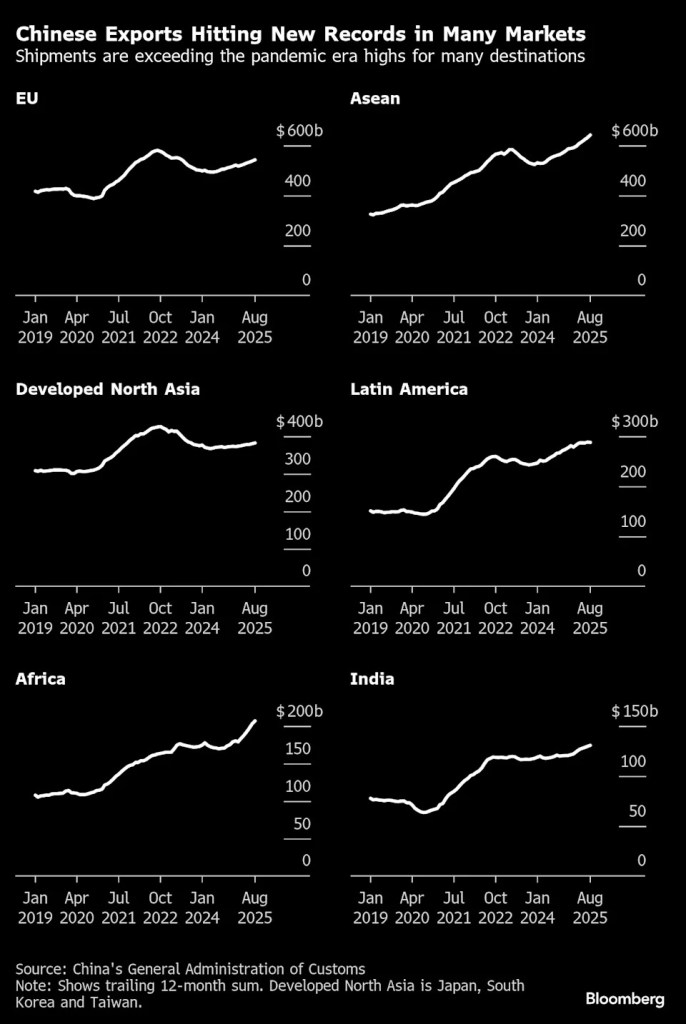
With access to the US curtailed, Chinese manufacturers have shown they aren’t backing down: Indian purchases hit an all-time high in August, shipments to Africa are on track for an annual record and sales to Southeast Asia have exceeded their pandemic-era peak
That across-the-board surge is causing alarm abroad, as governments weigh the potential damage to their domestic industries against the risk of antagonizing Beijing — the top trading partner for over half the planet.
While so far only Mexico has hit back publicly this year — floating tariffs as high as 50% on Chinese products including cars, auto parts and steel — other countries are coming under increasing pressure to act. Indian authorities have received 50 applications in recent weeks for investigations into goods dumping from nations including China and Vietnam, according to a person familiar with the matter who asked not to be identified as the information isn’t public. Indonesia’s trade minister pledged to monitor a deluge of goods, after viral videos of Chinese vendors touting plans to export jeans and shirts for as little as 80 US cents to major cities caused an outcry.
For all the pain, the chances of more meaningful action are limited. Countries already embroiled in tariff negotiations with the Trump administration appear reluctant to take on a separate trade war with the world’s second-largest economy. That’s giving Beijing breathing room from US levies at heights economists previously predicted would halve the nation’s annual growth rate.
“The subdued response is probably informed by ongoing US trade negotiations,” said Christopher Beddor, deputy China research director at Gavekal Dragonomics. “Some countries may not want to be seen as contributing to a breakdown in the global trading system. Some may also be holding back on tariffs against China in order to offer them as concessions to the US during their own trade negotiations.”Officials shielding their economies from Beijing are treading carefully. South Africa’s trade minister has advised against punitive tariffs on Chinese car exports — which nearly doubled this year — and is instead seeking more investment. Chile and Ecuador are quietly imposing targeted fees on low-cost imports, after Chinese e-commerce giant Temu’s monthly active users in Latin America soared 143% since January. While Brazil has threatened more aggressive retaliation, this summer it gave China’s biggest electric car maker, BYD Co Ltd, a tariff-free window to ramp up local production.
A BYD Brazil factory under construction in Camacari, Brazil in January. Photographer: Tuane Fernandes/Bloomberg
Beijing is using both diplomatic charm and economic threats to prevent countries from taking outright retaliation. Earlier this month, China’s president rallied BRICS nations to forge a united voice against protectionism during a leaders’ call of the bloc, while Commerce Ministry officials have warned Mexico to “think twice” before acting, making clear such steps will have recriminations. Adding to the risks, Trump is pressuring NATO nations to impose tariffs up to 100% on China over its support for Russia. Chinese officials say their trade with the world is within reasonable bounds and that Beijing isn’t out to dominate global markets. “When there’s demand from abroad, China exports accordingly,” Vice Finance Minister Liao Min said in July. The state-run People’s Daily newspaper on its social media account last month hit back against Western criticisms of “dumping,” arguing that China’s exporters don’t sell below cost. If Trump does corral other countries to gang up on China, it’ll make dealing with internal challenges such as a prolonged property crash and an aging population harder, according to Chang Shu and David Qu of Bloomberg Economics. “Beijing will likely hit back with reciprocal tariffs immediately, but that risks alienating partners at a time when it critically needs allies,” they said. “Over time, it may also encourage firms to localize production in partner countries.”
While Chinese exporters are defying the odds, surging trade isn’t making them richer — or helping the nation’s domestic issues. Profits at industrial firms fell 1.7% in the first seven months, as manufacturers trying to reduce overcapacity at home under Xi’s “anti-involution” drive slashed prices to sell more overseas. That’s only worsening China’s sticky deflation, on track for its longest spell since the country began opening up in the late 1970s.
The export explosion could also undermine Beijing’s efforts to rebalance its economy toward stimulating consumption — defying foreign officials such as US Treasury Secretary Scott Bessent, who has urged Beijing to make boosting the Chinese consumer a pillar of its blueprint for the next half-decade. China’s policy document outlining those plans will be in focus in the coming weeks at a key Communist Party meeting.
For Xi, the risks might just be worthwhile. Showing the world China doesn’t need the US consumer strengthens his hand going into a high-stakes meeting with Trump at a summit in South Korea. The world’s biggest economies are still hashing out a possible trade deal, with a 90-day pause on tariffs as high as 145% currently keeping the peace.
China Shock 2.0
Even before Trump stunned the world with America’s steepest tariffs since World War II in April, emerging markets at risk of shedding millions of manufacturing jobs were worried about a glut of Chinese goods. Indonesia’s previous president threatened a 200% tariff to protect local industry, while Brazil has hiked duties on Chinese steel. Even Vietnam took temporary action against Chinese online retail giants that undercut local sellers.
Ultimately, it’s been hard for foreign leaders to protect their economies from China’s vast fleet of factories.
“Protectionism from the US and other countries has turned into a paper tiger because Chinese exporters are extremely competitive,” said Arthur Kroeber, head of research at Gavekal Dragonomics. They “can absorb some of the tariff hit and also have plenty of workarounds through transshipment and relocating late-stage production to lower-tariff countries.”
China’s trade surplus last year was almost $1 trillion and is on track to exceed that in 2025, based on Bloomberg calculations.
Cambodia’s central bank governor Chea Serey was candid about the balancing act smaller economies reliant on Beijing are having to perform. “We do import a lot from China,” she told Bloomberg Television earlier this month, when asked about Chinese dumping. “We also rely a lot in terms of foreign direct investment from China.”
While a rise in shipments to Vietnam suggests some goods destined for US shores and other places are being re-routed to bypass Trump’s wall of tariffs, that’s only part of the picture. Demand for China’s world-beating, high-tech innovations helped drive much of the recent traffic. Rising sales to wealthy markets in Europe and Australia also indicate Beijing simply found new buyers for many products.
India shows how Trump’s redrawing of the global trade map is benefiting Beijing in new ways. Exports to China’s neighbor hit a record $12.5 billion last month, driven largely by Apple Inc.’s suppliers rapidly shifting output of iPhones to India from its Asian neighbor. Those companies, however, still depend on parts and tooling made mostly in China.
In July, Chinese firms shipped almost $1 billion worth of computer chips to India and billions of dollars more worth of phones and parts, according to data released by Beijing. That puts exports on track to exceed last year’s record, with the value of shipments so far this year almost as large as the whole of 2021.
“China has performed better than expected in the first half,” JPMorgan Chase & Co.’s chief India economist Sajjid Chinoy told Bloomberg Television. “Some of this is the fact that China has very cleverly found other export markets, including Europe, which has been a key hedge to slowing exports to the US.”
Read more on Chinese trade:
China Exports to US Slump 33% But Trade Surplus Heads for Record
China Pours Exports Into Africa Faster Than Anywhere Else
A Chinese E-Commerce Glut Is Meeting Resistance in Latin America
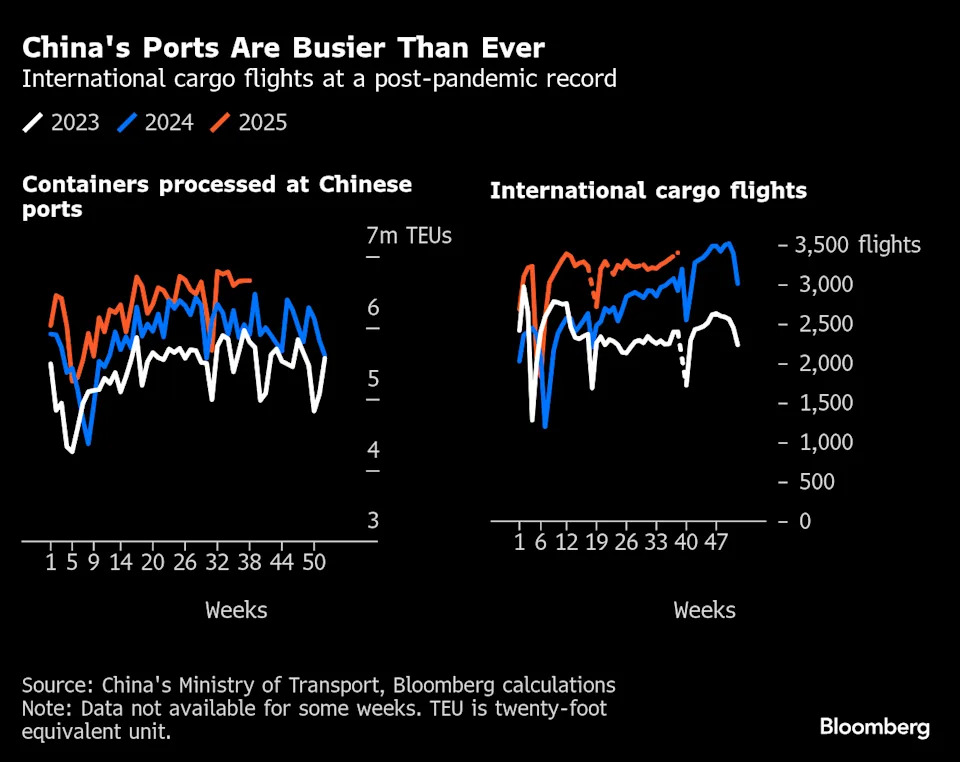
Shanghai’s Yangshan Deepwater Port in May.Photographer: Qilai Shen/Bloomberg
A weaker currency gave China another edge. The yuan has depreciated along with the dollar against currencies such as the euro. Macquarie Bank previously estimated the yuan’s real effective exchange rate — which accounts for inflation differentials between a nation and its main trading partners — was at the weakest level since December 2011.
And the Federal Reserve’s rate cut this month could drag the dollar and possibly the yuan down further, boosting both global demand and also the competitiveness of Chinese exports.
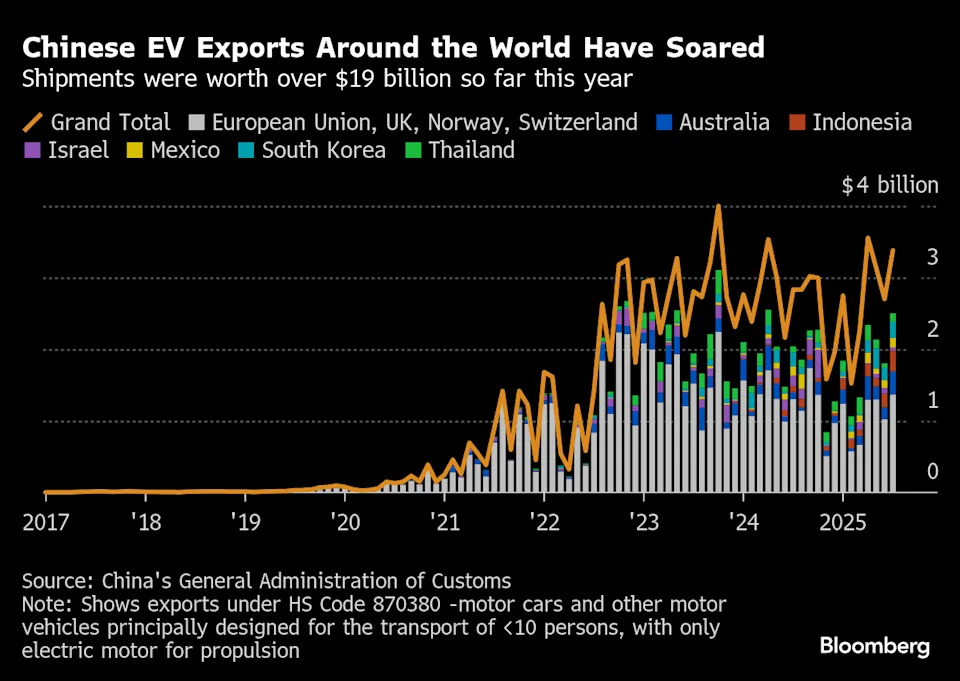
For all the consternation around the world, the glut of goods cascading from China won’t be easy to stop. Chinese electric car exports have continued to power ahead despite steps by the US and Canada to curb them with punitive tariffs and bans.
In the first seven months of this year, carmakers such as Nio, BYD and Xpeng Inc. exported more than $19 billion worth of electric-powered vehicles, about the same as in the same period last year, with Europe being the largest market even after the EU imposed tariffs last October.
China’s in a better position than many other countries to find alternative markets to the US, according to Adam Wolfe of Absolute Strategy Research. Its analysis shows there’s almost a 50% overlap between what China sold to the US and what it exports to BRICS nations, suggesting much of what America no longer buys can be shipped to other markets.
“China’s shown this ability to move into other markets and get market share abroad and that probably continues,” said Wolfe. “I don’t know that China is going to see a contraction in exports over the rest of the year.”
–With assistance from Shruti Srivastava, Philip Heijmans, Claire Jiao, Haslinda Amin, Linda Lew, Ntando Thukwana, Andy Lin and Alex Vasquez.
(Updates with details on China’s trade surplus this year.)








 Michael1942's Blog
You must be logged in to post a comment.