There is nothing I can add to this blather put out by Speaker Johnson aka Spkr. Milquetoast. I have reduced my news intake as it at once depressing, anger inciting and informative. I miss the days when one could look at any channel, any daily newsprint and get a reasonable idea of what is happening in the nation and the wider world. Now the advent podcasts, online apps and one-sided news on the tube have brought me to scour the news feed from the few sources I allow into my life just to get a “fair” idea of what the facts are. The pitch by Johnson below gives me the “ick”.
House Speaker Mike Johnson delivered a contentious pitch to voters Tuesday at President Donald Trump’s Florida resort, calling it “foolish” to vote against Republican candidates in November. This comes as an NBC News poll shows Democrats well-positioned to retake the House, with some Republicans fearing Senate losses too. Even Sen. Rand Paul predicted “disastrous” midterm results for the GOP. Johnson framed the election as a contest “between normal and crazy,” claiming the Republican majority has “defied expectation and historical trends,” while governing. Speaking at the Trump National Doral Miami, where membership costs $50,000 initiation plus $1,000 monthly dues, Johnson attacked Democrats as “Marxists, open socialists, the far-left insurgent politicians,” pushing the party “over the edge,” and leaving America behind. He vowed Republicans would defy historical odds again.
If indeed the Presidents party prevails in the midterms we can be assured of a modern day civil war which will allow the current clown to continue running the circus. I can only state again: cut through the fog of bull shit and vote for folks who are as honest as we can get in the political sphere. Keep in mind if it sounds like BS, it quite possibly is!
Comments Off on In less than a year, Trump erased 12 years of solvency for the trust fund that pays for Medicare Part A
Nick Lichtenberg
Mon, February 23, 2026 at 1:54 PM CST
Donald Trump’s One Big Beautiful Bill Act significantly reduced the revenues the trust fund normally receives from taxing Social Security benefits.
Recent policy changes and economic shifts have slashed 12 years off the projected life span of the trust fund that pays for Medicare Part A, according to a newly updated report from the Congressional Budget Office (CBO). The Hospital Insurance (HI) Trust Fund is now slated to be entirely exhausted by 2040, even though the balance generally increases through 2031, as spending will begin to outstrip income in the following year.
This rapid deterioration of Medicare’s financial solvency represents a stark drop from the CBO’s previous estimate, which was published just last year, in March 2025. The dramatically shortened timeline means future retirees could face significant cuts to vital health care services far sooner than previously anticipated. As required by the Deficit Control Act, CBO Director Phillip Swagel noted the projections reflect the assumption benefits would be paid as scheduled even after the HI trust fund was exhausted.
The primary culprit for this accelerated depletion is a sharp reduction in the fund’s projected income, heavily driven by legislation passed over the last year. Specifically, the 2025 reconciliation act (Public Law 119-21, more commonly known as the One Big Beautiful Bill Act) significantly reduced the revenues the trust fund normally receives from taxing Social Security benefits. This legislation lowered tax rates and established a temporary deduction for taxpayers age 65 or older. Consequently, this major policy shift enacted during the Trump administration has directly contributed to starving the Medicare safety net of critical future funding.
What is the HI trust fund?
The HI trust fund is the financial backbone for Medicare Part A, which covers essential services including inpatient hospital care, stays in skilled nursing facilities, home health care, and hospice care. Over the next 30 years, the fund is expected to rely on the Medicare payroll tax for about three-quarters of its annual income, with another roughly one-eighth derived from income taxes on Social Security benefits.
However, the recent tax cuts are not the only factor draining the fund. The CBO also cited decreased projections for payroll tax revenues, warning it had to adjust their models to account for lower expected worker earnings. Furthermore, because the trust fund will have smaller balances going forward, it will generate less interest income, creating a compounding negative effect on its overall finances.
On the other side of the ledger, Medicare spending is rising faster than anticipated. The CBO noted per-enrollee spending in Medicare Part A’s fee-for-service program in 2025, along with 2026 bids by Medicare Advantage plan providers, both came in higher than expected.
The consequences of the fund’s exhaustion in 2040 would be severe for both seniors and health care providers. By law, if the trust fund runs dry and spending continues to exceed income, Medicare would be legally restricted to paying out only what it takes in. To make up the shortfall, total benefits would need to be slashed. The CBO estimates these benefit reductions would start at 8% in 2040 and steadily climb to a 10% cut by 2056. It currently remains unclear exactly how the Centers for Medicare & Medicaid Services would manage the program under such dire financial constraints.
Addressing this looming crisis will require significant legislative action. The fund currently faces a 25-year actuarial deficit of 0.30% of taxable payroll—a figure representing the total amount of earnings subject to the payroll tax. This deficit is 0.17 percentage points worse than last year’s projection. To eliminate this deficit and restore the 12 years of solvency lost over the last 11 months, lawmakers will be forced to increase taxes, reduce health care payments, transfer money into the trust fund, or implement a combination of these politically fraught approaches.
Notably, these already grim baseline projections remain highly uncertain and do not yet account for the potential economic or budgetary fallout from the recent Supreme Court ruling on tariffs (Learning Res., Inc. v. Trump, issued on February 20, 2026).
This story was originally featured on Fortune.com
AARP and the business of an aging audience Scroll back up to restore default view.
Social Security’s main trust fund could be depleted a year earlier than expected, according to a projection from the Congressional Budget Office (CBO) released earlier this month.
The CBO forecasts that the Old-Age and Survivors Insurance Trust Fund — one of the two funds Social Security taps to disburse benefits — will be exhausted in 2032. The agency, which provides budgetary analysis to Congress, estimated last year that the trust fund would run dry in 2033.
Although the Social Security Administration wouldn’t stop administering benefits if the trust fund reserves are depleted, the agency could be forced to trim the amount it pays to beneficiaries, according to experts.
“My takeaway from all of this is we don’t have much time to spare to address the shortfall,” Max Richtman, CEO of the National Committee to Preserve Social Security and Medicare, a nonprofit advocacy group. “If there’s not enough revenue coming in payroll taxes — and I don’t see that changing — benefits are going to be cut dramatically.”
The Social Security Administration did not respond to a request for comment.
Why CBO changed its forecast
The CBO changed its Social Security funding projection after updating its economic forecast, which predicts hotter inflation in the coming years. That could affect Social Security’s annual cost-of-living adjustment (COLA), which is aimed at ensuring that inflation doesn’t erode beneficiaries’ purchasing power.
Higher inflation could mean a larger COLA, which would draw down the trust fund more quickly. The CBO forecasts a COLA of 3.1% for 2027, on the higher end of projections. The agency announced a 2.8% COLA for 2026.
The CBO also projects Social Security trust fund income will be lower because of a reduction in individual income taxes and payroll taxes.
Diminishing trust fund reserves
The Social Security Administration started tapping into the trust fund reserves in 2021, when the total cost to provide benefits started to outpace the agency’s income. Social Security, which is funded chiefly through payroll taxes paid by workers and employers, is facing greater financial strains as the U.S. population ages and more people claim retirement benefits.
Trump’s chief bigot, Stephen Miller, said on Fox News this month that immigrants to the United States bring problems that extend through generations.
“With a lot of these immigrant groups, not only is the first generation unsuccessful,” Miller claimed. “You see persistent issues in every subsequent generation. So you see consistent high rates of welfare use, consistent high rates of criminal activity, consistent failures to assimilate.”
In fact, the data show just the opposite. The children and grandchildren and great-grandchildren of most immigrants are models of upward mobility in America.
In a new paper, Princeton’s Leah Boustan, Stanford’s Ran Abramitzky, Elisa Jácome of Princeton, and Santiago Pérez of UC Davis used millions of father-son pairs spanning more than a century of U.S. history to show that immigrants today are no slower to move into the middle class than immigrants were a century ago.
In fact, no matter when their parents came to the U.S. or what country they came from, children of immigrants have higher rates of upward mobility than their U.S.-born peers.
Stephen Miller’s great-great-grandfather, Wolf-Leib Glosser, was born in a dirt-floor shack in the village of Antopol, a shtetl in what is now Belarus.
For much the same reasons my great-grandparents came to America — vicious pogroms that threatened his life — Wolf-Leib came to Ellis Island on January 7, 1903, with $8 in his pockets. Though fluent in Polish, Russian, and Yiddish, he understood no English.
The family settled in Johnstown, Pennsylvania, a booming coal and steel town, where they rose from peddling goods to owning a haberdashery and then owning a chain of supermarkets and discount department stores, run by Sam and Sam’s son, Izzy (Stephen Miller’s maternal grandfather).
Two generations later, in 1985, came little Stephen — who developed such a visceral hate for immigrants that he makes up lies about them that have no bearing on reality.
In a little more than 11 months, Stephen and his boss have made sweeping changes to limit legal immigration to America.
On his first day back in office, Trump signed an executive order declaring that children born to undocumented immigrants and to some temporary foreign residents would no longer be granted citizenship automatically.
The executive order, which was paused by the courts, could throw into doubt the citizenship of hundreds of thousands of babies born each year. Miller and his boss want the Supreme Court to uphold that executive order.
After the horrific shooting of two National Guard members on November 26 by a gunman identified by authorities as an Afghan national, Trump halted naturalizations for people from many African and Middle Eastern countries.
Trump is also threatening to strip U.S. citizenship from naturalized migrants “who undermine domestic tranquillity.” He plans to deport foreigners deemed to be “non-compatible with Western Civilization” and aims to detain even more migrants in jail or in warehouses — in the U.S. or in other countries — without due process.
In addition to the unconstitutionality of such actions, they stir up the worst nativist and racist impulses in America — blaming and scapegoating entire groups of people.
As they make their case to crack down on illegal and legal immigration, Miller and Trump have targeted Minnesota’s Somali community — seizing on an investigation into fraud that took place in pockets of the Somali diaspora in the state to denounce the entire community, which Trump has called “garbage.”
Let’s be clear. Apart from Native Americans, we are all immigrants — all descended from “foreigners.” Some of our ancestors came here eagerly; some came because they were no longer safe in their homelands; some came enslaved.
Almost all of us are mongrels — of mixed nationalities, mixed ethnicities, mixed races, mixed creeds. While we maintain our own traditions, we also embrace the ideals of this nation.
You can go to Japan to live, but you cannot become Japanese. You can go to France to live and not become a Frenchman. You can go to live in Germany or Turkey, and you won’t become a German or a Turk. But … anybody from any corner of the world can come to America to live and become an American. A person becomes an American by adopting America’s principles, especially those principles summarized in the “self-evident truths” of the Declaration of Independence, such as “life, liberty, and the pursuit of happiness.”
Reagan understood that America is a set of aspirations and ideals more than it is a nationality.
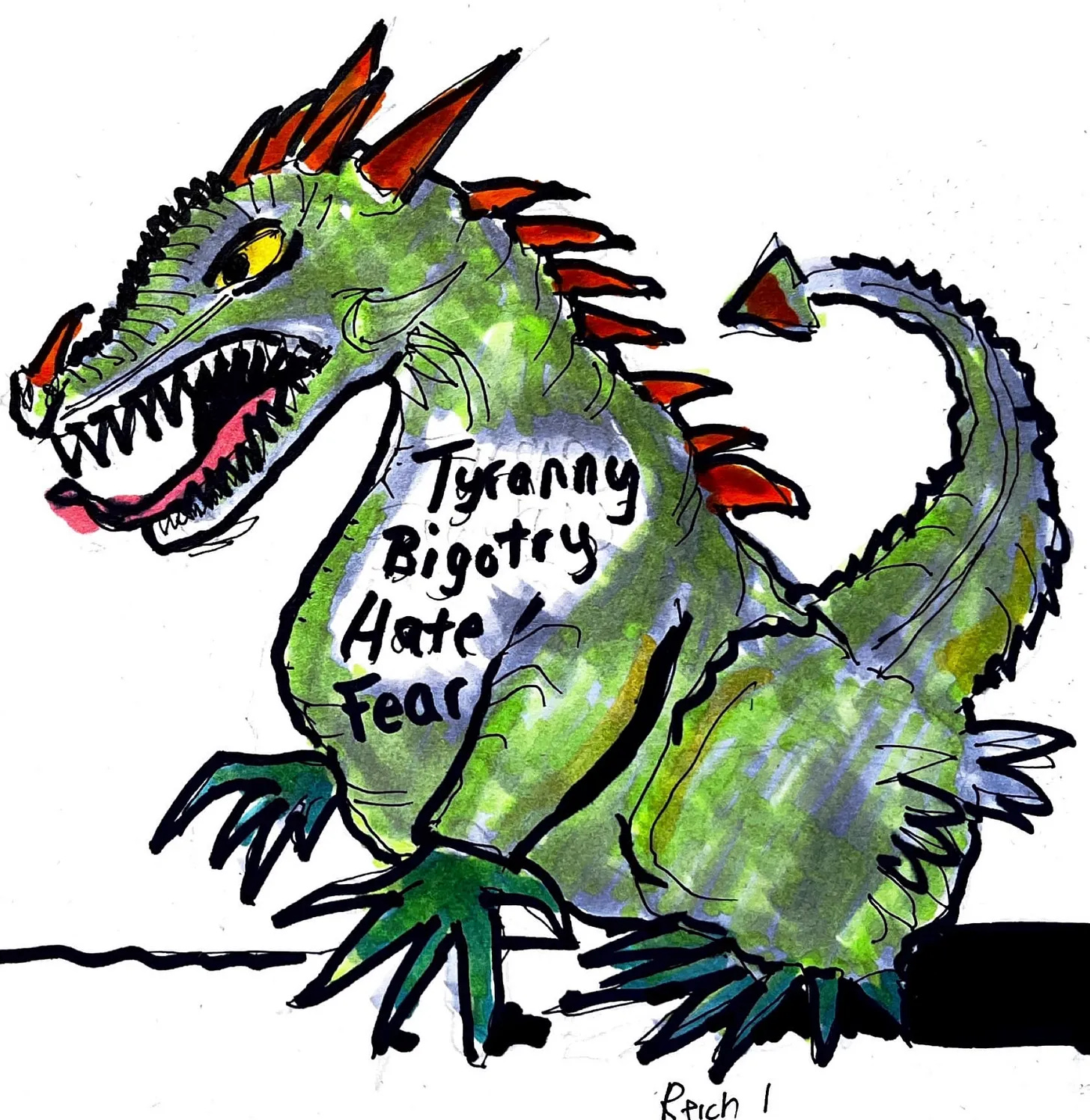
Miller and Trump want to fuel bigotry. Like dictators before him, Trump’s road to tyranny is paved with stones hurled at “them.” His entire project depends on hate.
America is better than Trump and his chief bigot.
We won’t buy their hate. To the contrary, we’ll call out bigots. We won’t tolerate intolerance. We’ll protect hardworking members of our community. We’ll alert them when ICE is lurking.
We will not succumb to the ravings of a venomous president who wants us to hate each other — or his bigoted sidekick.
It is pretty obvious by now that facts riles up the liars no matter the party. It seems that all purveyors of non facts get upset when presented with facts and counter with more non facts or personal attacks.
Sixes 2 A
We’re doing what best for you
autocrats, dictators, people in power all seem to tell us that what they are doing to us is for our own good and somehow many of us believe it. If we are paying attention, we can see that the GOP is doing and saying the same thing while enacting repressive laws on
voting, reproduction and installing “their choice of judges” while stopping passage of infrastructure legislation. Is this for our own good?
No truth in poLItics, neither party
Dishonesty appears to be the bedrock of politics and unfortunately too many voters are accepting it.
Botch already backing TOTUS for 2024
Botch McConnell in a play to remain in power has already endorsed TOTUS for a 2024 Presidential run-Is it possible that his (Mitch) constituents are blind and numb?
Cruz, Hawley, Johnson, modern JoeMcCarthy’s
Only in America can miscreants become lawmakers (or breakers?) and suffer no consequences
Higher standards-N/A to elected officials
We always thought it- politicians generally are suspect
Foxes have control of the henhouse
The GOP now has control of the US house and has proceeded to exact revenge on the DEMs for perceived and real (correct) sins against the party. This energy world be better used to actually strike an accord and govern instead of pursuing irrational and uninformed issues. The course being followed will certainly come back to
bite” them and further divide the voters.
Shiny objects no motive for support-The most prominent or shiniest object more distracting than useful
Flip flops are not just footwear-
ask Linsey Hop graham and Botch McConnell
Patton slap to GOP-all Cowards!
General Patton was reprimanded for slapping a GI who was suffering from what we now know as” battle fatigue”, he was wrong in what he did however he was ordered to apologize for it. We as voters need not apologize if we “Patton” slap our elected officials
2Tr tax cut or 2Tr stimulus?
The GOP happily passed a 2trillion dollar tax cut that benefitted themselves and big business yet balk against 2trillion to stimulate the economy and help the voters. No brainer on who to vote foTop of Form
r.
Why Do Balding heads require parting?
Just curious
Congress competing for standup Comic jobs?
Standups are more serious about their work than these neer do wells
Its Ok until you’re the victim
What happens to one affects us all and we should all be involved or be at least paying attention.
Possibly hoods in the Congressional closet?
Ron Johnson has made plain what we have always suspected of the GOP. Perhaps not all but too many to ignore and we should not let the Dems off the hook either.
Fist Bump ridiculed once, now gentrified
During Obama Presidency fist bump was ridiculed, not so “ghetto” now is it?
Amazing disgrace: current miscreant elected officials
There is no partisanship when elected officials disrespect the office for their personal gain, not the country and the voters who put them in office.
“Do the best you can until you know better. Then when you know better, do better.”
Comments Off on All Been Said Before But Nothing Happens!
The United States has again reached a crossroad where good evil meet. The last time much like this one it was about economics- granted that there were and still are personal freedoms involved, and a national split occurred aka a “CIVIL WAR”. There are still remnants of that event remaining after 100 plus years, but many Americans have thankfully moved and some unfortunately have not! Now we have one if not the worst national leaders since Andrew Jackson. The difference is that we as a country have grown up intellectually (mostly) but that intellect has sometimes been rooted in the same biases from long ago. There has been a coopting of certain words and sayings as being Anti American, leftist, rightist or any of several “buzzwords” and sayings. One of the most recent is “DEI” also known as “Diversity, Equity, Inclusion”. I have tried hard to define or find a definition of this as a Radical, left Wing, right wing or Racist trope. It is nowhere close to the names or definitions used behind closed doors of our current Government. The current “Caligula” is as evil and self-centered as the original but multiplied by a cohort of sycophantic power grabbers who will be remembered in history for their evil deeds. How many can name or spell the names of the Nazi perpetrators of the death camp activities that led to millions being murdered? There are similarities to several of those activities to present day that gather people across the country, send them to other cities, state, and counties at the expense of the taxpayer (US!). Now there is a move to create camps (alligator Alcatraz, in Florida) that can house “illegal” migrants. It should be remembered that many migrants work here seasonally only, and many are awaiting asylum hearings but need to work to provide for their families yet they are swept up in ICE raids and incarcerated without due process.
Comments Off on The cheap health insurance promoted by Trump officials has this catch
Washington Post
Peter Whoriskey
Sat, November 15, 2025 at 11:09 AM CST
The cheap health insurance promoted by Trump officials has this catch
Robert Hays, an industrial electronics salesman in Arkansas, thought he’d purchased conventional medical insurance. So did Essie Nath, 67, a retired cafeteria worker in Wyoming. So did Martin Liz, 47, a Key West chef.
Each enrolled in the kind of private health insurance that Trump administration officials have promoted as an alternative to plans sold under Obamacare.
The difference between the two options became all too clear after Hays, Nath and Liz required surgery: Their cheaper policies left them facing bills of tens of thousands of dollars. Hays is facing bills of $116,000 for neck surgery required after tweaking his neck while lifting weights; Nath had heart failure and got bills of $82,000; Liz is stuck with bills of more than $100,000 for a knee replacement.
(The Trumpelstilskin scams continues, wine, steaks, college and now healthcare. There is no Red and Blue states in these scams)
“These policies are a horrible idea,” said Ken Swindle, an Arkansas-based attorney for Hays. “People think they’re getting comprehensive medical coverage, but they’re not, and they often don’t realize that until it’s too late.”
With enhanced government subsidies for Obamacare plans expiring this year and millions of Americans facing soaring insurance costs, many are expected to consider enrolling in the kind of “short-term” plans bought by Hays, Nath and Liz.
Unlike most insurance, these plans are not required to cover preexisting conditions or even basic needs such as maternity care and mental health. Their coverage is so full of holes that five states have banned their sale, according to KFF, a nonpartisan health policy research group. Even some major insurers have questioned whether relying on the short-term plans is a good idea, warning that many consumers could mistake them for comprehensive coverage. The Biden administration referred to them as “junk” plans.
The policies tend to be cheaper, though, costing as little as half as much as a plan sold on HealthCare.gov or state-run marketplaces created by the landmark Affordable Care Act, also known as Obamacare. For example, for a 40-year-old nonsmoker in Florida, the cheapest ACA plan may cost about $500 a month, while a short-term plan would be $320. Millions of people have signed up for them.
Millions looking for cheaper options
Now, as millions of consumers see huge spikes in Obamacare costs, many seeking a cheaper alternative will entertain the short-term plans as a viable option, insurance agents said. “Costs continue to go up, leaving individuals, families, and businesses scrambling to find and keep the coverage they need,” said Kelly Loussedes, vice president of NABIP, a trade group representing more than 100,000 licensed health insurance agents, brokers and consultants. “It’s essential that consumers understand these plans are not comprehensive coverage.”
China is hurtling towards a record $1.2 trillion trade surplus.
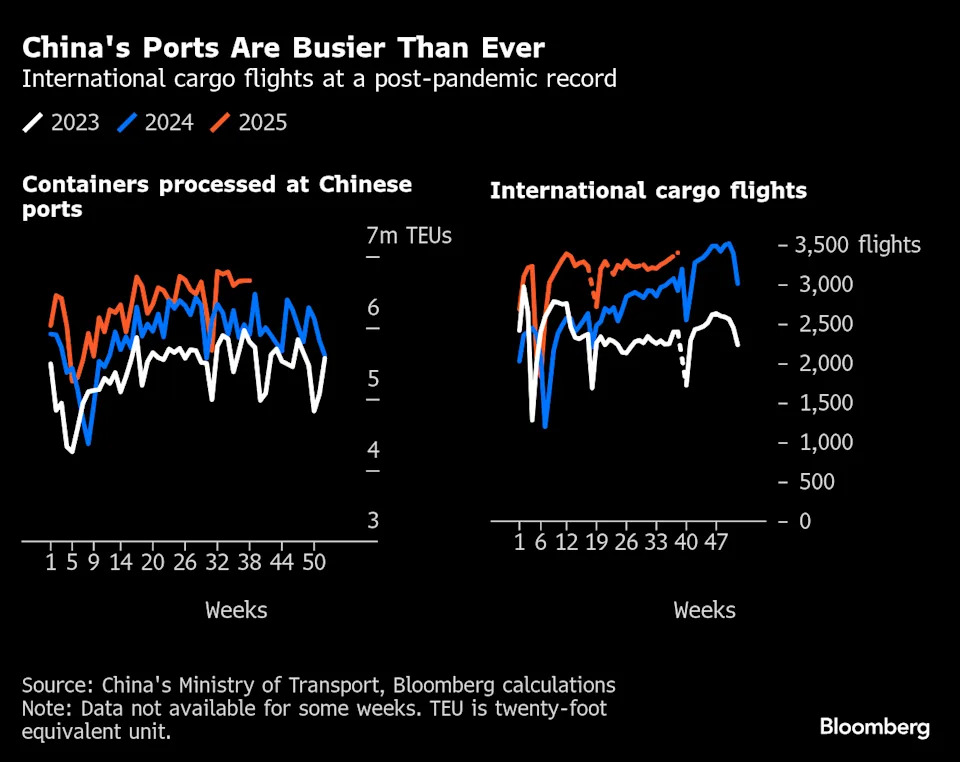
(Bloomberg) — President Xi Jinping’s export engine has proved unstoppable during five months of sky-high US tariffs, sending China toward a record $1.2 trillion trade surplus.
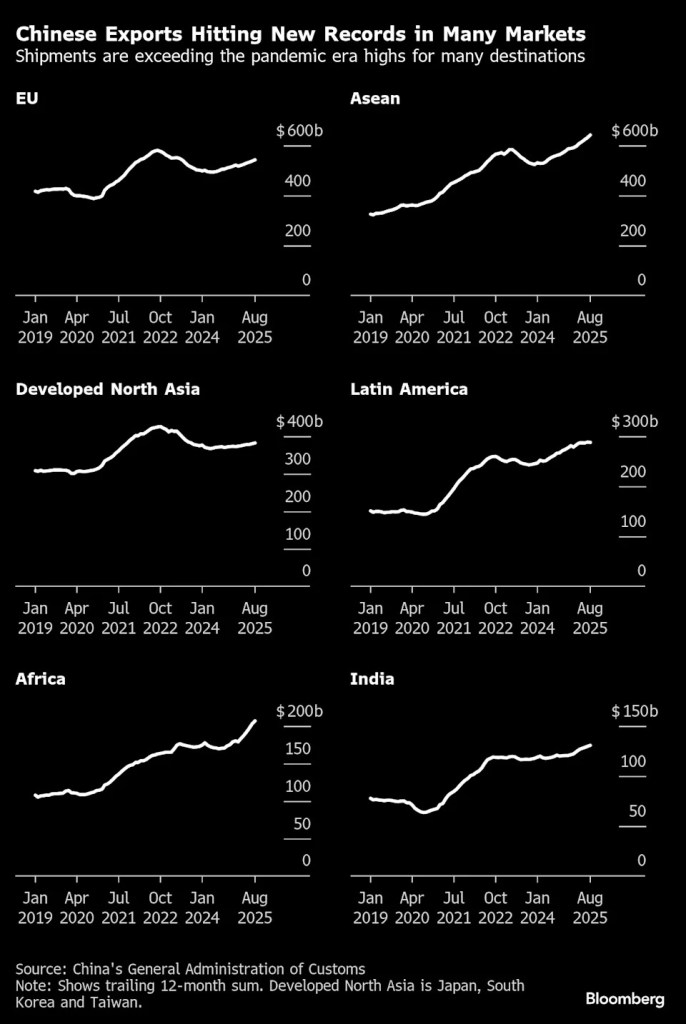
With access to the US curtailed, Chinese manufacturers have shown they aren’t backing down: Indian purchases hit an all-time high in August, shipments to Africa are on track for an annual record and sales to Southeast Asia have exceeded their pandemic-era peak
That across-the-board surge is causing alarm abroad, as governments weigh the potential damage to their domestic industries against the risk of antagonizing Beijing — the top trading partner for over half the planet.
While so far only Mexico has hit back publicly this year — floating tariffs as high as 50% on Chinese products including cars, auto parts and steel — other countries are coming under increasing pressure to act. Indian authorities have received 50 applications in recent weeks for investigations into goods dumping from nations including China and Vietnam, according to a person familiar with the matter who asked not to be identified as the information isn’t public. Indonesia’s trade minister pledged to monitor a deluge of goods, after viral videos of Chinese vendors touting plans to export jeans and shirts for as little as 80 US cents to major cities caused an outcry.
For all the pain, the chances of more meaningful action are limited. Countries already embroiled in tariff negotiations with the Trump administration appear reluctant to take on a separate trade war with the world’s second-largest economy. That’s giving Beijing breathing room from US levies at heights economists previously predicted would halve the nation’s annual growth rate.
“The subdued response is probably informed by ongoing US trade negotiations,” said Christopher Beddor, deputy China research director at Gavekal Dragonomics. “Some countries may not want to be seen as contributing to a breakdown in the global trading system. Some may also be holding back on tariffs against China in order to offer them as concessions to the US during their own trade negotiations.”Officials shielding their economies from Beijing are treading carefully. South Africa’s trade minister has advised against punitive tariffs on Chinese car exports — which nearly doubled this year — and is instead seeking more investment. Chile and Ecuador are quietly imposing targeted fees on low-cost imports, after Chinese e-commerce giant Temu’s monthly active users in Latin America soared 143% since January. While Brazil has threatened more aggressive retaliation, this summer it gave China’s biggest electric car maker, BYD Co Ltd, a tariff-free window to ramp up local production.
A BYD Brazil factory under construction in Camacari, Brazil in January. Photographer: Tuane Fernandes/Bloomberg
Beijing is using both diplomatic charm and economic threats to prevent countries from taking outright retaliation. Earlier this month, China’s president rallied BRICS nations to forge a united voice against protectionism during a leaders’ call of the bloc, while Commerce Ministry officials have warned Mexico to “think twice” before acting, making clear such steps will have recriminations. Adding to the risks, Trump is pressuring NATO nations to impose tariffs up to 100% on China over its support for Russia. Chinese officials say their trade with the world is within reasonable bounds and that Beijing isn’t out to dominate global markets. “When there’s demand from abroad, China exports accordingly,” Vice Finance Minister Liao Min said in July. The state-run People’s Daily newspaper on its social media account last month hit back against Western criticisms of “dumping,” arguing that China’s exporters don’t sell below cost. If Trump does corral other countries to gang up on China, it’ll make dealing with internal challenges such as a prolonged property crash and an aging population harder, according to Chang Shu and David Qu of Bloomberg Economics. “Beijing will likely hit back with reciprocal tariffs immediately, but that risks alienating partners at a time when it critically needs allies,” they said. “Over time, it may also encourage firms to localize production in partner countries.”
While Chinese exporters are defying the odds, surging trade isn’t making them richer — or helping the nation’s domestic issues. Profits at industrial firms fell 1.7% in the first seven months, as manufacturers trying to reduce overcapacity at home under Xi’s “anti-involution” drive slashed prices to sell more overseas. That’s only worsening China’s sticky deflation, on track for its longest spell since the country began opening up in the late 1970s.
The export explosion could also undermine Beijing’s efforts to rebalance its economy toward stimulating consumption — defying foreign officials such as US Treasury Secretary Scott Bessent, who has urged Beijing to make boosting the Chinese consumer a pillar of its blueprint for the next half-decade. China’s policy document outlining those plans will be in focus in the coming weeks at a key Communist Party meeting.
For Xi, the risks might just be worthwhile. Showing the world China doesn’t need the US consumer strengthens his hand going into a high-stakes meeting with Trump at a summit in South Korea. The world’s biggest economies are still hashing out a possible trade deal, with a 90-day pause on tariffs as high as 145% currently keeping the peace.
China Shock 2.0
Even before Trump stunned the world with America’s steepest tariffs since World War II in April, emerging markets at risk of shedding millions of manufacturing jobs were worried about a glut of Chinese goods. Indonesia’s previous president threatened a 200% tariff to protect local industry, while Brazil has hiked duties on Chinese steel. Even Vietnam took temporary action against Chinese online retail giants that undercut local sellers.
Ultimately, it’s been hard for foreign leaders to protect their economies from China’s vast fleet of factories.
“Protectionism from the US and other countries has turned into a paper tiger because Chinese exporters are extremely competitive,” said Arthur Kroeber, head of research at Gavekal Dragonomics. They “can absorb some of the tariff hit and also have plenty of workarounds through transshipment and relocating late-stage production to lower-tariff countries.”
China’s trade surplus last year was almost $1 trillion and is on track to exceed that in 2025, based on Bloomberg calculations.
Cambodia’s central bank governor Chea Serey was candid about the balancing act smaller economies reliant on Beijing are having to perform. “We do import a lot from China,” she told Bloomberg Television earlier this month, when asked about Chinese dumping. “We also rely a lot in terms of foreign direct investment from China.”
While a rise in shipments to Vietnam suggests some goods destined for US shores and other places are being re-routed to bypass Trump’s wall of tariffs, that’s only part of the picture. Demand for China’s world-beating, high-tech innovations helped drive much of the recent traffic. Rising sales to wealthy markets in Europe and Australia also indicate Beijing simply found new buyers for many products.
India shows how Trump’s redrawing of the global trade map is benefiting Beijing in new ways. Exports to China’s neighbor hit a record $12.5 billion last month, driven largely by Apple Inc.’s suppliers rapidly shifting output of iPhones to India from its Asian neighbor. Those companies, however, still depend on parts and tooling made mostly in China.
In July, Chinese firms shipped almost $1 billion worth of computer chips to India and billions of dollars more worth of phones and parts, according to data released by Beijing. That puts exports on track to exceed last year’s record, with the value of shipments so far this year almost as large as the whole of 2021.
“China has performed better than expected in the first half,” JPMorgan Chase & Co.’s chief India economist Sajjid Chinoy told Bloomberg Television. “Some of this is the fact that China has very cleverly found other export markets, including Europe, which has been a key hedge to slowing exports to the US.”
Read more on Chinese trade:
China Exports to US Slump 33% But Trade Surplus Heads for Record
China Pours Exports Into Africa Faster Than Anywhere Else
A Chinese E-Commerce Glut Is Meeting Resistance in Latin America
Shanghai’s Yangshan Deepwater Port in May.Photographer: Qilai Shen/Bloomberg
A weaker currency gave China another edge. The yuan has depreciated along with the dollar against currencies such as the euro. Macquarie Bank previously estimated the yuan’s real effective exchange rate — which accounts for inflation differentials between a nation and its main trading partners — was at the weakest level since December 2011.
And the Federal Reserve’s rate cut this month could drag the dollar and possibly the yuan down further, boosting both global demand and also the competitiveness of Chinese exports.
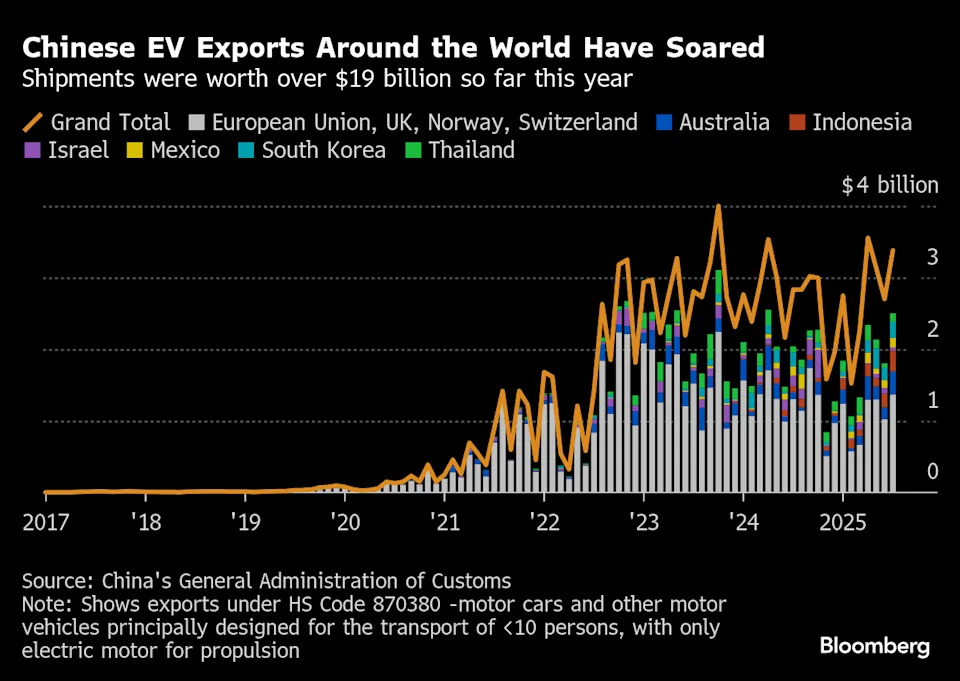
For all the consternation around the world, the glut of goods cascading from China won’t be easy to stop. Chinese electric car exports have continued to power ahead despite steps by the US and Canada to curb them with punitive tariffs and bans.
In the first seven months of this year, carmakers such as Nio, BYD and Xpeng Inc. exported more than $19 billion worth of electric-powered vehicles, about the same as in the same period last year, with Europe being the largest market even after the EU imposed tariffs last October.
China’s in a better position than many other countries to find alternative markets to the US, according to Adam Wolfe of Absolute Strategy Research. Its analysis shows there’s almost a 50% overlap between what China sold to the US and what it exports to BRICS nations, suggesting much of what America no longer buys can be shipped to other markets.
“China’s shown this ability to move into other markets and get market share abroad and that probably continues,” said Wolfe. “I don’t know that China is going to see a contraction in exports over the rest of the year.”
–With assistance from Shruti Srivastava, Philip Heijmans, Claire Jiao, Haslinda Amin, Linda Lew, Ntando Thukwana, Andy Lin and Alex Vasquez.
(Updates with details on China’s trade surplus this year.)
The same person 100 years apart? The division of the people according politics, religion or ethnicities in order to attack and subjugate those who are least able to fight back!
Comments Off on ‘Dangerous as hell’: Ted Cruz compares FCC chair’s threats against ABC to mob tactics
Please note Ted Cruz for all of his MAGA adherence is finally speaking the facts! MA
Michael Williams, CNN
Fri, September 19, 2025 at 4:28 PM CDT·4 min read
9.2k
GOP Sen. Ted Cruz on Friday denounced Federal Communications Commission Chairman Brendan Carr’s threats to pull ABC’s broadcast license as “unbelievably dangerous” and compared some of his rhetoric to “mafioso” tactics.
In an episode of his podcast, “Verdict with Ted Cruz,” released on Friday, the Texas Republican said he was “thrilled” Jimmy Kimmel was pulled off the air by ABC over his comments about conservative influencer Charlie Kirk. But he said he strongly disagreed with the government policing speech, asserting it could come back to bite conservatives when Democrats retake power.
“I hate what Jimmy Kimmel said. I am thrilled that he was fired,” Cruz said. “But let me tell you: If the government gets in the business of saying, ‘We don’t like what you, the media, have said. We’re going to ban you from the airwaves if you don’t say what we like,’ that will end up bad for conservatives.”
Though Carr’s comments have drawn widespread condemnation on the left, Cruz’s remarks represent one of the strongest denunciations of the threats against broadcasters by an elected conservative. Cruz also chairs the Senate Committee on Commerce, Science, and Transportation, which has broad authority over the F
“Going down this road, there will come a time when a Democrat wins again – wins the White House … they will silence us. They will use this power, and they will use it ruthlessly. And that is dangerous,” Cruz said.
Asked later by reporters on Capitol Hill if the Commerce Committee will hold hearings into the matter or investigate Carr if he continues in the same vein, Cruz left the door open to the possibility.
“There’s no doubt the Commerce Committee has oversight, authority and responsibility over the FCC, and when the Democrats had the majority, they did not engage in oversight … We will do our job and engage in oversight.”
President Donald Trump has also vaguely threatened to pull networks’ licenses if they air overwhelmingly negative coverage of him, though Cruz did not rebut the president’s remarks directly on the podcast.
Trump offered praise for Carr when pressed on the scathing remarks from the Texas Republican. “I think Brendan Carr is a great American patriot. So I disagree with Ted Cruz on that,” he said.
The president also continued to lament what he described as “dishonesty” from network broadcasts that are critical of him.
Cruz played recent remarks Carr made on far-right podcaster Benny Johnson’s podcast, in which the FCC chairman threatened to take action against broadcasters who don’t “find ways to change conduct” the government considers disagreeable.
“I mean, look, we can do this the easy way or the hard way,” Carr said. “These companies can find ways to change conduct, to take action, frankly, on Kimmel, or you know, there’s going to be additional work for the FCC ahead.” ABC pulled Kimmel’s show off the air indefinitely the day after Carr made those comments.
Responding to Carr’s comments, Cruz said: “No, no, no, no, no.”
“Look, look, I like Brendan Carr,” the senator said. “He’s a good guy. He’s the chairman of the FCC. I work closely with him. But what he said there is dangerous as hell.”
“He says, ‘We can do this the easy way, or we can do this the hard way.’ And I got to say, that’s right out of ‘Goodfellas.’ That’s right out of a mafioso coming into a bar going, ‘nice bar you have here. It’d be a shame if something happened to it.’”
Cruz later added: “I think it is unbelievably dangerous for government to put itself in the position of saying, ‘We’re going to decide what speech we like and what we don’t, and we’re going to threaten to take you off air if we don’t like what you’re saying.’”
“And it might feel good right now to threaten Jimmy Kimmel,” the senator said. “But when it is used to silence every conservative in America, we will regret it.”
CNN’s Morgan Rimmer and Betsy Klein contributed to this report.
This story has been updated with additional details.
For more CNN news and newsletters create an account at CNN.com
Trumplelstilskin has spent most of 100 plus days signing and issuing executive orders that look good on paper (maybe) but are terrible in implementation. How he ever got the idea that tariffs are great for the country is a mystery, any child in high school understands that tariffs are taxes on goods coming from other places yet he is using tariffs as a basis for making “deals”. These “so called deals” are merely negotiations that could occur with a simple meeting with the countries involved and they would be willing even glad to take on these conversations.
A Tariff is a tax pure and simple (that’s one of causes for the American revolution). Consider the effect on many goods we buy and the extra tariffs on good we send out for manufacturing and receive back; we are paying taxes on our own goods. The Europeans are looking at this with a tongue in cheek and allowing the fool to continue his quest when all that’s needed is a conversation.
Instead, these so-called negotiations have been dramatized, turned into spectacles that stir up headlines but rarely deliver meaningful results. The very notion of governance has become a performance, where optics trump outcomes and bluster supersedes substance. The disconnect between policy promises and practical impacts grows wider each day, leaving citizens to wonder if leadership is measured by the number of signatures on parchment rather than the coherence of a national vision. As one decree follows another, uncertainty mounts among business owners, workers, and everyday people caught in the crossfire of impulsive policy shifts. The country, it seems, is being steered by a philosophy that prizes bravado over balance, with little concern for the ripples each decision sends through the fabric of society.
Trumple can tout his actions as success all day long but in the end the American people suffer for it.
Couple the tariff fiasco with the blackmailing of companies and higher education this administration is looked upon with a smile of tolerance. We are the richest country and the strongest with an idiot at the wheel speeding around uphill curves. It is even more remarkable that the majority party is allowing it with no regard to the effect it has on their constituents. Now as far as I am concerned neither party is doing that great a job overall, but both have small pockets of success which have a small benefit. The gilded cage that is now the Whitehouse is a perfect example of the Midas touch gone awry. The Majority party has allowed the high court to be corrupted along with the confirmation of a band of irregular cabinet members unfit for their jobs.
The cause? Each party has failed in their own mandates to do what they were elected to do but instead they have made the congress a school yard scrap in which no one wins, and recess is the main objective.








 Michael1942's Blog
You must be logged in to post a comment.