Exactly a week ago, Jake Sherman of Punchbowl News reported that Republican House leaders were talking about moving the government funding debate away from spending levels—their original complaint—to border security. “[T]he vast majority of House R[epublican]s,” Sherman wrote, “would rather fight on border policy than spending.”
True to form, party leaders today began to insist that we are barreling toward a shutdown because of President Joe Biden’s policies on the southern border. House speaker Kevin McCarthy says he wants to meet with Biden to “cut a deal.”
But, of course, McCarthy already cut a deal with Biden, back in May, that provided a clear roadmap for this year’s funding. McCarthy is refusing to honor that deal.
The Republicans’ willingness to invent a new reason for their threatened government shutdown suggests it was never about principle so much as about power. They are quite aware that the cuts the extremists are proposing before they will agree to fund the government are unpopular, so they have manufactured another reason for the shutdown that they hope will be more palatable to the country.
At any point, McCarthy could agree to work with the Democrats to pass the 12 appropriations bills that will fund the government. Last night, by a vote of 77–19, the Senate illustrated how that could be done by passing a bipartisan continuing resolution to fund the government through November 17 and to provide additional funding for Ukraine.
Today, McCarthy told Republican House members that he would not bring the Senate’s measure up for a vote. Instead, he will continue to court the extremists, who spent the day posturing. At the motion of Representative Marjorie Taylor Greene (R-GA), for example, they voted to reduce Defense Secretary Lloyd Austin’s salary to $1 a year. They went on to pass a number of similarly extreme measures that will never make it through the Senate.
House minority leader Representative Hakeem Jeffries (D-NY) accused Republicans of using the threat of a shutdown “to jam your right-wing ideology down the throats of the American people.” The bills they were advancing, he said, had “zero chance of becoming law…. And they’re filled with extreme policy poison pills.”
For all that McCarthy is trying to pin the blame for a shutdown on the Democrats, it is the House Republicans who are refusing to perform the most basic of government procedures: fund the government for the next year. When Republicans have shut down the government in the past, the American people blamed them for it, and today Senate minority leader Mitch McConnell (R-KY) called out his House colleagues, clearly trying to isolate them, likely hoping to keep them from tainting the whole party in the eyes of voters before the 2024 election.
McConnell called out his colleagues on their new switch to complain about border security: “A vote against a standard short-term funding measure is a vote against paying over $1 billion in salary for Border Patrol and ICE agents working to track down lethal fentanyl and tame our open borders. Shutting down the government isn’t an effective way to make a point,” he said.
The 2024 election was also on former president Trump’s mind today. He was in Michigan tonight to try to draw attention away from the Republican primary debate that he refused to attend. But while President Biden yesterday visited the United Auto Workers picket line, Trump visited a non-union shop and talked about a future “fueled by American energy” and “built by highly skilled American hands and high-wage American labor.” As Craig Mauger of the Detroit News noted, however, “his address was short on specifics for how he would accomplish the goals.”
Trump told the crowd to get the UAW to support him, but the UAW doesn’t represent the workforce where he was speaking. Mauger noted that one woman holding a “union members for Trump” sign acknowledged she wasn’t a union member, while a man with a sign that said “auto workers for Trump” said he wasn’t an autoworker. The plant where Trump was speaking employs about 150 people, but 400–500 Trump supporters were there for his speech.
Yesterday, UAW president Shawn Fain said, “I find it odd he’s going to go to a non-union business to talk to union workers. I don’t think he gets it.”
Sen. Min. Leader McConnell sends pointed message to House Speaker McCarthy:
“A vote against a standard short-term funding measure is a vote against paying over $1 billion in salary for Border Patrol and ICE agents working to track down lethal fentanyl and tame our open borders.” pic.twitter.com/dz36nxHzlS
There’s a debate in the upper ranks of the House GOP about trying to move the CR debate away from spending levels and toward border security. This is McCarthys preference, being echoed by other senior republicans.
Last Tuesday, former Wyoming Representative Liz Cheney tweeted this in response to Russian President Vladimir Putin’s claim that the criminal indictments of Trump are politically motivated:
“Putin has now officially endorsed the Putin-wing of the Republican Party. Putin Republicans & their enablers will end up on the ash heap of history. Patriotic Americans in both parties who believe in the values of liberal democracy will make sure of it.”
In reality, the Putin wing of the Republican Party has taken over the Republican Party. The GOP no longer believes in the values of liberal democracy. It has become a cesspool of authoritarian nihilism.
As Mitt Romney told the Atlantic’s McKayu Coppins, “a very large portion of my party really doesn’t believe in the Constitution.”
The GOP is now a rogue elephant — increasingly dangerous, out of control, and on a rampage.
Knowing that most of the American public rejects it, it’s busily repressing votes through extreme partisan gerrymandering and new barriers to voting.
Notwithstanding zero evidence of any wrongdoing by Joe Biden, it’s seeking to impeach him.
Even though there’s still no basis for Trump’s big lie that he won the 2020 election, most Republican lawmakers continue to support it.
A growing number of House and Senate Republicans are questioning America’s commitment to defending Ukraine.
House Republicans are about renege on the deal they made before the debt ceiling was lifted, and shutter the U.S. government.
Meanwhile, Wisconsin Republicans are threatening to impeach a State Supreme Court justice who disagrees with their agenda. Tennessee Republicans have expelled Democratic lawmakers who supported an anti-gun protest.
Alabama Republicans are denying Black voters the opportunity to elect another representative to Congress. Florida Republicans have suspended an elected official because they don’t like their policies.
The GOP engaged in authoritarian antics before Trump (see: Gingrich, Newt), but Trump has pushed the Party over the edge, morally and politically.
Trump has so profoundly poisoned the Republican Party — filling it with election deniers, bigots, paranoids, and anti-democracy zealots — that it won’t recover its capacity to govern even after Trump leaves the stage.
Frankly, I don’t give a fig about the Republican Party. But I do care deeply about this nation. And America needs two major political parties capable of governing. Right now, only the Democratic Party has that capacity.
As long as the Trump Republican Party exists, it poses a profound danger to American democracy.
What should be done, and who should do it?
America needs a third party that stands for all the things conservative Republicans stood for before Gingrich and Trump — limited government, fiscal prudence, a strong defense against dictators and autocrats, and the stability and integrity of the nation’s major institutions.
Is Mitt Romney the person to start such a Real Republican Party? He’s now basking in the adulation of the Washington establishment because he had the courage to utter some truths about Trump when the former president was in power and just announced he won’t be running again.
But Romney is too elitist and too, well, 2012.
The person to lead it is Liz Cheney. She should run for president on a third-party Real Republican ticket.
I’m sure there are plenty of anti-Trump Republicans willing to support this effort. Some of them, I expect, have enough money to get the Real Republican Party on the ballot in most states. There’s still time.
Don’t get me wrong. I’m not endorsing Liz Cheney for president. I’ve disagreed with too many of her policy ideas and votes over the years.
I’m merely suggesting that it would be good for all of us if she took the reins of a new Republican Party — good for Republicans, good for Democrats, good for democracy, good for America.
When it comes to the survival of American democracy, Liz Cheney has displayed more courage and integrity than any other member of her party.
Six days after the January 6, 2021, attack on the Capitol — when no other Republican in the House or Senate was willing to rebuke Trump — Cheney charged on the House floor that “the president of the United States summoned this mob, assembled the mob, and lit the flame of this attack. Everything that followed was his doing.”
The next day, Cheney joined just nine other House Republicans and 222 Democrats in voting to impeach Trump. (Few, if any, of these principled Republicans remain in the House today. Most have resigned or been purged.)
Then, as vice chair of the House of Representatives’ January 6 committee investigating the causes of the January 6 attack, Cheney ceaselessly and tirelessly helped lay out the case against Trump.
To get revenge, Trump did everything possible to end Cheney’s career. He selected Cheney’s opponent in the 2022 Wyoming Republican primary, Harriet Hageman — who rallied behind Trump and amplified his false claims that the 2020 election was stolen — and made sure Hageman won.
I think it would be a fitting rebuke to Trump — as fitting politically as his criminal convictions will be legally — to have Liz Cheney create a new Real Republican Party that replaces the squalor of Trump’s (and Putin’s) GOP.
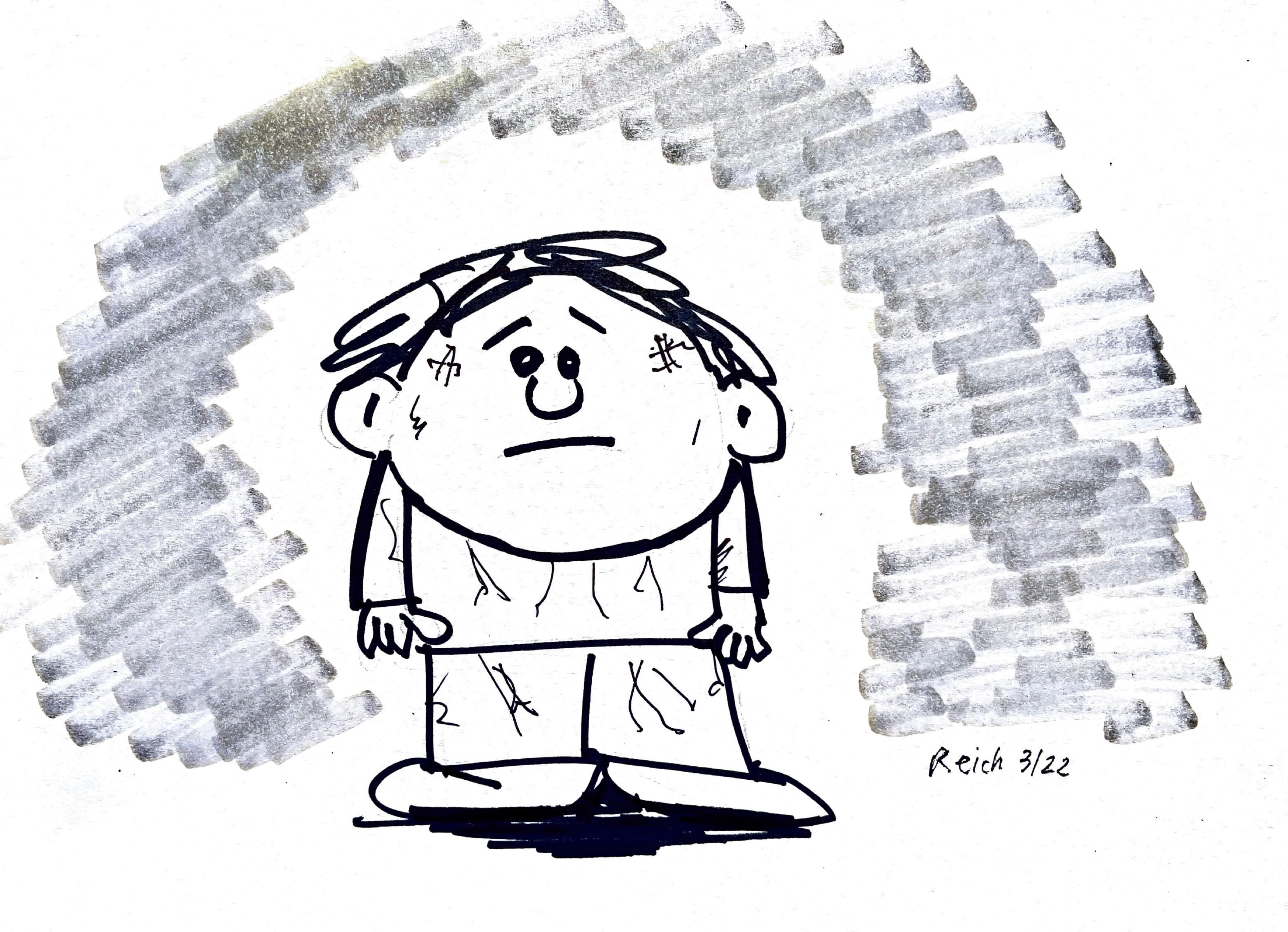
The richest nation in the history of the world has chosen to impoverish millions of our children.
SEP 14, 2023
Friends,
Poverty is a policy choice. We have chosen to have a significant percentage of our population impoverished, including — especially — our nation’s children.
When I say we’ve chosen this, I mean that it doesn’t have to be this way. There is no law of nature or principle of economics or Constitutional provision that dictates such a high number of people in poverty within the richest nation in the history of the world.
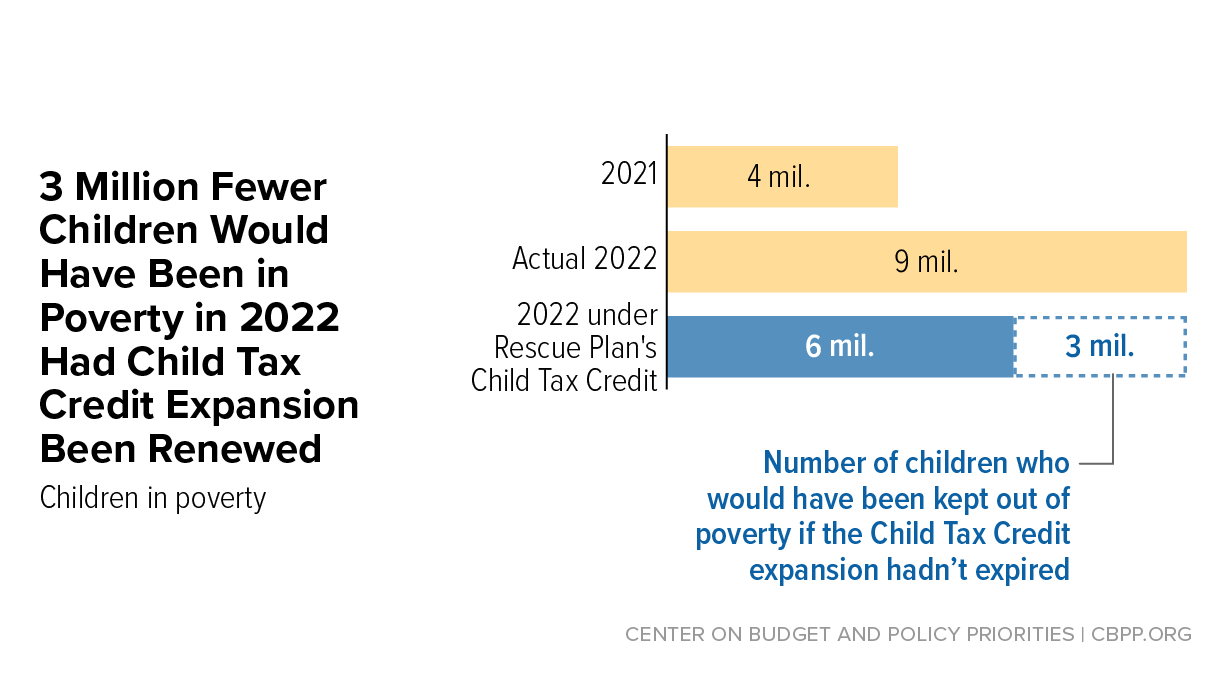
Census data released Tuesday provides clear evidence of the choice we’ve made. The number of people with incomes below the poverty line in 2022 rose by 15.3 million. The poverty rate for children more than doubled — from an historic low of 5.2 percent in 2021 to 12.4 percent in 2022.
The United States has just experienced the largest spike in child poverty since the current models for measuring economic distress were developed in 2009. All of the record gains made against child poverty over the previous two years have been erased.
The reason for this extraordinary rise in poverty? Not the pandemic. Not a vicious recession. Not an economic depression. Not a huge increase in the numbers of people unemployed. In fact, employment is high.
The reason, according to the Census Bureau, is the refusal by Congress to renew the enhanced child tax credit that was developed during the Covid-19 pandemic. That expiration was a policy choice.
Poverty has shot upwards because we as a nation (through our representatives in Congress) decided to eliminate a relatively modest monthly bump in federal support — $250 to $300 per month for households with children.
In the previous year, that modest bump had the astounding effect of reducing the rate of child poverty by nearly half. When lawmakers expanded the child tax credit in 2021, fewer kids lived in poverty. When they failed to continue the expansion in 2022, child poverty more than doubled.
Ergo, two policy choices by Congress — one that dramatically cut child poverty, followed by a second that dramatically increased it.
Who exactly in Congress made this choice? Republicans and a handful of Democrats such as West Virginia Senator Joe Manchin and Arizona Senator Kyrsten Sinema. They rejected efforts by the Biden administration and most congressional Democrats to maintain the enhanced child tax credits.
Although House Democrats backed the proposed extension of the credits, Senate Democrats needed all 50 members of their caucus to pass the legislation via the reconciliation process. Manchin refused to go along unless his colleagues accepted a scheme to penalize parents with work requirements and other restrictions.
Sinema also refused, as has been noted by the campaign of US Representative Ruben Gallego, an Arizona Democrat who is running to replace Sinema in 2024. (Let’s do everything we can to make sure he does.)
Ending poverty is not difficult, especially for wealthy nations such as the United States. We know exactly how to do it. We did it. Then we undid it. In effect, the United States is now making a concerted effort to impoverish millions of our children.
As John Nichols of The Nationreminds us, our success at reducing poverty is similar to what occurred in the 1930s, when President Franklin Delano Roosevelt responded to the Great Depression with the myriad job creation, rural development, and social safety net programs (including Social Security) that formed the New Deal.
When FDR took office in 1933, the unemployment rate in the US was close to 25 percent. After eight years of federal interventions by the Roosevelt administration, it was down to around 10 percent when World War II began.
Similarly, just before Lyndon Johnson got Congress to enact Medicare and Medicaid in 1965, 22 percent of Americans were impoverished. When Johnson left office, it was around 13 percent. Why the drop? Because Medicare and Medicaid addressed a key driver of poverty among the elderly—medical costs. And other Great Society initiatives, such as expanded nutrition and housing programs, contributed to the decline.
This is not rocket science. The expanded Child Tax Credit cut child poverty nearly in half. Sinema, Manchin, and the GOP let it expire and child poverty spiked.
This is not only a policy choice. It is a moral choice. In the richest country in the world, it is inexcusable that millions of our children are living in poverty. They don’t have to be.
Friends, expanding the Child Tax Credit should be the top tax policy priority both this year and during the 2025 tax debate. Period.
Lex Hinkley is a 27-year-old nurse based in San Diego, California — and their frustration with American healthcare recently made waves when they posted a passionate TikTok rant that perfectly sums up everything that’s wrong with our system.
She starts the video by saying, “It is virtually impossible to be a ethical healthcare worker in this extremely unethical healthcare system. The amount of times I’ve had to discharge patients back to situations where I knew they weren’t going to be able to take care of themselves, but I had no other options, is truly too hard to even give a number to. If my career as a healthcare worker has done anything to my worldview or life, it has simply radicalized me further than anyone could believe.”
Then, they share a really upsetting story that perfectly illustrates how for-profit healthcare puts money over patients’ lives and dignity. “I’ve seen varying levels of this happen at every single hospital I’ve worked at. I’ve been a nurse for four years. I’ve worked in seven states. It is happening everywhere and if you think your hospital is different, you’re fucking wrong. Recently, as of December, hospitals in Louisville, Kentucky, came under fire for leaving patients outside on fucking sidewalks.”
“They do this in front of shelters. They will drop patients off in front of shelters just like this, but sometimes they don’t even take them to the shelter. They literally leave them right outside the hospital. This specific patient was left in this condition in 36 degree weather.” When the local news outlet WAVE was alerted, they staked out the hospital and observed several more patients being left outside with no resources.
One patient’s mother told WAVE, “I thought ‘They’ve dumped my son…’ My garbage I have to put out to the curb, that’s how they dumped my son. Like garbage.” It’s utterly heartbreaking.
when a stabilized emergency room patient who needs more care is essentially kicked to the curb like this, it’s called patient dumping. This practice is not isolated to the Kentucky hospital Lex mentioned. In just a quick Google News search, I found news reports about patient dumping in San Diego, Las Vegas, Phoenix, and Colorado Springs, all within the last year.
Patients who are uninsured, low-income, or experiencing homelessness are at the highest risk of being patient dumped.
Next, Lex connects the dots between incidents of patient dumping and the gutting of the American social safety net. “When you defund social programs, it all ends up in the ER. When you defund senior care, when you defund psychiatric care, when you defund shelters, whether it’s homeless shelters or women’s shelters.”
Phil Fisk / Getty Images/Image SourceWhen you defund the safety nets that our society needs to prevent people from beginning a crisis, a downward spiral, they end up in the ER and simply put, ER workers and hospital workers are already at their fucking wit’s end. We cannot act as a catch all for every single issue in society, and yet, we are here we are doing it. And at the very fucking same time, treating people like literal fucking garbage should never fucking happen.”
Finally, Lex urges our country to start putting money back into social services. “The only way to fix situations as unethical and disgusting as this from happening is to fund solutions. We need to fund proper safety nets for our society. In this country, if you lose your job, you lose your health insurance, you potentially lose all of your income, which means you’re not going to be able to pay rent. Well, then what happens if you get sick? Do you see what I’m saying? We don’t have safety nets for our poor in this country. We have a greased chute, and at the very bottom of that greased chute of poverty is a trip to your local emergency room because everything ends up in the ER and then we have nowhere to place people.”
“There are solutions for these problems, but they cost money. They cost money. And we as a society have said that we’re A-okay with 400 people having 70% of the nation’s wealth while our community members get treated like this.”
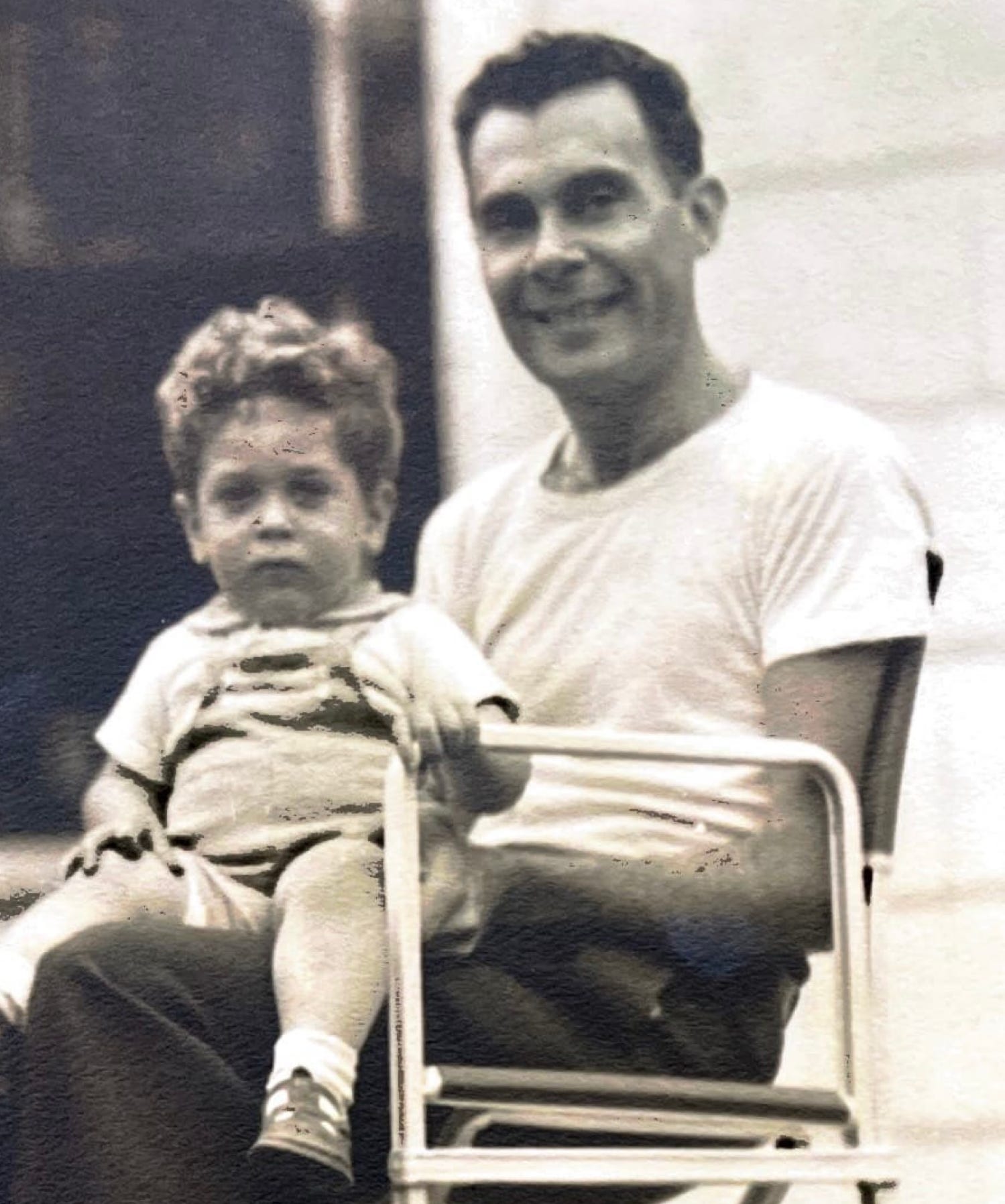
My father called himself a liberal Republican in the days when such creatures still roamed the earth. He voted for Thomas Dewey in 1948 (canceling my mother’s vote for Harry Truman) and then for Dwight Eisenhower in 1952 and 1956 (canceling my mother’s votes for Adlai Stevenson), and he thought highly of New York’s Republican governor, Nelson Rockefeller, and its Republican senator, Jacob Javits — neither of whom would last a nanosecond in today’s GOP.
But Ed Reich could not abide political bullies. He gave up on the Republican Party when Nixon became president. He would have detested Trump. (My father died in 2016, two weeks before his 102nd birthday, and nine months before Trump was elected.)
Ed thought anyone who had to bully someone else to feel good about himself was despicable. If they did their bullying through politics, they were doubly despicable. In his mind, political bullying had led to the Holocaust.
In 1947, Ed moved us from Scranton, Pennsylvania, to a small town some 60 miles north of New York City called South Salem, to be within driving distance of his two women’s clothing stores, in Norwalk, Connecticut, and Peekskill, New York.
Soon after we moved in, a delegation of older men came by our house. When they knocked on the door, my mother thought they were a welcoming committee and opened it with a big “hello!” But when she saw the expressions on their faces, she became alarmed.
She invited them into the living room and asked if they’d like coffee. They declined.
My father greeted them stiffly, suggesting they sit down. They did not.
“What’s this about?” he asked. “What’s happened? Is there a problem?”
“Mr. and Mrs. Reich,” one of them spoke gravely, “we’ve come to inform you that South Salem is a Christian community.”
There was a long pause. I could see my father redden.
“So, we’re not welcome here?” His voice was tight.
“Legally, you have a right to be here, of course,” the speaker said. (New York state had just enacted a law prohibiting homeowners from including “restrictive covenants” in their deeds that barred sales to “Negroes or Hebrews.”) “But we don’t think you and your family will be happy here.”
“Thank you for coming by,” my father said flatly, opening the front door for them. Then he exploded: “Now get the hell out of my house!”
That was the day Ed Reich decided we’d stay put in South Salem forever. “I showed those sons of bitches,” he said some years later.
“Son of a bitch” was the worst epithet Ed could hurl at someone. It burst out of him like a volcanic eruption. For many years, I didn’t know it contained separate English words, including a term many would find offensive today. To my young ears it was one word — sonofaBITCH — that might have been Russian or Yiddish, but whatever language it was, it was huge and frightening.
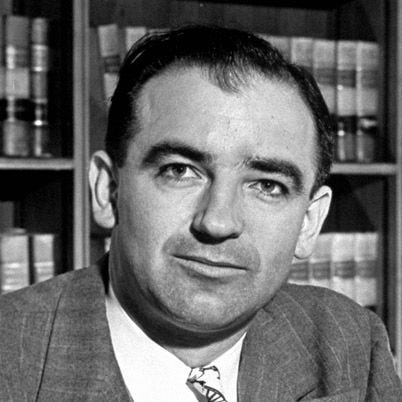
WISCONSIN SENATOR JOE McCARTHY HAD A SPECIAL PLACE in Ed Reich’s pantheon of horrible people. McCarthy didn’t just bully those he claimed were members of the Communist Party. He attacked them with malice. McCarthy ridiculed the “pitiful squealing” of “those egg-sucking phony liberals” who “would hold sacrosanct those Communists and queers.”
Every time McCarthy’s image came across the six-inch screen of the Magnavox television in our living room, my father would shout “son-of-a-BITCH” so loudly it made me shudder.
McCarthyism was the byproduct of the Republican Party’s postwar effort to eradicate the New Deal by linking it to communism. The GOP had portrayed the midterm election of 1946 as a “battle between Republicanism and communism.” The Republican National Committee chairman claimed that the federal bureaucracy was filled with “pink puppets.”
Southern segregationist Democrats joined in the red baiting. Mississippi Senator Theodore Bilbo, a Klansman who had filibustered to block anti-lynching legislation, described multiracial labor unions’ advocacy for civil rights as the work of “northern communists.” Representative John Elliott Rankin, a racist and antisemitic Mississippi Democrat who helped establish the House Un-American Activities Committee, called the CIO’s southern organizing campaign “a communist plot” and charged it would give more voting rights to Black people. “We’re asleep at the switch,” he warned. “They’re taking over this country; we’ve got to stop them if we want this country.”
The tactic was temporarily successful. In the 1946 midterms, Democrats lost control of both the Senate and the House. Wisconsin ended its era of progressive Republican La Follettes and sent Joe McCarthy to the Senate. California replaced New Dealer Jerry Voorhis with a young Republican lawyer who had already figured out how to use red baiting as a political tool. His name was Richard Nixon.
In December 1946, at the founding convention of the Progressive Citizens of America, FDR’s former vice president Henry Wallace called the red scare a tool used by the most powerful economic forces in America and warned America not to give in to it. “We shall … repel all the attacks of the plutocrats and monopolists who will brand us as Reds,” he said, adding:
“If it is traitorous to believe in peace — we are traitors. If it is communistic to believe in prosperity for all — we are communists. If it is unAmerican to believe in freedom from monopolistic dictation — we are unAmerican. We are more American than the neo-fascists who attack us. The more we are attacked the more likely we are to succeed, provided we are ready and willing to counterattack.”
But there was no counterattack. The red baiting escalated, encouraged by J. Edgar Hoover, the first director of the FBI.
President Truman succumbed to the mounting hysteria. On March 21, 1947, he signed Executive Order 9835, the “Loyalty Order.” It ushered in loyalty oaths and background checks and created the Attorney General’s List of Subversive Organizations.
As the 1950 election approached, a Times headline announced that the “Left is Silent in Campaign.” Even the American Civil Liberties Union, whose roots lay in the Red Scare of the World War I era, was reluctant to take the lead in opposing the threat to civil liberties in the second Red Scare of the 1950s.
California Representative Helen Gahagan Douglas — dubbed the “Pink Lady” for her supposed communist sympathies — tried for the Senate in 1950. She survived a bitter primary battle only to be beaten in November by red-baiter Richard Nixon.
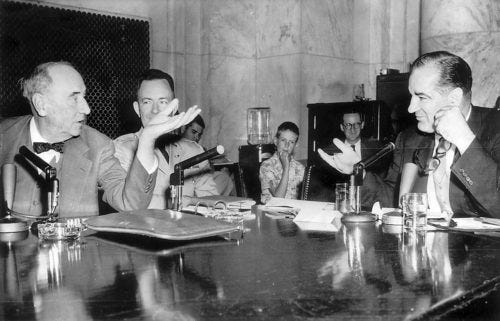
ON JUNE 9, 1954, I SAT AT MY FATHER’S SIDE ON OUR LIVING ROOM COUCH, watching the Army-McCarthy hearings. McCarthy had accused the U.S. Army of having poor security at a top-secret facility.
Joseph Welch, a private attorney, was representing the Army. McCarthy charged that one of Welch’s young staff attorneys was a communist. Such a charge was likely to end the young man’s career.
“Son-of-a-BITCH,” my father shouted. I hid my head.
As McCarthy continued his attack on Welch’s staff attorney, Welch broke in. “Until this moment, Senator, I think I never really gauged your cruelty or your recklessness.”
I was only eight years old, but I was spellbound.
McCarthy didn’t stop. “Son-of-a-BITCH!” Ed Reich shouted even more loudly. The earth seemed to shake.
At this point, Welch demanded that McCarthy listen to him. “Let us not assassinate this lad further, Senator,” he said. “You have done enough. Have you no sense of decency?”
Almost overnight, McCarthy imploded. His national popularity evaporated. Three years later, censured by his Senate colleagues, ostracized by his party, and ignored by the press, McCarthy drank himself to death, a broken man at the age of 48.
During the Army-McCarthy hearings, McCarthy’s chief counsel was Roy Cohn. Cohn became one of America’s most notorious bullies.
Cohn had gained prominence as the Department of Justice attorney who successfully prosecuted Julius and Ethel Rosenberg for espionage, leading to their execution in 1953. (Evidence made public decades after the execution confirmed that Julius was a spy, but that Ethel, while aware of her husband’s activities, was not.)
In public, Cohn was homophobic. Privately, he was gay at a time when being gay was a crime. A character in Tony Kushner’s epic Angels in America describes him as “the polestar of human evil. The worst human being who ever lived … the most evil, twisted, vicious bastard ever to snort coke at Studio 54.” His bullying was particularly vicious, I think, because he was filled with self-loathing.
The Rosenberg trial brought the 24-year-old Cohn to the attention of J. Edgar Hoover, who convinced Joe McCarthy to hire Cohn as chief counsel for McCarthy’s Senate Permanent Subcommittee on Investigations. Cohn became known for his aggressive questioning of suspected communists.
My father thought Roy Cohn almost as despicable as Joe McCarthy. “Son-of-a BITCH!” my father shouted whenever Cohn’s name was in the news.
After McCarthy’s downfall, it was assumed that Cohn’s career was also over. Yet Cohn reinvented himself as a power broker in New York. Despite scandals and indictments, along with accusations of tax evasion, bribery, and theft, Cohn survived.
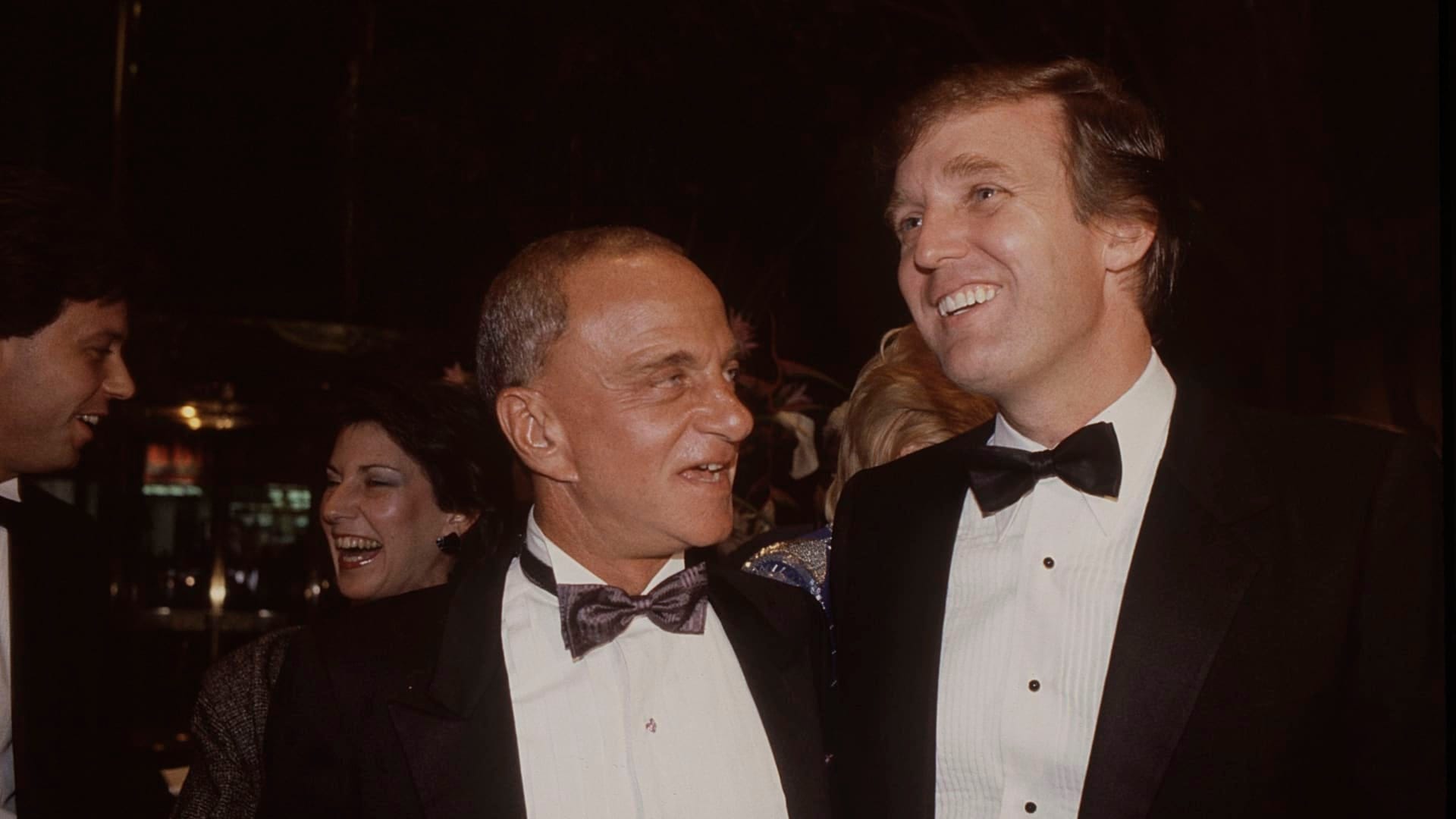
COHN PROVED HIMSELF USEFUL TO A YOUNG REAL ESTATE DEVELOPER NAMED DONALD TRUMP. Fred Trump had started his son’s career by bringing him into the family business of renting apartments in Brooklyn and Queens.
Cohn established Donald in Manhattan by introducing him to New York’s social and political elite. Donald was undertaking several large construction projects in Manhattan and needed both a fixer and mentor. Cohn filled both roles, and along the way bequeathed to Trump a penchant for ruthless bullying, profane braggadocio, and opportunistic bigotry.
Like Trump, Cohn was utterly without principle. Like Trump, his priority was personal power that could be leveraged for wealth, influence, and celebrity.
In 1973, the Justice Department accused Trump Management Inc., its 27-year-old president, Donald, and chairman, Fred, of violating the Fair Housing Act of 1968 in 39 of his properties — alleging that the company quoted different rental terms and conditions to prospective tenants based on their race and made false “no vacancy” statements to Black people seeking to rent.
Trump employees had secretly marked the applications of Black people with codes, such as “C” for “colored,” according to accounts filed in federal court. The employees allegedly directed Black people away from buildings with mostly white tenants, steering them toward properties that had many Black tenants.
Representing the Trumps, Roy Cohn filed a countersuit against the government for $100 million, asserting that the charges were “irresponsible and baseless.” Although the countersuit was unsuccessful, Trump settled the charges out of court in 1975, asserting he was satisfied that the agreement did not “compel the Trump organization to accept persons on welfare as tenants unless as qualified as any other tenant.”
Three years later, when the Trump Organization was again in court for violating terms of the 1975 settlement, Cohn called the charges “nothing more than a rehash of complaints by a couple of planted malcontents.” Donald Trump denied the charges.
Cohn was also involved in the construction of Trump Tower, helping secure concrete during a citywide Teamster strike via a union leader linked to a mob boss.
At about this time, Cohn introduced Trump to another of Cohn’s clients, Rupert Murdoch.
During Ronald Reagan’s 1980 presidential campaign, Cohn helped another young man named Roger Stone.
As Stone later recounted, Cohn gave him a suitcase filled with money that Stone dropped off at the office of a lawyer influential in Liberal Party circles. “I paid his law firm. Legal fees. I don’t know what he did for the money.” In fact, the money was used to get New York’s Liberal Party to nominate Illinois Congressman John Anderson — thereby splitting New York’s opposition to Reagan. It worked. Reagan carried the state with 46 percent of the vote. (Ed Reich voted for Jimmy Carter.)
In 1986, Cohn was disbarred by the New York State Bar for unethical conduct after attempting to defraud a dying client by forcing the client to sign a will amendment leaving Cohn his fortune. (Cohn died five weeks later from AIDS-related complications.)
In his first and best-known book, The Art of the Deal, Trump drew a distinction between integrity and loyalty. He preferred the latter.
For Trump, Roy Cohn exemplified loyalty. Trump compared Cohn to “all the hundreds of ‘respectable’ guys who make careers out of boasting about their uncompromising integrity but have absolutely no loyalty … What I liked most about Roy Cohn was that he would do just the opposite.”
Speaker Kevin McCarthy plans to get an impeachment of Joe Biden underway in the House by the end of September.
But McCarthy faces two problems. First, there are no grounds for impeachment — no evidence, for example, that Biden got money or agreed to do anything so his son, Hunter, could get money. Or any other grounds.
Second, McCarthy doesn’t have the votes of moderate Republicans, whose constituents don’t want the House to waste time and money impeaching Biden.
So what’s McCarthy going to do? Open the inquiry anyway, without a formal vote.
McCarthy wants to start an impeachment of Biden because Trump is pressuring him to. As Trump posted Sunday:
“The Republicans in Congress, though well meaning, keep talking about an Impeachment ‘Inquiry’ on Crooked Joe Biden. Biden is a Stone Cold Crook-You don’t need a long INQUIRY to prove it, it’s already proven… Either IMPEACH the BUM, or fade into OBLIVION.”
Why is Trump so eager to get a Biden impeachment underway? Not to retaliate against the Democrats for impeaching him. It’s mainly to have Biden impeachment stories run at the same time as Trump trial stories. That way, Trump and his Republican enablers can deflect attention from the trials and confuse the public with arguments that Biden is even more guilty of something.
It’s part of a broader Republican strategy to defend Trump during his coming trials not by claiming he’s innocent but by launching investigations to tarnish Biden — similar to the strategy Republicans used investigating Hillary Clinton’s emails in 2016 and tried to use when Trump pressured Ukrainian President Volodymyr Zelensky to announce an investigation into Hunter Biden in 2019.
Deflection, confusion, and baseless lies repeated on social media, then magnified by Fox News and expanded on by Newsmax and other extremist outlets. Sound familiar?
I doubt Americans will fall for it.
On Tuesday, the Biden administration announced the first 10 drugs whose prices will be negotiated downward under Biden’s Inflation Reduction Act, which gave Medicare such power. This is a big deal. Last year, Medicare enrollees paid $3.4 billion in out-of-pocket expenses for these drugs. The savings will be considerable.
So while Biden delivers practical solutions to the problems facing Americans, such as high drug costs, Republicans engage in partisan stunts like impeaching Biden. Even though Democrats are terrible at messaging, the contrast should be obvious to everyone.
On March 4, 1858, South Carolina senator James Henry Hammond rose to his feet to explain to the Senate how society worked. “In all social systems,” he said, “there must be a class to do the menial duties, to perform the drudgery of life.” That class, he said, needed little intellect and little skill, but it should be strong, docile, and loyal.
“Such a class you must have, or you would not have that other class which leads progress, civilization and refinement,” Hammond said. His workers were the “mud-sill” on which society rested, the same way that a stately house rested on wooden sills driven into the mud.
He told his northern colleagues that the South had perfected this system by enslavement based on race, while northerners pretended that they had abolished slavery. “Aye, the name, but not the thing,” he said. “[Y]our whole hireling class of manual laborers and ‘operatives,’ as you call them, are essentially slaves.”
While southern leaders had made sure to keep their enslaved people from political power, Hammond said, he warned that northerners had made the terrible mistake of giving their “slaves” the vote. As the majority, they could, if they only realized it, control society. Then “where would you be?” he asked. “Your society would be reconstructed, your government overthrown, your property divided, not…with arms…but by the quiet process of the ballot-box.”
He warned that it was only a matter of time before workers took over northern cities and began slaughtering men of property.
Hammond’s vision was of a world divided between the haves and the have-nots, where men of means commandeered the production of workers and justified that theft with the argument that such a concentration of wealth would allow superior men to move society forward. It was a vision that spoke for the South’s wealthy planter class—enslavers who held more than 50 of their Black neighbors in bondage and made up about 1% of the population—but such a vision didn’t even speak for the majority of white southerners, most of whom were much poorer than such a vision suggested.
And it certainly didn’t speak for northerners, to whom Hammond’s vision of a society divided between dim drudges and the rich and powerful was both troubling and deeply insulting.
On September 30, 1859, at the Wisconsin State Agricultural Fair, rising politician Abraham Lincoln answered Hammond’s vision of a society dominated by a few wealthy men. While the South Carolina enslaver argued that labor depended on capital to spur men to work, either by hiring them or enslaving them, Lincoln said there was an entirely different way to see the world.
Representing an economy in which most people worked directly on the land or water to pull wheat into wagons and fish into barrels, Lincoln believed that “[l]abor is prior to, and independent of, capital; that, in fact, capital is the fruit of labor, and could never have existed if labor had not first existed—that labor can exist without capital, but that capital could never have existed without labor. Hence they hold that labor is the superior—greatly the superior of capital.”
A man who had, himself, worked his way up from poverty to prominence (while Hammond had married into money), Lincoln went on: “[T]he opponents of the ‘mud-sill’ theory insist that there is not…any such things as the free hired laborer being fixed to that condition for life.”
And then Lincoln articulated what would become the ideology of the fledgling Republican Party:
“The prudent, penniless beginner in the world, labors for wages awhile, saves a surplus with which to buy tools or land, for himself; then labors on his own account for another while, and at length hires another new beginner to help him. This, say its advocates, is free labor—the just and generous, and prosperous system, which opens the way for all—gives hope to all, and energy and progress, and improvement of condition to all.”
In such a worldview, everyone shared a harmony of interest. What was good for the individual worker was, ultimately, good for everyone. There was no conflict between labor and capital; capital was simply “pre-exerted labor.” Except for a few unproductive financiers and those who wasted their wealth on luxuries, everyone was part of the same harmonious system.
The protection of property was crucial to this system, but so was opposition to great accumulations of wealth. Levelers who wanted to confiscate property would upset this harmony, as Hammond warned, but so would rich men who sought to monopolize land, money, or the means of production. If a few people took over most of a country’s money or resources, rising laborers would be forced to work for them forever or, at best, would have to pay exorbitant prices for the land or equipment they needed to become independent.
A lot of water has gone under the bridge since Lincoln’s day, but on this Labor Day weekend, it strikes me that the worldviews of men like Hammond and Lincoln are still fundamental to our society: Should our government protect people of property as they exploit the majority so they can accumulate wealth and move society forward as they wish? Or should we protect the right of ordinary Americans to build their own lives, making sure that no one can monopolize the country’s money and resources, with the expectation that their efforts will build society from the ground up?




 Michael1942's Blog