The richest nation in the history of the world has chosen to impoverish millions of our children.
SEP 14, 2023
Friends,
Poverty is a policy choice. We have chosen to have a significant percentage of our population impoverished, including — especially — our nation’s children.
When I say we’ve chosen this, I mean that it doesn’t have to be this way. There is no law of nature or principle of economics or Constitutional provision that dictates such a high number of people in poverty within the richest nation in the history of the world.
Census data released Tuesday provides clear evidence of the choice we’ve made. The number of people with incomes below the poverty line in 2022 rose by 15.3 million. The poverty rate for children more than doubled — from an historic low of 5.2 percent in 2021 to 12.4 percent in 2022.
The United States has just experienced the largest spike in child poverty since the current models for measuring economic distress were developed in 2009. All of the record gains made against child poverty over the previous two years have been erased.
The reason for this extraordinary rise in poverty? Not the pandemic. Not a vicious recession. Not an economic depression. Not a huge increase in the numbers of people unemployed. In fact, employment is high.
The reason, according to the Census Bureau, is the refusal by Congress to renew the enhanced child tax credit that was developed during the Covid-19 pandemic. That expiration was a policy choice.
Poverty has shot upwards because we as a nation (through our representatives in Congress) decided to eliminate a relatively modest monthly bump in federal support — $250 to $300 per month for households with children.
In the previous year, that modest bump had the astounding effect of reducing the rate of child poverty by nearly half. When lawmakers expanded the child tax credit in 2021, fewer kids lived in poverty. When they failed to continue the expansion in 2022, child poverty more than doubled.
Ergo, two policy choices by Congress — one that dramatically cut child poverty, followed by a second that dramatically increased it.
Who exactly in Congress made this choice? Republicans and a handful of Democrats such as West Virginia Senator Joe Manchin and Arizona Senator Kyrsten Sinema. They rejected efforts by the Biden administration and most congressional Democrats to maintain the enhanced child tax credits.
Although House Democrats backed the proposed extension of the credits, Senate Democrats needed all 50 members of their caucus to pass the legislation via the reconciliation process. Manchin refused to go along unless his colleagues accepted a scheme to penalize parents with work requirements and other restrictions.
Sinema also refused, as has been noted by the campaign of US Representative Ruben Gallego, an Arizona Democrat who is running to replace Sinema in 2024. (Let’s do everything we can to make sure he does.)
Ending poverty is not difficult, especially for wealthy nations such as the United States. We know exactly how to do it. We did it. Then we undid it. In effect, the United States is now making a concerted effort to impoverish millions of our children.
As John Nichols of The Nationreminds us, our success at reducing poverty is similar to what occurred in the 1930s, when President Franklin Delano Roosevelt responded to the Great Depression with the myriad job creation, rural development, and social safety net programs (including Social Security) that formed the New Deal.
When FDR took office in 1933, the unemployment rate in the US was close to 25 percent. After eight years of federal interventions by the Roosevelt administration, it was down to around 10 percent when World War II began.
Similarly, just before Lyndon Johnson got Congress to enact Medicare and Medicaid in 1965, 22 percent of Americans were impoverished. When Johnson left office, it was around 13 percent. Why the drop? Because Medicare and Medicaid addressed a key driver of poverty among the elderly—medical costs. And other Great Society initiatives, such as expanded nutrition and housing programs, contributed to the decline.
This is not rocket science. The expanded Child Tax Credit cut child poverty nearly in half. Sinema, Manchin, and the GOP let it expire and child poverty spiked.
This is not only a policy choice. It is a moral choice. In the richest country in the world, it is inexcusable that millions of our children are living in poverty. They don’t have to be.
Friends, expanding the Child Tax Credit should be the top tax policy priority both this year and during the 2025 tax debate. Period.
Lex Hinkley is a 27-year-old nurse based in San Diego, California — and their frustration with American healthcare recently made waves when they posted a passionate TikTok rant that perfectly sums up everything that’s wrong with our system.
She starts the video by saying, “It is virtually impossible to be a ethical healthcare worker in this extremely unethical healthcare system. The amount of times I’ve had to discharge patients back to situations where I knew they weren’t going to be able to take care of themselves, but I had no other options, is truly too hard to even give a number to. If my career as a healthcare worker has done anything to my worldview or life, it has simply radicalized me further than anyone could believe.”
Then, they share a really upsetting story that perfectly illustrates how for-profit healthcare puts money over patients’ lives and dignity. “I’ve seen varying levels of this happen at every single hospital I’ve worked at. I’ve been a nurse for four years. I’ve worked in seven states. It is happening everywhere and if you think your hospital is different, you’re fucking wrong. Recently, as of December, hospitals in Louisville, Kentucky, came under fire for leaving patients outside on fucking sidewalks.”
“They do this in front of shelters. They will drop patients off in front of shelters just like this, but sometimes they don’t even take them to the shelter. They literally leave them right outside the hospital. This specific patient was left in this condition in 36 degree weather.” When the local news outlet WAVE was alerted, they staked out the hospital and observed several more patients being left outside with no resources.
One patient’s mother told WAVE, “I thought ‘They’ve dumped my son…’ My garbage I have to put out to the curb, that’s how they dumped my son. Like garbage.” It’s utterly heartbreaking.
when a stabilized emergency room patient who needs more care is essentially kicked to the curb like this, it’s called patient dumping. This practice is not isolated to the Kentucky hospital Lex mentioned. In just a quick Google News search, I found news reports about patient dumping in San Diego, Las Vegas, Phoenix, and Colorado Springs, all within the last year.
Patients who are uninsured, low-income, or experiencing homelessness are at the highest risk of being patient dumped.
Next, Lex connects the dots between incidents of patient dumping and the gutting of the American social safety net. “When you defund social programs, it all ends up in the ER. When you defund senior care, when you defund psychiatric care, when you defund shelters, whether it’s homeless shelters or women’s shelters.”
Phil Fisk / Getty Images/Image SourceWhen you defund the safety nets that our society needs to prevent people from beginning a crisis, a downward spiral, they end up in the ER and simply put, ER workers and hospital workers are already at their fucking wit’s end. We cannot act as a catch all for every single issue in society, and yet, we are here we are doing it. And at the very fucking same time, treating people like literal fucking garbage should never fucking happen.”
Finally, Lex urges our country to start putting money back into social services. “The only way to fix situations as unethical and disgusting as this from happening is to fund solutions. We need to fund proper safety nets for our society. In this country, if you lose your job, you lose your health insurance, you potentially lose all of your income, which means you’re not going to be able to pay rent. Well, then what happens if you get sick? Do you see what I’m saying? We don’t have safety nets for our poor in this country. We have a greased chute, and at the very bottom of that greased chute of poverty is a trip to your local emergency room because everything ends up in the ER and then we have nowhere to place people.”
“There are solutions for these problems, but they cost money. They cost money. And we as a society have said that we’re A-okay with 400 people having 70% of the nation’s wealth while our community members get treated like this.”
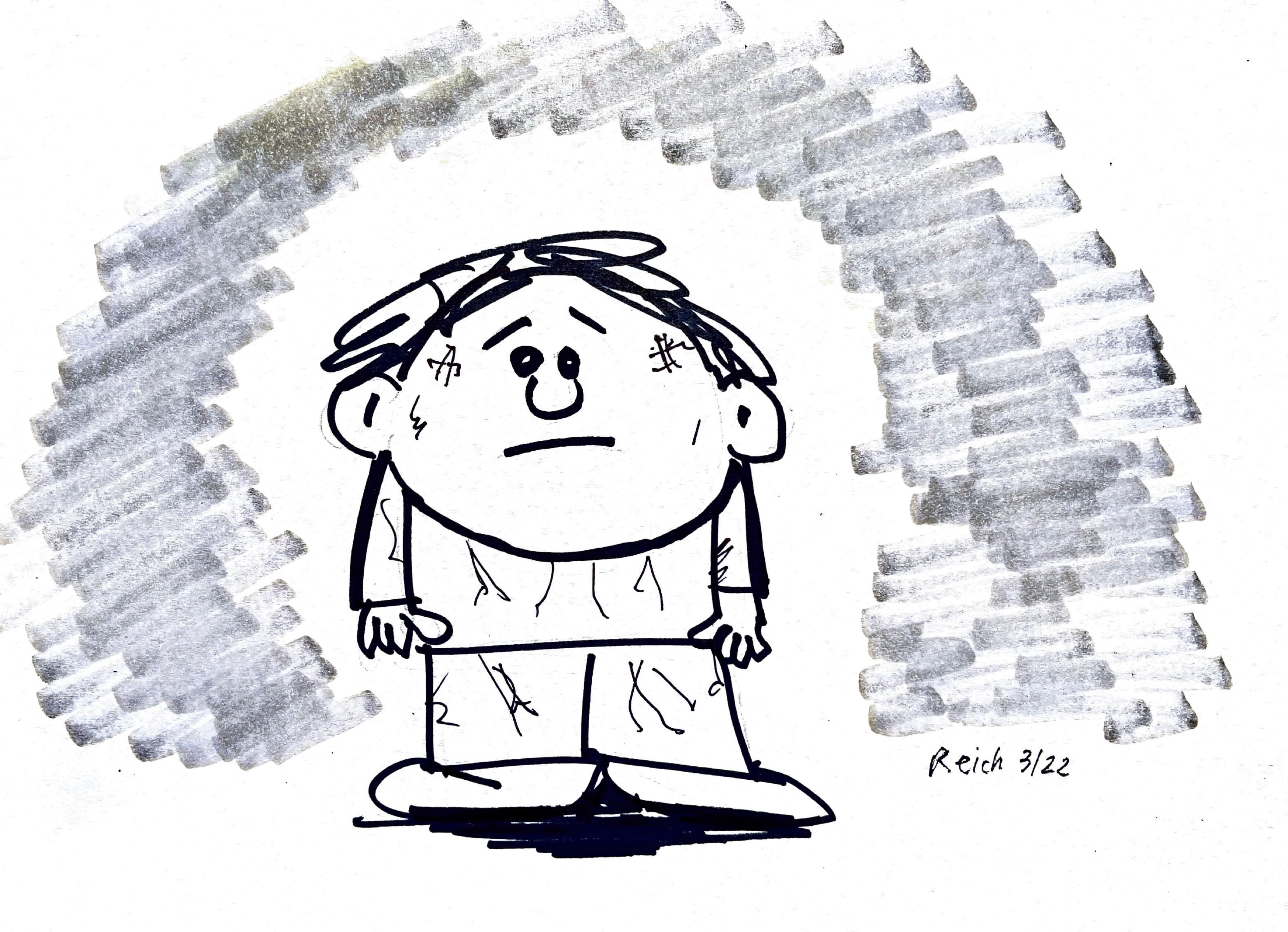
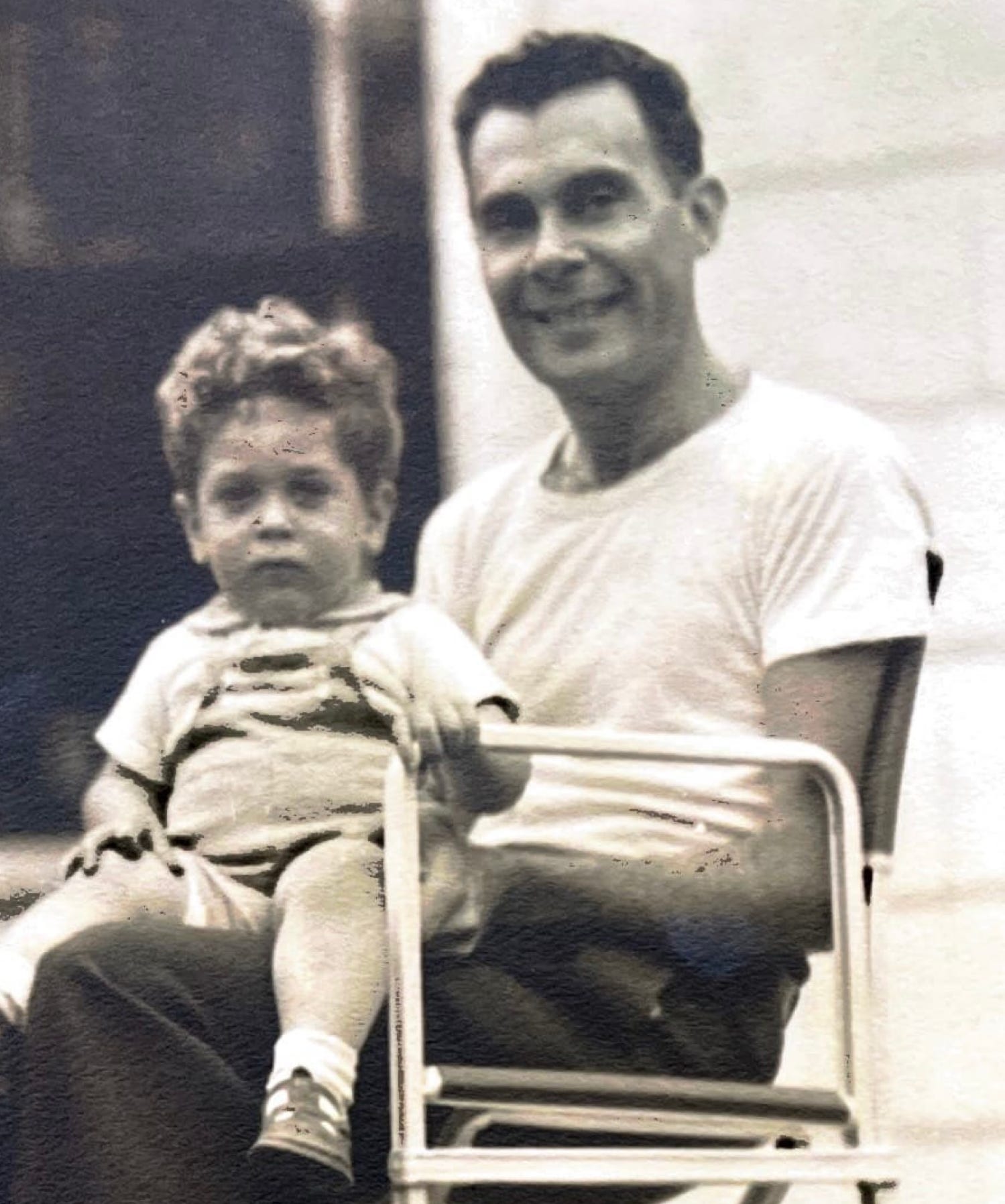
My father called himself a liberal Republican in the days when such creatures still roamed the earth. He voted for Thomas Dewey in 1948 (canceling my mother’s vote for Harry Truman) and then for Dwight Eisenhower in 1952 and 1956 (canceling my mother’s votes for Adlai Stevenson), and he thought highly of New York’s Republican governor, Nelson Rockefeller, and its Republican senator, Jacob Javits — neither of whom would last a nanosecond in today’s GOP.
But Ed Reich could not abide political bullies. He gave up on the Republican Party when Nixon became president. He would have detested Trump. (My father died in 2016, two weeks before his 102nd birthday, and nine months before Trump was elected.)
Ed thought anyone who had to bully someone else to feel good about himself was despicable. If they did their bullying through politics, they were doubly despicable. In his mind, political bullying had led to the Holocaust.
In 1947, Ed moved us from Scranton, Pennsylvania, to a small town some 60 miles north of New York City called South Salem, to be within driving distance of his two women’s clothing stores, in Norwalk, Connecticut, and Peekskill, New York.
Soon after we moved in, a delegation of older men came by our house. When they knocked on the door, my mother thought they were a welcoming committee and opened it with a big “hello!” But when she saw the expressions on their faces, she became alarmed.
She invited them into the living room and asked if they’d like coffee. They declined.
My father greeted them stiffly, suggesting they sit down. They did not.
“What’s this about?” he asked. “What’s happened? Is there a problem?”
“Mr. and Mrs. Reich,” one of them spoke gravely, “we’ve come to inform you that South Salem is a Christian community.”
There was a long pause. I could see my father redden.
“So, we’re not welcome here?” His voice was tight.
“Legally, you have a right to be here, of course,” the speaker said. (New York state had just enacted a law prohibiting homeowners from including “restrictive covenants” in their deeds that barred sales to “Negroes or Hebrews.”) “But we don’t think you and your family will be happy here.”
“Thank you for coming by,” my father said flatly, opening the front door for them. Then he exploded: “Now get the hell out of my house!”
That was the day Ed Reich decided we’d stay put in South Salem forever. “I showed those sons of bitches,” he said some years later.
“Son of a bitch” was the worst epithet Ed could hurl at someone. It burst out of him like a volcanic eruption. For many years, I didn’t know it contained separate English words, including a term many would find offensive today. To my young ears it was one word — sonofaBITCH — that might have been Russian or Yiddish, but whatever language it was, it was huge and frightening.
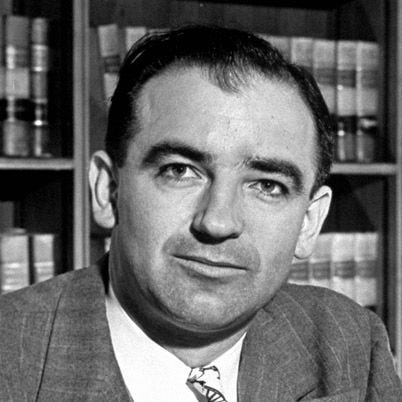
WISCONSIN SENATOR JOE McCARTHY HAD A SPECIAL PLACE in Ed Reich’s pantheon of horrible people. McCarthy didn’t just bully those he claimed were members of the Communist Party. He attacked them with malice. McCarthy ridiculed the “pitiful squealing” of “those egg-sucking phony liberals” who “would hold sacrosanct those Communists and queers.”
Every time McCarthy’s image came across the six-inch screen of the Magnavox television in our living room, my father would shout “son-of-a-BITCH” so loudly it made me shudder.
McCarthyism was the byproduct of the Republican Party’s postwar effort to eradicate the New Deal by linking it to communism. The GOP had portrayed the midterm election of 1946 as a “battle between Republicanism and communism.” The Republican National Committee chairman claimed that the federal bureaucracy was filled with “pink puppets.”
Southern segregationist Democrats joined in the red baiting. Mississippi Senator Theodore Bilbo, a Klansman who had filibustered to block anti-lynching legislation, described multiracial labor unions’ advocacy for civil rights as the work of “northern communists.” Representative John Elliott Rankin, a racist and antisemitic Mississippi Democrat who helped establish the House Un-American Activities Committee, called the CIO’s southern organizing campaign “a communist plot” and charged it would give more voting rights to Black people. “We’re asleep at the switch,” he warned. “They’re taking over this country; we’ve got to stop them if we want this country.”
The tactic was temporarily successful. In the 1946 midterms, Democrats lost control of both the Senate and the House. Wisconsin ended its era of progressive Republican La Follettes and sent Joe McCarthy to the Senate. California replaced New Dealer Jerry Voorhis with a young Republican lawyer who had already figured out how to use red baiting as a political tool. His name was Richard Nixon.
In December 1946, at the founding convention of the Progressive Citizens of America, FDR’s former vice president Henry Wallace called the red scare a tool used by the most powerful economic forces in America and warned America not to give in to it. “We shall … repel all the attacks of the plutocrats and monopolists who will brand us as Reds,” he said, adding:
“If it is traitorous to believe in peace — we are traitors. If it is communistic to believe in prosperity for all — we are communists. If it is unAmerican to believe in freedom from monopolistic dictation — we are unAmerican. We are more American than the neo-fascists who attack us. The more we are attacked the more likely we are to succeed, provided we are ready and willing to counterattack.”
But there was no counterattack. The red baiting escalated, encouraged by J. Edgar Hoover, the first director of the FBI.
President Truman succumbed to the mounting hysteria. On March 21, 1947, he signed Executive Order 9835, the “Loyalty Order.” It ushered in loyalty oaths and background checks and created the Attorney General’s List of Subversive Organizations.
As the 1950 election approached, a Times headline announced that the “Left is Silent in Campaign.” Even the American Civil Liberties Union, whose roots lay in the Red Scare of the World War I era, was reluctant to take the lead in opposing the threat to civil liberties in the second Red Scare of the 1950s.
California Representative Helen Gahagan Douglas — dubbed the “Pink Lady” for her supposed communist sympathies — tried for the Senate in 1950. She survived a bitter primary battle only to be beaten in November by red-baiter Richard Nixon.
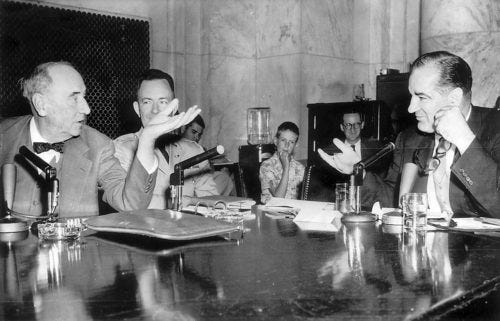
ON JUNE 9, 1954, I SAT AT MY FATHER’S SIDE ON OUR LIVING ROOM COUCH, watching the Army-McCarthy hearings. McCarthy had accused the U.S. Army of having poor security at a top-secret facility.
Joseph Welch, a private attorney, was representing the Army. McCarthy charged that one of Welch’s young staff attorneys was a communist. Such a charge was likely to end the young man’s career.
“Son-of-a-BITCH,” my father shouted. I hid my head.
As McCarthy continued his attack on Welch’s staff attorney, Welch broke in. “Until this moment, Senator, I think I never really gauged your cruelty or your recklessness.”
I was only eight years old, but I was spellbound.
McCarthy didn’t stop. “Son-of-a-BITCH!” Ed Reich shouted even more loudly. The earth seemed to shake.
At this point, Welch demanded that McCarthy listen to him. “Let us not assassinate this lad further, Senator,” he said. “You have done enough. Have you no sense of decency?”
Almost overnight, McCarthy imploded. His national popularity evaporated. Three years later, censured by his Senate colleagues, ostracized by his party, and ignored by the press, McCarthy drank himself to death, a broken man at the age of 48.
During the Army-McCarthy hearings, McCarthy’s chief counsel was Roy Cohn. Cohn became one of America’s most notorious bullies.
Cohn had gained prominence as the Department of Justice attorney who successfully prosecuted Julius and Ethel Rosenberg for espionage, leading to their execution in 1953. (Evidence made public decades after the execution confirmed that Julius was a spy, but that Ethel, while aware of her husband’s activities, was not.)
In public, Cohn was homophobic. Privately, he was gay at a time when being gay was a crime. A character in Tony Kushner’s epic Angels in America describes him as “the polestar of human evil. The worst human being who ever lived … the most evil, twisted, vicious bastard ever to snort coke at Studio 54.” His bullying was particularly vicious, I think, because he was filled with self-loathing.
The Rosenberg trial brought the 24-year-old Cohn to the attention of J. Edgar Hoover, who convinced Joe McCarthy to hire Cohn as chief counsel for McCarthy’s Senate Permanent Subcommittee on Investigations. Cohn became known for his aggressive questioning of suspected communists.
My father thought Roy Cohn almost as despicable as Joe McCarthy. “Son-of-a BITCH!” my father shouted whenever Cohn’s name was in the news.
After McCarthy’s downfall, it was assumed that Cohn’s career was also over. Yet Cohn reinvented himself as a power broker in New York. Despite scandals and indictments, along with accusations of tax evasion, bribery, and theft, Cohn survived.
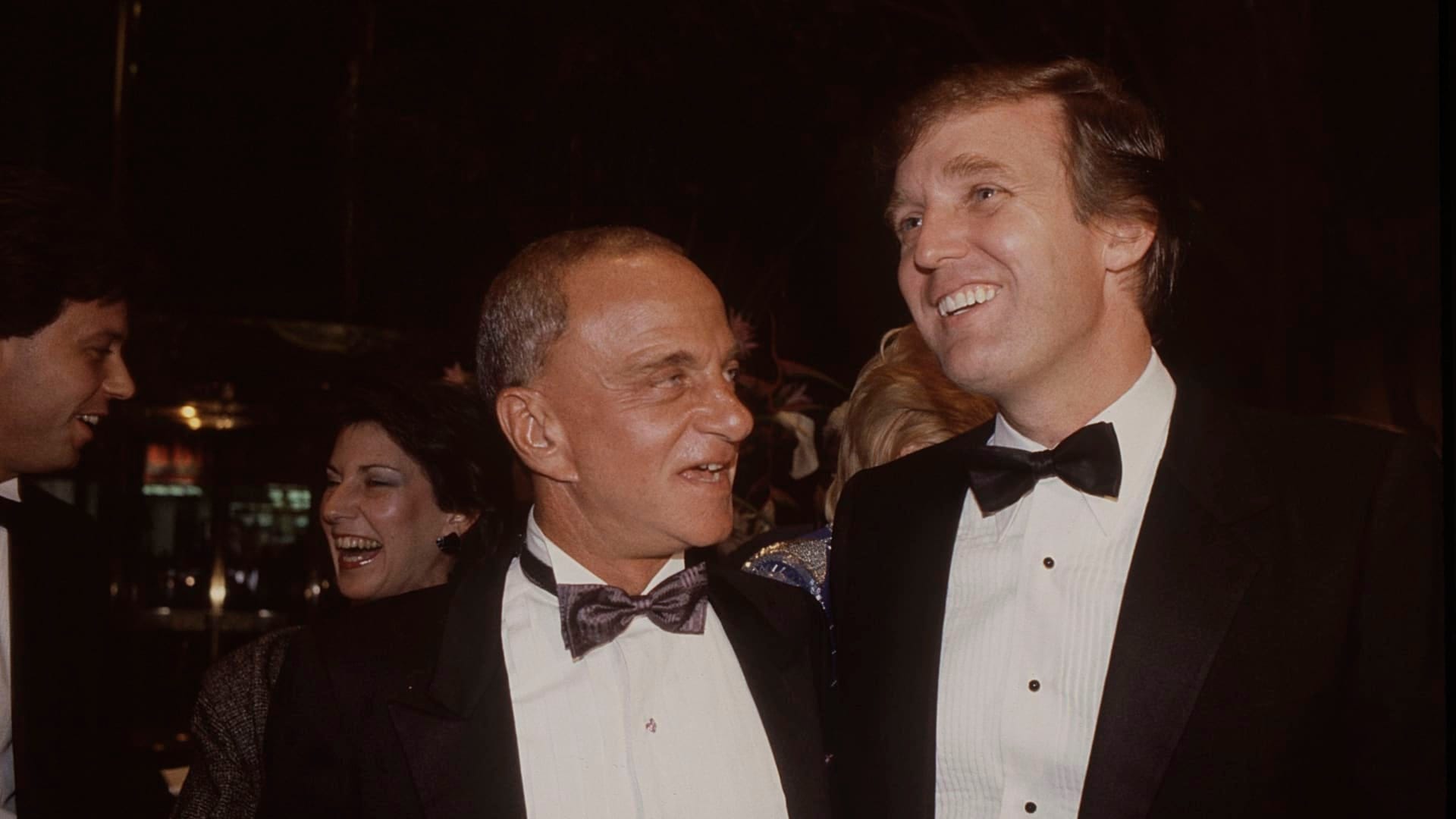
COHN PROVED HIMSELF USEFUL TO A YOUNG REAL ESTATE DEVELOPER NAMED DONALD TRUMP. Fred Trump had started his son’s career by bringing him into the family business of renting apartments in Brooklyn and Queens.
Cohn established Donald in Manhattan by introducing him to New York’s social and political elite. Donald was undertaking several large construction projects in Manhattan and needed both a fixer and mentor. Cohn filled both roles, and along the way bequeathed to Trump a penchant for ruthless bullying, profane braggadocio, and opportunistic bigotry.
Like Trump, Cohn was utterly without principle. Like Trump, his priority was personal power that could be leveraged for wealth, influence, and celebrity.
In 1973, the Justice Department accused Trump Management Inc., its 27-year-old president, Donald, and chairman, Fred, of violating the Fair Housing Act of 1968 in 39 of his properties — alleging that the company quoted different rental terms and conditions to prospective tenants based on their race and made false “no vacancy” statements to Black people seeking to rent.
Trump employees had secretly marked the applications of Black people with codes, such as “C” for “colored,” according to accounts filed in federal court. The employees allegedly directed Black people away from buildings with mostly white tenants, steering them toward properties that had many Black tenants.
Representing the Trumps, Roy Cohn filed a countersuit against the government for $100 million, asserting that the charges were “irresponsible and baseless.” Although the countersuit was unsuccessful, Trump settled the charges out of court in 1975, asserting he was satisfied that the agreement did not “compel the Trump organization to accept persons on welfare as tenants unless as qualified as any other tenant.”
Three years later, when the Trump Organization was again in court for violating terms of the 1975 settlement, Cohn called the charges “nothing more than a rehash of complaints by a couple of planted malcontents.” Donald Trump denied the charges.
Cohn was also involved in the construction of Trump Tower, helping secure concrete during a citywide Teamster strike via a union leader linked to a mob boss.
At about this time, Cohn introduced Trump to another of Cohn’s clients, Rupert Murdoch.
During Ronald Reagan’s 1980 presidential campaign, Cohn helped another young man named Roger Stone.
As Stone later recounted, Cohn gave him a suitcase filled with money that Stone dropped off at the office of a lawyer influential in Liberal Party circles. “I paid his law firm. Legal fees. I don’t know what he did for the money.” In fact, the money was used to get New York’s Liberal Party to nominate Illinois Congressman John Anderson — thereby splitting New York’s opposition to Reagan. It worked. Reagan carried the state with 46 percent of the vote. (Ed Reich voted for Jimmy Carter.)
In 1986, Cohn was disbarred by the New York State Bar for unethical conduct after attempting to defraud a dying client by forcing the client to sign a will amendment leaving Cohn his fortune. (Cohn died five weeks later from AIDS-related complications.)
In his first and best-known book, The Art of the Deal, Trump drew a distinction between integrity and loyalty. He preferred the latter.
For Trump, Roy Cohn exemplified loyalty. Trump compared Cohn to “all the hundreds of ‘respectable’ guys who make careers out of boasting about their uncompromising integrity but have absolutely no loyalty … What I liked most about Roy Cohn was that he would do just the opposite.”
Speaker Kevin McCarthy plans to get an impeachment of Joe Biden underway in the House by the end of September.
But McCarthy faces two problems. First, there are no grounds for impeachment — no evidence, for example, that Biden got money or agreed to do anything so his son, Hunter, could get money. Or any other grounds.
Second, McCarthy doesn’t have the votes of moderate Republicans, whose constituents don’t want the House to waste time and money impeaching Biden.
So what’s McCarthy going to do? Open the inquiry anyway, without a formal vote.
McCarthy wants to start an impeachment of Biden because Trump is pressuring him to. As Trump posted Sunday:
“The Republicans in Congress, though well meaning, keep talking about an Impeachment ‘Inquiry’ on Crooked Joe Biden. Biden is a Stone Cold Crook-You don’t need a long INQUIRY to prove it, it’s already proven… Either IMPEACH the BUM, or fade into OBLIVION.”
Why is Trump so eager to get a Biden impeachment underway? Not to retaliate against the Democrats for impeaching him. It’s mainly to have Biden impeachment stories run at the same time as Trump trial stories. That way, Trump and his Republican enablers can deflect attention from the trials and confuse the public with arguments that Biden is even more guilty of something.
It’s part of a broader Republican strategy to defend Trump during his coming trials not by claiming he’s innocent but by launching investigations to tarnish Biden — similar to the strategy Republicans used investigating Hillary Clinton’s emails in 2016 and tried to use when Trump pressured Ukrainian President Volodymyr Zelensky to announce an investigation into Hunter Biden in 2019.
Deflection, confusion, and baseless lies repeated on social media, then magnified by Fox News and expanded on by Newsmax and other extremist outlets. Sound familiar?
I doubt Americans will fall for it.
On Tuesday, the Biden administration announced the first 10 drugs whose prices will be negotiated downward under Biden’s Inflation Reduction Act, which gave Medicare such power. This is a big deal. Last year, Medicare enrollees paid $3.4 billion in out-of-pocket expenses for these drugs. The savings will be considerable.
So while Biden delivers practical solutions to the problems facing Americans, such as high drug costs, Republicans engage in partisan stunts like impeaching Biden. Even though Democrats are terrible at messaging, the contrast should be obvious to everyone.
On March 4, 1858, South Carolina senator James Henry Hammond rose to his feet to explain to the Senate how society worked. “In all social systems,” he said, “there must be a class to do the menial duties, to perform the drudgery of life.” That class, he said, needed little intellect and little skill, but it should be strong, docile, and loyal.
“Such a class you must have, or you would not have that other class which leads progress, civilization and refinement,” Hammond said. His workers were the “mud-sill” on which society rested, the same way that a stately house rested on wooden sills driven into the mud.
He told his northern colleagues that the South had perfected this system by enslavement based on race, while northerners pretended that they had abolished slavery. “Aye, the name, but not the thing,” he said. “[Y]our whole hireling class of manual laborers and ‘operatives,’ as you call them, are essentially slaves.”
While southern leaders had made sure to keep their enslaved people from political power, Hammond said, he warned that northerners had made the terrible mistake of giving their “slaves” the vote. As the majority, they could, if they only realized it, control society. Then “where would you be?” he asked. “Your society would be reconstructed, your government overthrown, your property divided, not…with arms…but by the quiet process of the ballot-box.”
He warned that it was only a matter of time before workers took over northern cities and began slaughtering men of property.
Hammond’s vision was of a world divided between the haves and the have-nots, where men of means commandeered the production of workers and justified that theft with the argument that such a concentration of wealth would allow superior men to move society forward. It was a vision that spoke for the South’s wealthy planter class—enslavers who held more than 50 of their Black neighbors in bondage and made up about 1% of the population—but such a vision didn’t even speak for the majority of white southerners, most of whom were much poorer than such a vision suggested.
And it certainly didn’t speak for northerners, to whom Hammond’s vision of a society divided between dim drudges and the rich and powerful was both troubling and deeply insulting.
On September 30, 1859, at the Wisconsin State Agricultural Fair, rising politician Abraham Lincoln answered Hammond’s vision of a society dominated by a few wealthy men. While the South Carolina enslaver argued that labor depended on capital to spur men to work, either by hiring them or enslaving them, Lincoln said there was an entirely different way to see the world.
Representing an economy in which most people worked directly on the land or water to pull wheat into wagons and fish into barrels, Lincoln believed that “[l]abor is prior to, and independent of, capital; that, in fact, capital is the fruit of labor, and could never have existed if labor had not first existed—that labor can exist without capital, but that capital could never have existed without labor. Hence they hold that labor is the superior—greatly the superior of capital.”
A man who had, himself, worked his way up from poverty to prominence (while Hammond had married into money), Lincoln went on: “[T]he opponents of the ‘mud-sill’ theory insist that there is not…any such things as the free hired laborer being fixed to that condition for life.”
And then Lincoln articulated what would become the ideology of the fledgling Republican Party:
“The prudent, penniless beginner in the world, labors for wages awhile, saves a surplus with which to buy tools or land, for himself; then labors on his own account for another while, and at length hires another new beginner to help him. This, say its advocates, is free labor—the just and generous, and prosperous system, which opens the way for all—gives hope to all, and energy and progress, and improvement of condition to all.”
In such a worldview, everyone shared a harmony of interest. What was good for the individual worker was, ultimately, good for everyone. There was no conflict between labor and capital; capital was simply “pre-exerted labor.” Except for a few unproductive financiers and those who wasted their wealth on luxuries, everyone was part of the same harmonious system.
The protection of property was crucial to this system, but so was opposition to great accumulations of wealth. Levelers who wanted to confiscate property would upset this harmony, as Hammond warned, but so would rich men who sought to monopolize land, money, or the means of production. If a few people took over most of a country’s money or resources, rising laborers would be forced to work for them forever or, at best, would have to pay exorbitant prices for the land or equipment they needed to become independent.
A lot of water has gone under the bridge since Lincoln’s day, but on this Labor Day weekend, it strikes me that the worldviews of men like Hammond and Lincoln are still fundamental to our society: Should our government protect people of property as they exploit the majority so they can accumulate wealth and move society forward as they wish? Or should we protect the right of ordinary Americans to build their own lives, making sure that no one can monopolize the country’s money and resources, with the expectation that their efforts will build society from the ground up?
On August 6, 1880, Republican presidential candidate James A. Garfield gave one of his most famous speeches. Then a congressional representative from Ohio, Garfield was in New York City to make peace with Roscoe Conkling, a Republican kingmaker who hated him and his insistence on clean government.
In the evening, Garfield spoke to a crowd of well-wishers, made up in large part of men who had fought in the Civil War, as Garfield had. The one-time college professor spoke directly to the “Boys in Blue,” telling them “how great a thing it is to live in this Union and be a part of it.” He told them that they, the soldiers of the Civil War, represented the same ideas of union embraced by the men who framed the Constitution.
“Gentlemen,” said Garfield to great applause, “ideas outlive men; ideas outlive all earthly things. You who fought in the war for the Union fought for immortal ideas, and by their might you crowned the war with victory. But victory was worth nothing except for the truths that were under it, in it, and above it. We meet to-night as comrades to stand guard around the sacred truths for which we fought. And while we have life to meet and grasp the hand of a comrade, we will stand by the great truths of the war.”
In 1880, four years after unreconstructed southern Democrats had taken control of all the former Confederate states and cemented the process of taking the vote away from Black men, Garfield promised that “we will remember our allies who fought with us.” He explained: “Soon after the great struggle began, we looked behind the army of white rebels, and saw 4,000,000 of black people condemned to toil as slaves for our enemies; and we found that the hearts of these 4,000,000 were God-inspired with the spirit of liberty, and that they were all our friends.”
As the crowd applauded, he continued: “We have seen white men betray the flag and fight to kill the Union; but in all that long, dreary war we never saw a traitor in a black skin.” To great cheers, he went on: “Our comrades escaping from the starvation of prison, fleeing to our lines by the light of the North star, never feared to enter the black man’s cabin and ask for bread.” “That’s so!” yelled a man in the crowd. “In all that period of suffering and danger, no Union soldier was ever betrayed by a black man or woman.”
“[S]o long as we live we will stand by these black allies,” Garfield said. “We will stand by them until the sun of liberty, fixed in the firmament of our Constitution, shall shine with equal ray upon every man, black or white, throughout the Union. Fellow-citizens, fellow-soldiers, in this there is the beneficence of eternal justice, and by it we will stand forever….” To wild cheers, Garfield concluded: “[T]he Republic rises on the glorious achievements of its dead and living heroes to a higher and nobler national life. We must stand guard over our past as soldiers, and over our country as the common heritage of all.”
In an era in which the smart money said the Democrats, with their promise to overturn the Reconstruction laws that established a legal framework for racial equality, would win the 1880 election, Garfield squeaked into the White House.
But he did not live long enough to put his vision into law. After his death, the Republican Party slid away from the protection of equal rights, focusing instead on protecting big business, its leaders looking the other way as state laws increasingly kept Black Americans and immigrants from voting so long as that same focus on state power prevented national regulation of business.
But those who believed in civil rights never gave up. In 1909 the National Association for the Advancement of Colored People (NAACP) organized “to promote equality of rights and eradicate caste or race prejudice among citizens of the United States,” and worked to secure “complete equality before the law,” including voting rights.
NAACP members publicized racial atrocities and insisted that authorities enforce the laws already on the books. By the 1960s, those protecting Black rights ramped up their efforts to register voters and to organize communities to support political change. When voter registration workers disappeared during the “Freedom Summer” of 1964, popular anger at their disappearance gave Democratic president Lyndon Baines Johnson leverage to pressure Congress to act. It passed the Civil Rights Act of 1964, in part to make it easier to vote.
After voters put Johnson back into the White House in November 1964, voting rights activists stepped up their efforts. In Selma, Alabama, where the voting rolls were 99% white even though Black Americans outnumbered white Americans, law enforcement officers harassed activists. After officers beat and shot an unarmed man marching for voting rights in a town near Selma, Black leaders planned a march from Selma to the state capitol at Montgomery to draw attention to voter suppression.
Law enforcement officers met the protesters on March 7, 1965, with billy clubs, bullwhips, and tear gas. On March 15, Johnson addressed a national televised joint session of Congress to ask it to pass a national voting rights act. “Our fathers believed that if [their] noble view of the rights of man was to flourish, it must be rooted in democracy,” he said. “The most basic right of all was the right to choose your own leaders. The history of this country, in large measure, is the history of the expansion of that right to all of our people.”
He submitted to Congress voting rights legislation, and Congress delivered.
On August 6, 1965, Johnson signed the Voting Rights Act to guarantee Black Americans the right to vote.
“Today is a triumph for freedom as huge as any victory that has ever been won on any battlefield,” Johnson told the American people in a televised joint session of Congress. The Civil War had promised equality to all Americans, but that promise had not been fulfilled. “Today is a towering and certain mark that, in this generation, that promise will be kept.”
“I pledge you that we will not delay, or we will not hesitate, or we will not turn aside until Americans of every race and color and origin in this country have the same right as all others to share in the process of democracy,” Johnson said.
That resolve did not hold. In the 2013 Shelby County v. Holder decision, the Supreme Court significantly weakened the Voting Rights Act. Republican-dominated states immediately found ways to keep minority voters from the polls and their votes from being counted, and in 2020, then-president Trump tried to throw out the votes of people in majority Black districts in order to overturn the results of that year’s presidential election. On July 10, 2023, House Republicans introduced a sweeping “election integrity” bill that would loosen campaign finance regulations and make it harder to vote.
Eight days later, on July 18, Democrats in the House and Senate reintroduced the Freedom to Vote Act, which would make it easier for all Americans to vote, end partisan gerrymandering, require transparency in campaign donations to try to limit dark money in elections, and protect state and local election officials. “The story of American democracy is one of a relentless march towards further equality,” said Senate majority leader Chuck Schumer (D-NY). “The Freedom To Vote Act would rectify one of the great historic harms of our past and put us closer to our goal of a fully representative democracy.”
And then, on August 1—last Tuesday—the Department of Justice charged Trump under laws Congress passed during Reconstruction to protect the Black Americans’ political rights. Trump is charged with conspiring to obstruct an official proceeding—violating a law passed to stop Ku Klux Klan terrorists from breaking up official meetings in the late 1860s—and obstructing that proceeding: the counting of electoral votes.
Trump is also charged with conspiring “to injure, oppress, threaten, and intimidate one or more persons in the free exercise and enjoyment of a right and privilege secured to them by the Constitution and laws of the United States—that is, the right to vote, and to have one’s vote counted.”
Comments Off on Why does white Christian nationalism now define the Republican Party?
The Supreme Court, red states, and Trump
ROBERT REICH
JUL 13
Friends,
On June 30, the six Republican appointees to the Supreme Court ruled that a graphic artist who designs wedding websites can refuse to design a website for same-sex weddings, despite a Colorado law that bars discrimination based on sexual orientation, race, gender, and other characteristics. They said that forcing her to create the website would violate her free speech rights under the First Amendment.
But where and how to draw the line between protected expression and illegal discrimination? What about wedding planners, photographers, florists, caterers, decorators, musicians, or dressmakers who consider their work to be artistic expressions and also believe that forcing them to offer their services to gay couples violates their free speech rights?
The point is, there is no clear line. Instead, the Supreme Court’s Republican majority is prioritizing religious beliefs over all other values.
Over the past three years, the court has sided with a public school football coach who insisted on praying at midfield after games, on some accounts causing students to feel pressure to participate. A religious foster-care agency that refused to certify same-sex couples as foster parents. Religious schools in Maine that sought public subsidies. A religious group that wished to fly a Christian flag over Boston’s City Hall. Religious organizations that challenged early Covid restrictions on gathering in large groups. And, of course, those who oppose abortions, largely because of their religion, which they prioritize over the rights of women to control their bodies.
Unlike the court’s older important religious freedom rulings that protected members of minority religions from discrimination, the recent cases have protected practitioners of mainstream Christianity.
It is not just the court. All over America, the wall separating church and state is getting hit with a Republican battering ram.
A few weeks ago, Oklahoma Republicans approved the nation’s first religious charter school — St. Isidore — offering Catholic religious instruction and financed by taxpayers. They claimed that excluding religious schools from charter funding would violate the First Amendment’s protection of religious freedom.
Texas lawmakers have pushed bills requiring the Ten Commandments be posted in every classroom in the state, allowing chaplains to replace counselors in schools, and letting school districts set time for staff and students to pray and read religious texts.
Montana’s House recently passed a requirement that schools accept “without question” a “conscience exemption” for immunizations for school attendance — thereby doing away with required vaccinations for measles, rubella, mumps, diphtheria, whooping cough, tetanus, and influenza type B.
Idaho and Kentucky have signed into law measures allowing teachers and public school employees to pray in front of and with students while on duty.
Republican state lawmakers are falling over themselves to pass book bans, abortion prohibitions, and anti-trans laws — and justify them with scripture.
“Put on the full armor of God. Stand firm against the left’s schemes,” Florida governor and Republican presidential candidate Ron DeSantis proclaimed at the Christian Hillsdale College (substituting “left’s schemes” for the “devil’s schemes” of Ephesians 6:11).
And it’s not just any religion. It’s Christianity. As former Trump national security adviser Michael Flynn (whom Trump has promised to bring back for a second Trump term) put it at a recent ReAwaken America event, “If we are going to have one nation under God, which we must, we have to have one religion.”
The paradox is that religious observance has shown a steep decline over the past quarter century. In 1999, Gallup found that 70 percent of Americans belonged to a church, a synagogue, or a mosque. In 2020, the number was 47 percent. For the first time in nearly a century of polling, worshippers were the minority in America.
Does this precipitous decline help explain the militance of white Christian nationalism? A fierce minority religious movement has taken over the Republican Party — giving the GOP fervor and purpose that are now being championed by Republican appointees to the Supreme Court, Republican state legislators, and Ron DeSantis and Donald Trump.
Army Chief of Staff General James McConville, the 40th person to hold that position, retired today. Because Senator Tommy Tuberville (R-AL) has put a hold on military promotions for the past 8 months, there is no Senate-confirmed leader to take McConville’s place. There are eight seats on the Joint Chiefs of Staff, the group of the most senior military officers who advise the president, homeland security officials, the secretary of defense, and the National Security Council. Currently, two of those seats are filled by acting officials who have not been confirmed by the Senate.
Politico’s defense reporter Paul McLeary wrote that as of today, there are 301 senior military positions filled by temporary replacements as Tuberville refuses to permit nominations to go through the Senate by the usual process. Two more members of the Joint Chiefs of Staff will retire before the end of September.
Politico’s Pentagon reporter Lara Seligman illustrated what this personnel crisis means for national security: “U.S. forces are on high alert in the Persian Gulf,” she wrote today. “As Tehran attempts to seize merchant ships in the Strait of Hormuz, the U.S. is sending warships, fighter jets and even considering stationing armed troops aboard civilian vessels to protect mariners. Yet two of the top senior officers overseeing the escalating situation aren’t where they’re supposed to be.”
Two days ago, Defense Secretary Lloyd Austin wrote in a memo that the “unprecedented, across-the-board hold is having a cascading effect, increasingly hindering the normal operations of this Department and undermining both our military readiness and our national security.” Today he reiterated: “The failure to confirm our superbly qualified senior uniformed leaders undermines our military readiness.” He added, “It undermines our retention of some of our very best officers. And it is upending the lives of far too many of their spouses, children and loved ones.”
Tuberville, who did not serve in the military, likes to say “there is no one more military than me.” And yet, thanks to him and the Republican conference that is permitting him to hold the nominations, we are down two chiefs of staff tonight.
Meanwhile, on July 26, when soldiers took charge in Niger, a country central to the fight against Islamic terrorists and the security of democracy on the African continent, the U.S. had no ambassador there. Senator Rand Paul (R-KY) was blocking the confirmation of more than 60 State Department officials the same way that Tuberville was blocking the confirmation of military officials.
Paul claimed he was blocking State Department confirmations because he wanted access to information about the origins of COVID, but Secretary of State Antony Blinken said the department had “been working extensively” with Paul, providing the documents and other information he had requested. “But unfortunately, he continues to block all our nominees.” Paul complained that he had been only given private access, and wanted to “take those documents out.”
As of July 17, the current Senate had confirmed only five State Department nominees. On that day, Blinken wrote to each senator to express “serious concern” about the delays. He told reporters that he respects and values the Senate’s “critical oversight role…[b]ut that’s not what is happening here. No one has questioned the qualifications of these career diplomats. They are being blocked for leverage on other unrelated issues. It’s irresponsible. And it’s doing harm to our national security.”
Ambassadors “advance the interests of our country,” he said, and not having confirmed ambassadors “makes us less effective at advancing every one of our policy priorities—from getting more countries to serve as temporary hubs for [immigrant visa] processing, to bringing on more partners for global coalitions like the one we just announced to combat fentanyl, to support competitive bids for U.S. companies to build…critical infrastructure projects around the world.”
Our adversaries benefit from these absences, not only because they offer an opening to exploit, but also because “[t]he refusal of the Senate to approve these career public servants also undermines the credibility of our democracy. People abroad see it as a sign of dysfunction, ineffectiveness—inability to put national interests over political ones.”
Blinken noted that “[i]n previous administrations, the overwhelming majority of career nominees received swift support to advance through the Senate by unanimous consent. Today, for reasons that have nothing to do with the nominees’ qualifications or abilities, they are being forced to proceed through individual floor votes.” More than a third of the nominees had been waiting for more than a year for their confirmation.
Late on July 27, the day after the conflict began in Niger and the day before the senators left for their summer recess, Paul lifted his hold, tweeting that the State Department and the United States Agency for International Development (USAID), an independent agency that administers foreign aid, had agreed to release the documents he wanted. The Senate then confirmed career diplomat Kathleen A. FitzGibbon as ambassador to Niger, as well as ambassadors to other countries including Rwanda, the United Arab Emirates, Georgia, Guyana, Ethiopia, Jordan, Uganda, and Italy.
But FitzGibbon did not arrive in Niger before the U.S. government on Wednesday ordered “non-emergency U.S. government personnel” and their families to leave the country out of concerns for their safety.
The attack on our nation by individual Republicans seems to be a theme these days. After yesterday’s arraignment on charges that he conspired to defraud the United States, conspired and attempted to obstruct an official proceeding, and conspired to overturn Americans’ constitutionally protected right to vote, Donald Trump today flouted the judge’s warning not to try to influence jurors. He posted on social media: “IF YOU GO AFTER ME, I’M COMING AFTER YOU!”
Prosecutors from the office of Special Counsel Jack Smith tonight alerted the court to Trump’s threat when they asked the court for a protective order to stop him from publishing information about the materials they are about to deliver to his lawyers. They expressed concern that publishing personal information “could have a harmful chilling effect on witnesses” or taint the jury pool by telling potential jurors too much before the trial.
As I try to cover the news tonight, I am struck by how completely the Republican Party, which began in the 1850s as a noble endeavor to keep the United States government intact and to rebuild it to work for ordinary people, has devolved into a group of chaos agents feeding voters a fantasy world.
The big news today was the hearing in Washington, D.C., where Department of Justice prosecutors argued for a protective order to stop former president Trump from intimidating witnesses and tainting the jury pool in the case against him for trying to stop the counting of electoral votes that would decide the 2020 presidential election.
Trump appears to have given up on winning the cases against him on the legal merits and is instead trying to win by whipping up a political base to reelect him, or even to fight for him. He has filled his Truth Social account with unhinged rants attacking the justice system and the president, and on Sunday his lawyer, John Lauro, echoed Trump as he made a tour of the Sunday talk shows, misleadingly suggesting that Trump had been indicted for free speech. In fact, the indictment says up front that even Trump’s lies are protected by the First Amendment, but what isn’t protected is a conspiracy that stops an official proceeding and deprives the rest of us of our right to vote and to have our votes counted.
A grand jury indicted Trump on August 1; when he was arraigned on August 3, the magistrate judge warned him that it is a crime to “influence a juror or try to threaten or bribe a witness or retaliate against anyone” connected to the case. Trump said he understood.
The next day, he posted on Truth Social: “IF YOU GO AFTER ME, I’M COMING AFTER YOU!”
Justice Department lawyers promptly sought a protective order to limit what information Trump and his lawyers can release. Trump has a longstanding pattern of releasing misleading information to bolster his position among his base, and lawyers are concerned that he will continue to intimidate witnesses and try to taint the jury pool in hopes of getting the trial venue moved.
Days later, Trump told an audience in New Hampshire that he would not stop talking about the case, and called Special Counsel Jack Smith a “thug” and “deranged.” He has continued to post such messages on social media.
U.S. District Judge Tanya Chutkan reinforced that Trump’s focus on politics had no relevance in her court of law. Justice reporter for NBC News Ryan Reilly noted: “The word of the Trump hearing today: yield. Came up six times, as in: ‘the fact that he’s running a political campaign currently has to yield to the orderly administration of justice.’”
Chutkan agreed to the protective order but agreed with Trump’s team that it would not include any material already in the public domain. She also prohibited Trump from reviewing materials with “any device capable of photocopying, recording, or otherwise replicating the Sensitive Materials, including a smart cellular device.”
Finally, she warned Trump’s lawyers: “I caution you and your client to take special care in your public statements in this case…. I will take whatever measures are necessary to protect the integrity of these proceedings.” If Trump repeats “inflammatory” statements, she said, she will have to speed up his trial to protect witnesses and keep the jury pool untainted.
Just what that might mean was illustrated today when a judge revoked the bail of former FTX cryptocurrency chief executive officer Sam Bankman-Fried for witness tampering and sent him to jail. Prosecutors say Bankman-Fried was leaking the private diary entries of his former girlfriend to the New York Times to discredit her testimony against him.
In Ohio, where voters on Tuesday overwhelmingly rejected the attempt of the Republicans in the legislature to stop a November vote on an amendment to the state constitution protecting abortion rights, Republicans tried to stop the inclusion of that amendment by challenging its form. Today the Ohio Supreme Court unanimously rejected that lawsuit. The proposed amendment will be on the ballot in November.
After demanding that David Weiss, the U.S. attorney in charge of investigating and charging Hunter Biden, be named a special counsel and then charging that Weiss had asked for and been denied that status—both he and Attorney General Merrick Garland denied that allegation—Republicans are now angry that Garland today gave Weiss that status.
Weiss requested that status for the first time earlier this week, and Garland granted it, although both Weiss and Garland had previously said Weiss had all the authority that status carries. Now House Republicans say appointing Weiss a special counsel is an attempt to obstruct Congress from investigating the Bidens. For all that Republicans are in front of the cameras every day insisting President Biden is corrupt, there is no evidence that President Biden has been party to any wrongdoing.
One of the things such behavior accomplishes is to distract from the party’s own troubles, including the inability of House Republicans to agree to measures to fund the government after September. Far-right extremists are still angry at the spending levels to which House speaker Kevin McCarthy (R-CA) agreed in a deal to raise the debt ceiling last June, and are threatening to refuse to agree to any funding measures until they get cuts that the Senate will never accept.
The House left for its August break after passing only one of the twelve bills it needs to pass, and when it gets back, it will have only twelve work days before the September 30 deadline. This chaos takes a toll: when the Fitch rating system downgraded the U.S. long-term rating last week, the first reason it cited was “a steady deterioration in standards of governance.” It explained: “The repeated debt-limit political standoffs and last-minute resolutions have eroded confidence in fiscal management.”
Another thing this chaos does is convince individuals that the entire government is corrupt. On Wednesday, as Biden was to visit Utah, FBI agents shot and killed an armed man there who made threats against him, Vice President Kamala Harris, and other officials who have been associated with Trump’s legal troubles: Attorney General Garland, Manhattan district attorney Alvin Bragg, and New York attorney general Letitia James. Craig Deleeuw Robertson described himself as a “MAGA Trumper.”
It seems we are reaping the fruits of the political system planted in 1968, when the staff of Republican presidential candidate Richard Nixon reworked American politics to package their leader for the election. “Voters are basically lazy,” one of Nixon’s media advisors wrote. “Reason requires a high degree of discipline, of concentration; impression is easier. Reason pushes the viewer back, it assaults him, it demands that he agree or disagree; impression can envelop him, invite him in, without making an intellectual demand…. When we argue with him, we…seek to engage his intellect…. The emotions are more easily roused, closer to the surface, more malleable.”
The confusion also takes up so much oxygen it’s hard for the Democrats, who are actually trying to govern in the usual ways, to get any attention. Today was the one-year anniversary of the PACT Act, officially known as the Sergeant First Class Heath Robinson Honoring our Promise to Address Comprehensive Toxics Act of 2022. The law improves access to healthcare and funding for veterans who were exposed to burn pits, the military’s waste disposal method for everything from tires to chemicals and jet fuel from the 1990s into the new century.
According to Senator Dick Durbin (D-IL), the PACT Act has already enabled more than 4 million veterans to be screened for toxic exposure, more than 744,000 PACT Act claims have been filed, and hundreds of thousands of veterans have been approved for expanded benefits.
Biden spoke in Utah about the government’s protections for veterans and why they’re important. In addition to the PACT Act, he talked about his recent executive order moving the authority for addressing claims of sexual assault, domestic violence, child abuse, and murder outside the chain of command to a specialized independent military unit—a move long championed by survivors and members of Congress.
Today the White House released a detailed explanation of “Bidenomics” along with resources explaining why the administration has focused on certain areas for public investment and how the Bipartisan Infrastructure Law, the CHIPS and Science Act, and the Inflation Reduction Act have supported that investment. That collection explains why the administration is overturning forty years of political economy to return to the system on which the U.S. relied from 1933 to 1981, and yet it got far less traction than the fight over the protective order designed to keep Trump from attacking witnesses.





 Michael1942's Blog
You must be logged in to post a comment.