Skip navigation

Category Archives: Trumpedation


Toluse Olorunnipa, Ashley Parker, Josh Dawsey
President Trump has instructed his White House to identify and force out officials across his administration who are not seen as sufficiently loyal, a post-impeachment escalation that administration officials say reflects a new phase of a campaign of retribution and restructuring ahead of the November election.

a man wearing a suit and tie: White House aide Johnny McEntee, left, follows President Trump to board the Marine One helicopter on the South Lawn of the White House June 7, 2017.© Jabin Botsford/The Washington Post White House aide Johnny McEntee, left, follows President Trump to board the Marine One helicopter on the South Lawn of the White House June 7, 2017.Johnny McEntee, Trump’s former personal aide who now leads the effort as director of presidential personnel, has begun combing through various agencies with a mandate from the president to oust or sideline political appointees who have not proved their loyalty, according to several administration officials and others familiar with the matter who spoke on the condition of anonymity to discuss internal deliberations.

The push comes in the aftermath of an impeachment process in which several members of Trump’s administration provided damning testimony about his behavior with regard to Ukraine. The stream of officials publicly criticizing Trump’s actions frustrated the president and caused him to fixate on cleaning house after his acquittal this month.

“We want bad people out of our government!” Trump tweeted Feb. 13, kicking off a tumultuous stretch of firings, resignations, controversial appointments and private skirmishes that have since spilled into public view.

The National Security Council, the State Department and the Justice Department are targets of particular focus, according to two administration officials, and there have recently been multiple resignations and reassignments at each of those agencies.

John C. Rood, the official in charge of Defense Department policy who had certified that Ukraine had met anti-corruption obligations, was let go this week. Victoria Coates, the deputy national security adviser who was viewed with suspicion by some White House aides, was removed from her post and was moved to an advisory position in the Energy Department.

McEntee spent part of this week asking officials in various Cabinet agencies to provide names of political appointees working in government who are not fully supportive of Trump’s presidency, according to administration officials.

The president instructed McEntee to find people in the administration who aren’t aligned with Trump and “get rid” of them, according to someone familiar with the president’s directive. Trump did not provide additional specificity on what exactly he wanted beyond a workforce that more fully reflects his instincts, the person said, and it is unclear what criteria are being used to determine an official’s fealty to the president. McEntee’s discussions with Cabinet agencies were first reported by Axios.

The 29-year-old former campaign aide is planning to prepare a presentation for Trump about what he has found. While Sean Doocey, the former director of presidential personnel, reported to acting White House chief of staff Mick Mulvaney’s deputy, McEntee reports directly to the president, according to a senior administration official.

What began as a campaign of retribution against officials who participated in the impeachment process has evolved into a full-scale effort to create an administration more fully in sync with Trump’s id and agenda, according to several officials familiar with the plan. It is unclear whether civil servants will be targeted as well, but it would be harder to dislodge them than removing political appointees. Civil servants, however, could be sidelined in other ways.

As he became the third president in American history to be impeached, Trump seethed against his own appointees who defied White House lawyers to comply with congressional subpoenas and testify about his conduct. The process clarified for Trump and his top advisers that they had not focused enough on personnel in the early part of the presidency, creating a loyalty deficiency the president is moving quickly to correct, officials said.

The burgeoning effort was reflected in Trump’s decision this week to appoint Richard Grenell as the next acting director of national intelligence, placing a fiercely loyal but inexperienced ally atop an intelligence structure against which the president has frequently railed.

Mulvaney used a speech this week at the Oxford Union in Britain to inveigh against the “deep state,” and he lamented that the administration could not fire more agency employees who do not implement the president’s orders. He referred to some of testimony of the witnesses who participated in Trump’s impeachment inquiry.

Bureaucrats who want to make policy instead of implementing it “should put their name on the effing ballot and run” for office, he said during remarks to a group of several hundred people, according to audio of a speech obtained by The Washington Post.

Trump’s family members have been among the main champions of the effort to force out officials who have not proved their devotion to Trump.

Jared Kushner, the president’s son-in-law and a senior adviser in the White House, has played a central in the push, concentrating more power in the West Wing and working to combat leaks, officials said.

Trump’s son Donald Trump Jr. wrote on Twitter that the impeachment investigation was helpful in “unearthing who all needed to be fired.”

Cliff Sims, a former White House adviser who wrote a book titled “Team of Vipers,” about his time in the White House, has said Trump’s presidency has been repeatedly undermined by disloyal underlings.

“Loyalist shouldn’t be a dirty word,” he said. “Loyalty to the duly elected president and his agenda is exactly what we should expect from our unelected appointees.”

Brendan Buck, a longtime adviser to former House speaker Paul D. Ryan (R-Wis.), said that while Trump is entitled to have political appointees who support his agenda, the purity tests could make it difficult to find qualified people.

“If they also insist on hiring only people who’ve never taken issue with something the president has done, it’s going to be slim pickings,” he said.

Trump selected Grenell, the ambassador to Germany, to lead the intelligence community in place of Joseph Maguire after becoming angry last week when he learned that a U.S. intelligence official had told lawmakers that Russia wants to see him reelected, according to people familiar with the matter.

Grenell has moved quickly to concentrate power within the intelligence agencies. Maguire’s deputy, Andrew P. Hallman, resigned Friday. Grenell hired Kash Patel, a National Security Council aide who has worked in the past to cast doubt on the FBI’s investigation into Russian election interference. Grenell has requested access to information from the C.I.A. and other intelligence agencies, the New York Times reported, citing two people familiar with the matter.

The moves reflect the skeptical view the president has had of the intelligence community after his campaign’s links to Russia were investigated and several of his associates were prosecuted.

The anger extends beyond the intelligence agencies, and Trump has also called for law enforcement officials who investigated his campaign to be investigated or prosecuted. Even some Trump allies are feeling heat over not being aggressive enough about taking on the president’s perceived enemies.

At a donor roundtable Tuesday at the Montage Hotel in Los Angeles, one participant pointedly questioned Senate Judiciary Committee Chairman Lindsey O. Graham (R-S.C.) on why he was not holding accountable people who were responsible for the Russia investigation.

“I see you on Fox News every night, and then you do nothing about it. What are you going to do about it?” the donor asked, according to an attendee.

“What a fantastic question!” Trump said.

Meanwhile, administration officials are conducting a search for the “Anonymous” author of a tell-all book about Trump titled “A Warning,” according to White House trade adviser Peter Navarro, who told CNN on Friday that the search had become a “vocation with everybody.”

McEntee, who lost his job in 2018 over concerns about his online gambling, has long expressed an interest in the personnel office despite having no previous government experience, two administration officials said. Within the West Wing, he is seen as fiercely devoted to the president and is well liked by first lady Melania Trump, the officials said.

Some within the White House have bristled at his lack of experience and aggressive approach to ferreting out “Never Trumpers.”

McEntee “does not have the relevant experience to do this job, unless the job is to purge Never Trumpers and reward loyalists,” one official said.

Another senior administration official countered that McEntee was talented and up to the task, with the key qualification of having the president’s confidence.

As he gears up for the reelection contest, Trump has moved to surround himself with longtime allies who have proved their devotion to him while pushing away those who have not earned his trust.

This month, Trump rehired Hope Hicks, one of his longest-serving aides and closest confidants.

During a podcast interview last week, Trump concurred when Fox News analyst Geraldo Rivera described the White House as “a nest of vipers and snitches and backstabbers and rats”

“I inherited a place with, you know, many different administrations, and they worked there for years and were civil service and with unions and all of it,” he said on Rivera’s “Roadkill” podcast. “You can’t do what you’d like to do.”

toluse.olorunnipa@washpost.com

ashley.parker@washpost.com

josh.dawsey@washpost.com

btn_donateCC_LG

Please Donate


The recent news cycle has covered the emboldened actions of TOTUS. He has pardoned convicted felons and probably will do the same for recently the  sentenced Roger Stone. We were warned by Previous associate  Anthony Scaramucci that TOTUS is capable and will do exactly what he doing now, Pardoning loyalists even though they are convicted criminals. Now this:

Lawmakers Are Warned That Russia Is Meddling to Re-elect Trump

Adam Goldman, Julian E. Barnes, Maggie Haberman and Nicholas Fandos

8 hrs ago

WASHINGTON — Intelligence officials warned House lawmakers last week that Russia was interfering in the 2020 campaign to try to get President Trump re-elected, five people familiar with the matter said, a disclosure to Congress that angered Mr. Trump, who complained that Democrats would use it against him.

The day after the Feb. 13 briefing to lawmakers, the president berated Joseph Maguire, the outgoing acting director of national intelligence, for allowing it to take place, people familiar with the exchange said. Mr. Trump was particularly irritated that Representative Adam B. Schiff, Democrat of California and the leader of the impeachment proceedings, was at the briefing.

During the briefing to the House Intelligence Committee, Mr. Trump’s allies challenged the conclusions, arguing that he had been tough on Russia and that he had strengthened Europe Some intelligence officials viewed the briefing as a tactical error, saying the conclusions could have been delivered in a less pointed manner or left out entirely to avoid angering Republicans. The intelligence official who delivered the briefing, Shelby Pierson, is an aide to Mr. Maguire and has a reputation for speaking bluntly.

Though intelligence officials have previously told lawmakers that Russia’s interference campaign was continuing, last week’s briefing included what appeared to be new information: that Russia intended to interfere with the 2020 Democratic primaries as well as the general election.

On Wednesday, the president announced that he was replacing Mr. Maguire with Richard Grenell , the ambassador to Germany and an aggressively vocal Trump supporter. And though some current and former officials speculated that the briefing might have played a role in that move, two administration officials said the timing was coincidental. Mr. Grenell had been in discussions with the administration about taking on new roles, they said, and Mr. Trump had never felt a kinship with Mr. Maguire.

Spokeswomen for the Office of the Director of National Intelligence and its election security office declined to comment. A White House spokesman did not immediately respond to requests for comment.

A Democratic House Intelligence Committee official called the Feb. 13 briefing an important update about “the integrity of our upcoming elections” and said that members of both parties attended, including Representative Devin Nunes of California, the top Republican on the committee.

In a tweet on Thursday evening , Mr. Schiff said that it appeared that Mr. Trump was “again jeopardizing our efforts to stop foreign meddling” with his objections to the briefing.

Mr. Trump has long accused the intelligence community’s assessment of Russia’s 2016 interference as the work of a “deep state” conspiracy intent on undermining the validity of his election. Intelligence officials feel burned by their experience after the last election, when their work became a subject of intense political debate and is now a focus of a Justice Department investigation.

© Doug Mills/The New York Times Mr. Trump believes that Russian efforts to get him elected in 2016 have cast doubts about the legitimacy of his campaign victory.

Part of the president’s anger stemmed from the administration’s reluctance to provide delicate information to Mr. Schiff. He has been a leading critic of Mr. Trump since 2016, doggedly investigating Russian election interference and later leading the impeachment inquiry into the president’s dealings with Ukraine.

Mr. Trump complained that Mr. Schiff would “weaponize” the intelligence about Russia’s support for him, according to a person familiar with the briefing. And he was angry that he was not told right away about the briefing, the person said.

Mr. Trump has fixated on Mr. Schiff since the impeachment saga began, pummeling him publicly with insults and unfounded accusations of corruption. In October, Mr. Trump refused to invite lawmakers from the congressional intelligence committees to a White House briefing on Syria because he did not want Mr. Schiff there, according to three people briefed on the matter.

The president did not erupt at Mr. Maguire, and instead just asked pointed questions, according to the person. But the message was unmistakable: He was not happy.

Ms. Pierson, officials said, was delivering the conclusion of multiple intelligence agencies, not her own opinion. The Washington Post first reported the Oval Office confrontation between Mr. Trump and Mr. Maguire, but not the substance of the disagreement.

The intelligence community issued an assessment in early 2017 that President Vladimir V. Putin personally ordered a campaign of influence in the previous year’s election and developed “a clear preference for President-elect Trump.” But Republicans have long argued that Moscow’s campaign was intended to sow chaos, not aid Mr. Trump specifically.

Some Republicans have accused the intelligence agencies of opposing Mr. Trump, but intelligence officials reject those accusations. They fiercely guard their work as nonpartisan, saying it is the only way to ensure its validity.

At the House briefing, Representative Chris Stewart, Republican of Utah, who has been considered for the director’s post, was among the Republicans who challenged the conclusion about Russia’s support for Mr. Trump. Mr. Stewart insisted that the president had aggressively confronted Moscow, providing anti-tank weapons to Ukraine for its war against Russia-backed separatists and strengthening the NATO alliance with new resources, according to two people briefed on the meeting.

Mr. Stewart declined to discuss the briefing but said that Moscow had no reason to support Mr. Trump. He pointed to the president’s work to confront Iran, a Russian ally, and encourage European energy independence from Moscow. “I’d challenge anyone to give me a real-world argument where Putin would rather have President Trump and not Bernie Sanders,” Mr. Stewart said in an interview, referring to the nominal Democratic primary race front-runner.

Under Mr. Putin, Russian intelligence has long sought to stir turmoil among around the world. The United States and key allies on Thursday accused Russian military intelligence, the group responsible for much of the 2016 election interference in the United States, of a cyberattack on neighboring Georgia that took out websites and television broadcasts.

The Russians have been preparing — and experimenting — for the 2020 election , undeterred by American efforts to thwart them but aware that they needed a new playbook of as-yet-undetectable methods, United States officials said.

They have made more creative use of Facebook and other social media. Rather than impersonating Americans as they did in 2016, Russian operatives are working to get Americans to repeat disinformation, the officials said. That strategy gets around social media companies’ rules that prohibit “inauthentic speech.”

And the Russians are working from servers in the United States, rather than abroad, knowing that American intelligence agencies are prohibited from operating inside the country. (The F.B.I. and the Department of Homeland Security are allowed to do so with aid from the intelligence agencies.)

Russian hackers have also infiltrated Iran’s cyberwarfare unit, perhaps with the intent of launching attacks that would look like they were coming from Tehran, the National Security Agency has warned.

Some officials believe that foreign powers, possibly including Russia, could use ransomware attacks, like those that have debilitated some local governments, to damage or interfere with voting systems or registration databases.

Still, much of the Russian aim is similar to its 2016 interference, officials said: search for issues that stir controversy in the United States and use various methods to stoke division.

One of Moscow’s main goals is to undermine confidence in American election systems, intelligence officials have told lawmakers, seeking to sow doubts over close elections and recounts. American officials have said they want to maintain confidence in the country’s voting systems, so confronting those Russian efforts is difficult.

Both Republicans and Democrats asked the intelligence agencies to hand over the underlying material that prompted their conclusion that Russia again is favoring Mr. Trump’s election.

Although the intelligence conclusion that Russia is trying to interfere in the 2020 Democratic primaries is new, in the 2019 report of the special counsel, Robert S. Mueller III, there is a reference to Russian desires to help Mr. Sanders in his presidential primary campaign against Hillary Clinton in 2016. The report quoted internal documents from the Internet Research Agency, a troll factory sponsored by Russian intelligence, in an order to its operatives: “Use any opportunity to criticize Hillary and the rest except for Sanders and Trump — we support them.”

How soon the House committee might get that information is not clear. Since the impeachment inquiry, tensions have risen between the Office of the Director of National Intelligence and the committee. As officials navigate the disputes, the intelligence agencies have slowed the amount of material they provide to the House, officials said. The agencies are required by law to regularly brief Congress on threats.

While Republicans have long been critical of the Obama administration for not doing enough to track and deter Russian interference in 2016, current and former intelligence officials said the party is at risk of making a similar mistake now. Mr. Trump has been reluctant to even hear about election interference, and Republicans dislike discussing it publicly.

The aftermath of last week’s briefing prompted some intelligence officials to voice concerns that the White House will dismantle a key election security effort by Dan Coats, the former director of national intelligence: the establishment of an election interference czar. Ms. Pierson has held the post since last summer.

And some current and former intelligence officials expressed fears that Mr. Grenell may have been put in place explicitly to slow the pace of information on election interference to Congress. The revelations about Mr. Trump’s confrontation with Mr. Maguire raised new concerns about Mr. Grenell’s appointment, said the Democratic House committee official, who added that the upcoming election could be more vulnerable to foreign interference.

Mr. Trump, former officials have said, is typically uninterested in election interference briefings, and Mr. Grenell might see it as unwise to emphasize such intelligence with the president.

“The biggest concern I would have is if the intelligence community was not forthcoming and not providing the analysis in the run-up to the next election,” said Andrea Kendall-Taylor, a former intelligence official now with the Center for a New American Security. “It is really concerning that this is happening in the run-up to an election.”

Mr. Grenell’s unbridled loyalty is clearly important to Mr. Trump but may not be ideally suited for an intelligence chief making difficult decisions about what to brief to the president and Congress, Ms. Kendall-Taylor said.

“Trump is trying to whitewash or rewrite the narrative about Russia’s involvement in the election,” she said. “Grenell’s appointment suggests he is really serious about that.”

The acting deputy to Mr. Maguire, Andrew P. Hallman, will step down on Friday, officials said, paving the way for Mr. Grenell to put in place his own management team. Mr. Hallman was the intelligence office’s principal executive, but since the resignation in August of the previous deputy, Sue Gordon, he has been performing the duties of that post.

Mr. Maguire is planning to leave government, according to an American official.

Adam Goldman, Julian E. Barnes and Nicholas Fandos reported from Washington, and Maggie Haberman from New York. Eric Schmitt and David E. Sanger contributed reporting from Washington.

btn_donateCC_LG

Please Donate


Michael Linden
Earlier this month, President Donald Trump released his 2021 budget proposal. It is likely going nowhere in Congress, since Democrats control the House of Representatives. But for the economy’s sake, we should be glad that the president’s budget has no shot at passage. It is full of outdated ideas that would instantly weaken the economy and undermine our ability to grow and prosper over time. If enacted, it would be an economic calamity.

© SAUL LOEB / AFP  To start with, President Trump proposes massive immediate cuts to the kinds of public services, protections and health care that help propel short-term economic growth by supporting demand for goods and services. In fact, according to the Brookings Institution’s Hutchins Center Fiscal Impact Measure, which measures the effect that government is directly having on overall gross domestic product, government investment has been directly supporting overall economic growth for most of the past two years. That means that, just last quarter, the government was contributing the most to GDP than at any other point since the end of the Great Recession. President Trump’s budget would reverse that, withdrawing critical support at a time when growth has already slowed.

The cuts are so deep, so massive and so poorly targeted that they could be large enough to even push us to the brink of a recession. Recall that, right now, overall economic activity grew by only 2.1% over the last year. Well, Trump’s budget includes roughly $958 billion in total cuts in the first four years. That amounts to about 1% shaved off of total gross domestic product right there. And some of these cuts would produce outsized effects that drag down growth. Some public spending is especially good at bouncing all around in local economies, supporting local businesses and generating additional dollars for everyone.

Programs like Medicaid, food stamps, and tax credits for low-income families tend to permeate throughout local economies most effectively, and those are exactly the resources that President Trump’s budget envisions cutting, to the tune of about $335 billion in the next four years. These cuts could reduce overall economic activity by another .3% to .4%. Put it all together, and Trump’s plan would slash the overall economic growth rate down to well under 1% over the next few years, putting us right on the edge of outright economic contraction.

But in some ways, it’s the long-term economic damage that President Trump’s budget will cause that should concern us the most. Over the medium and long term, the key to economic prosperity is improving the prospects of everyday people. Workers and consumers are what drive growth and prosperity. When workers have the support and investment they need to do their best work, they innovate, create and do more with less time and fewer resources. When consumers have money in their pockets, they drive demand for goods and services and induce businesses to invest in the future. They all need public support and strong foundations to ensure that private concentrations of wealth and power don’t distort the economy to the advantage of the ultra-wealthy, and to broaden the economic base by bringing more people into full participation.

Trump’s budget slashes at those very foundations: education, health care, research and development. The result would be both a less productive workforce and less consumer demand, producing a weaker economy overall, with the already rich capturing most of the gains.

Making matters worse, Trump’s budget would worsen economic disparities by race. He proposes cuts to nutrition assistance when black families are more than twice as likely to be food-insecure than white families. He proposes cuts to after-school programs, to student aid and to federal funding for homeless students, all of which will fall disproportionately on young black people. Black Americans already face systemic barriers to economic advancement, barriers that both diminish individual opportunity and hurt our economy overall.

Finally, Donald Trump’s budget would drive overall inequality even higher than it is now, exacerbating the negative economic effects that stem from concentrated income and wealth. His budget includes an extension of his signature tax cuts, which disproportionately benefited the rich. If extended, the richest 0.1% of Americans would get an additional tax cut of approximately $100,000 a year. This, paired with draconian cuts to public services that provide assistance to struggling families, would result in a significant increase in inequality. That’s appalling from a moral standpoint, of course, but it’s also bad economics. Extreme inequality is a drag on the overall economy in numerous ways. It distorts and narrows consumer demand, undermines the foundations for worker productivity and impedes strategic investment. And at a very basic level, higher inequality is associated with slower overall growth and deeper recessions.

Given the various ways that the policies within President Trump’s plan would damage the economy and hurt everyday people, there is a deep irony that the budget also assumes economic growth rates of 3% for the next five years that are well above what any other independent forecaster (such as the Congressional Budget Office’s 1.5% to 1.9%) assumes. In all likelihood, Trump’s budget would yield just the opposite: a much worse economy.

btn_donateCC_LG

Please Donate


If you are a Scamocrat, Trumper or staunch Dupublican then consider that any House Bills not acted upon or discussed is a denial of the voters right to representation. The idea that House Bills (these are bills that propose spending for Infrastructure, healthcare to name a couple.) These bills bring jobs along with their passage. Until these bills are taken up, we will never know what affect they will have , we only know what “Botch” wants us to know and that is just his opinion. We deserve better and to get it we need to vote intelligently. Holding up any legislation with no discussion is just wrong if not illegal. Remember that “Botch” is busily appointing conservative judges, some of whom are unqualified to lifetime positions which will affect US ALL for years to come.This is not how our representation is supposed to work The recent “acquittal”, .shows it is time remove “Botch” from office. MA 


BY JAMES CROWLEY ON 2/14/20 AT 12:14 PM EST

During a television interview, Senate Majority Leader Mitch McConnell said that 395 bills sitting in the Senate are not going to be passed.

On Fox News Friday, anchor Bret Baier asked McConnell if Democrats’ statements about those bills were true and whether they could move forward. McConnell confirmed that it was the case, but also said that proposed legislation would be rejected.

“It is true,” the senator said. “They’ve been on full left-wing parade over there, trotting out all of their left-wing solutions that are going to be issues in the fall campaign. They’re right. We’re not going to pass those.”

McConnell explained that the bills would not get passed, because the government is divided. He said that instead they “have to work on things we can agree,” listing government spending, the U.S.-Mexico-Canada free trade agreement, an infrastructure bill, a parks bill and some environmental issues as examples of bills that they may be able to agree on.

When asked about a bipartisan infrastructure bill, McConnell said that it may not be a “big” bill, because it would “require dealing with the revenue sources that both sides are nervous about raising the gas tax, which is a regressive tax on low-income people.”

When asked about legislature regarding prescription drugs, McConnell said that while there are “differences on both sides,” there is a chance that the Senate will be able to legislate on the issue.

“It’s not that we’re not doing anything. It’s that we’re not doing what the House Democrats and these candidates for president on the Democratic ticket want to do,” he said.

McConnell’s failure to pass many of the bills that are currently in the Senate has been a frequent target for Democrats, earning him the nickname the “Grim Reaper,” from House Speaker Nancy Pelosi last December. She has said that bills are sitting in a “legislative graveyard,” during this cycle.

“I have news for him,” Pelosi said. “He may think they’re dead on arrival, but they are alive and well in the general public.”

Earlier in the interview, Fox showed clips of Democratic presidential candidates criticizing McConnell for not passing bills.

Discussing issues such as gun control and raising wages, former South Bend, Indiana, Mayor Pete Buttigieg said the “trouble is, none of it can get past Mitch McConnell’s Senate.”

“We have a second thing we better be working hard on and thinking about, and that is: take back the Senate and put Mitch McConnell out of a job,” Massachusetts Senator Elizabeth Warren said on the campaign trail Sunday.

McConnell’s office did not immediately respond to an emailed request for comment from Newsweek.

btn_donateCC_LG

Please Donate


Editor’s note: The opinions in this article are the author’s, as published by our content partner, and do not necessarily represent the views of MSN or Microsoft.

David A. Graham, The Atlantic

Updated on February 11 at 5:51 p.m.

The Senate’s acquittal of Donald Trump elicited predictions that the president would now be “unleashed,” freed to do as he pleased. His actions over the past few days offer a first glimpse of what that might look like. With the threat of accountability gone, or at least diminished, Trump is bestowing favor on his loyal defenders, and visiting revenge on those he feels have betrayed him.

Lieutenant Colonel Alexander Vindman, who testified in the impeachment hearings, was sacked from his post on the National Security Council, in what presidential aides made very clear was revenge. For good measure, so was his twin brother, a lawyer at the NSC and a fellow Army officer. Gordon Sondland, the U.S. ambassador to the European Union, was asked to resign, and when he refused, he was fired Friday night. Elaine McCusker, who had been tapped to be Pentagon comptroller but clashed with the White House over freezing military aid to Ukraine, will have her nomination withdrawn, according to the New York Post.

And today, a day after prosecutors requested seven to nine years in prison for Roger Stone, the Justice Department suddenly intervened and announced that it would withdraw the recommendation in favor of a lighter sentence, a highly irregular move. Stone was convicted in November on seven counts, including witness tampering and making false statements, in a case that grew out of Special Counsel Robert Mueller’s probe into possible collusion with Russia in the 2016 election. Trump also tweeted angrily about the proposed sentence. “This is a horrible and very unfair situation,” he wrote. “The real crimes were on the other side, as nothing happens to them. Cannot allow this miscarriage of justice!” Later, at the White House, Trump asserted an “absolute right” to intervene.

The intervention led to a mass resignation from the case in protest by prosecutors. First Aaron Zelinsky, a former Mueller aide, resigned from the case. (Zelinsky remains an assistant U.S. attorney, a career position, in Maryland.) Two others, Adam Jed and Mike Marando, also dropped off the case. A fourth, Jonathan Kravis, resigned from DOJ altogether in protest.

The president has always been obsessed with loyalty, and in particular loyalty to himself, not to rule of law. He infamously asked then–FBI Director James Comey for loyalty in January 2017, and after concluding that he was not receiving it, fired Comey in May of that year. But for the most part, Trump has been somewhat restrained about flexing his muscles to enforce loyalty. He fired Attorney General Jeff Sessions, though Sessions had gotten that job only through political fealty. He tried to fire Mueller, but then–White House Counsel Don McGahn refused, and Trump relented.

Trump has been surprisingly spare with his pardon power. He hasn’t hesitated to hand out dubious pardons—to Dinesh D’Souza, for example, and former Sheriff Joe Arpaio—but he has so far not pardoned people like Paul Manafort, the former campaign chair who refused to testify against Trump and was sent to prison. Despite widespread predictions, Manafort remains in the clink.

The president had reason to hesitate. Though the pardon power is not reviewable, abusing it raised the risk of backlash, as did intervening in prosecutions. Voters might have gotten angry; Congress might have decided to investigate or even impeach him. But Trump has now survived impeachment, and has a good sense of how consistently Senate Republicans have his back. Some have even argued that Trump has learned his lesson from the impeachment.

The administration’s rush to aid Stone, especially set against the retributive firings, shows Trump newly willing to flex his muscles, and demonstrates how Pollyannaish the predictions of a chastened Trump were. The apology for firing Vindman goes this way: Vindman remains an officer, and Trump has a right to aides on the National Security Council whom he trusts. But Trump also said Tuesday that the military should consider disciplining Vindman, whose only offense seems to have been complying with a lawful subpoena from Congress.

The intervention on behalf of Stone is particularly disturbing because he was convicted of lying to protect Trump. Thanks to Stone’s stonewalling, we still don’t really know what happened between Trump and Russia in 2016. Stone had Trump’s back, and now Trump has his. So much for the law-and-order president.

During the Senate impeachment trial, House managers and the president’s lawyers tangled over whether a president could be impeached for actions that didn’t break specific laws. Trump’s help to Stone, even if it ends here, shows the stakes of that debate. The president isn’t breaking any laws by intervening in this case, but he is making clear that he places personal loyalty ahead of enforcing the rule of law.

btn_donateCC_LG

Please Donate


If you are still a supporter of the Neer do well Congress and it’s Impotent Leader, this article may upset you. If you believe we as a country are headed down the wrong path behind an aberrant leader then your vote should reflect that. MA
Politics

5 Whoppers From Trump’s State of the Union Address

Michael Rainey
The Fiscal Times
5 Whoppers From Trump’s State of the Union Address

President Trump delivered a polarizing, reality-show tinged State of the Union address Tuesday in which he claimed credit for three years of solid economic growth while making more than 30 “dubious statements” about everything from blue-collar employment to American energy independence, according to the fact checkers at The Washington Post.

As Politico’s John F. Harris summed it up, “President Donald Trump likes his superlatives, and you have to give him credit: He definitely earned them this time. This was the most defiant, most boastful, most ostentatiously theatrical, most overtly campaign-oriented, most am-I-hearing-this-right? outlandish—the most flamboyantly bizarre—State of the Union Address of All Time.”

With the economy in its 11th year of growth, unemployment at a 50-year low and the stock market at record highs, Trump certainly had plenty of facts at his disposal to tout his record. But in typical Trumpian fashion he deployed numerous exaggerated or entirely fictional assertions in an effort to back his claim that the economy is “the best it has ever been” and is growing at an “unimaginable” pace.

Trump, who came to power decrying the “carnage” imposed on the U.S. economy by elites in both parties, sought to portray his administration as delivering a decisive break from President Obama’s — a dramatic turnaround that revived the country and justifies a second term. “If we had not reversed the failed economic policies of the previous administration,” Trump said, “the world would not now be witnessing this great economic success.”

But most economists say that while there is plenty for the president to crow about, the economy is largely following a path that was established during the initial recovery from the Great Recession.

As the Post’s Tory Newmyer put it, “many key economic indicators — GDP growth, the unemployment rate, the stock market — show gains in the Trump era have simply continued along their trajectories from the Obama years.”

While Trump’s questionable claims were wide-ranging and worthy of extensive review, here are a few that touched on fiscal matters, along with brief fact checks:

1. Claiming the biggest tax cuts in history. “From the instant I took office, I moved rapidly to revive the U.S. economy … enacting historic and record-setting tax cuts,” Trump said Tuesday. The president has been exaggerating the size of the 2017 tax cuts for years, but the passage of time hasn’t made the claim any truer.

Here are The Washington Post’s Glenn Kessler, Salvador Rizzo and Sarah Cahlan: “Trump constantly claims he passed the biggest tax cut in U.S. history, but that’s Four-Pinocchios false. The best way to compare tax cuts (or spending plans) over time is to measure them as a percentage of the national economy. The Trump tax cut, according to Treasury Department data, is nearly 0.9 percent of GDP — compared with 2.89 percent of GDP for Ronald Reagan’s 1981 tax cut, the actual largest tax cut. When measured as a share of the U.S. economy, Trump’s tax cut is the eighth-largest in the past century.”

2. Claiming to protect people with pre-existing conditions. “We will always protect patients with pre-existing conditions,” Trump said Tuesday, and not for the first time. But his administration has taken steps that would do the opposite, including ongoing efforts to repeal the Affordable Care Act, which first established consumer protections for pre-existing conditions during the Obama administration.

Bloomberg’s Max Nisen: “The reality is, [Trump] came close to replacing the Affordable Care Act in 2017 with policies that would have gutted consumer safeguards for sick people and cut coverage for millions. The president continues to support a lawsuit that could eliminate the ACA, this time without even bothering to say how he’d replace it.”

3. Claiming unprecedented success for Opportunity Zones. Trump touted the Opportunity Zones program, which was created as part of the 2017 GOP tax reform and provides tax breaks for investors in about 9,000 low-income areas. “This is the first time that these deserving communities have seen anything like this,” he said. “It’s all working.”

But The Wall Street Journal’s Richard Rubin says it’s too early to reach any conclusions about the program: “Local governments and investors across the country have been excitedly touting opportunity zones and trying to encourage development. But it’s far from clear yet how well the program is working. There isn’t any official data on how much money is being invested or how much would have been invested without the incentive, and the law doesn’t require detailed disclosures.”

4. Claiming that drug prices are falling. Repeating a talking point the White House has been using for months, Trump said, “I was pleased to announce last year that, for the first time in 51 years, the cost of prescription drugs actually went down.”

Kaiser Health News’ Shefali Luthra says the claim is based on data that provide a misleading picture of what’s going on with drug prices: “We’ve examined this claim twice before, rating it Mostly False. But prescription drug prices are a major voter concern. So we wanted to take another look, in case things had changed. Experts told us the data remains essentially unchanged. Drug prices are still not going down.”

5. Claiming to protect Medicare and Social Security. Trump ran for office in 2016 promising to not cut popular entitlement programs, and he repeated that claim Tuesday: “We will always protect your Medicare and your Social Security.” But Trump recently said he would be open to entitlement cuts if he were to win a second term. Asked if entitlement reform would be on his agenda, Trump said that “[a]t some point they will be.”

More broadly, Trump’s budget requests have proposed substantial cuts to entitlement programs. His 2019 budget, for example, outlined $554 billion in Medicare cuts and up to $250 billion in Medicaid cuts over 10 years. And his 2020 budget called for more than $3 billion in cuts to the Social Security Disability Insurance program over four years.

“Not only has President Trump failed to strengthen Medicare and Social Security, but the financial outlook for both trusts has not improved or worsened, Linda Qiu says at The New York Times. “That is at least partly the result of Mr. Trump’s tax law, which has left the Treasury Department to collect fewer taxes from Americans and, in turn, invest less money into each program. Last April, the government projected that Medicare funds would be depleted by 2026, three years earlier than estimated in 2017. The report noted that less money will flow into the fund because of low wages and lower taxes.”

btn_donateCC_LG

Please Donate


© Leah Millis / Reuters Donald Trump on July 26, 2019, one day after his now-infamous phone call with Ukrainian President Volodymyr Zelensky Donald Trump sitting in front of a window: Donald Trump on July 26, 2019, one day after his now-infamous phone call with Ukrainian President Volodymyr Zelensky


David Frum 15 hrs ago

 
Editor’s note: The opinions in this article are the author’s, as published by our content partner, and do not necessarily represent the views of MSN or Microsoft.
Amid a two-day binge of post-Christmas rage-tweeting, President Donald Trump retweeted the name of the CIA employee widely presumed to be the whistle-blower in the Ukraine scandal. On Thursday night, December 26, Trump retweeted his campaign account, which had tweeted a link to a Washington Examiner article that printed the name in the headline. Then, in the early hours of Friday morning, December 27, Trump retweeted a supporter who named the presumed whistle-blower in the text of the tweet.

This is a step the president has been building toward for some time. The name of the presumed whistle-blower has been circulating among Trump supporters for months. Trump surrogates—including the president’s elder son—have posted the name on social media and discussed it on television. Yet actually crossing the line to post the name on the president’s own account? Until this week, Trump hesitated. That red line has now been crossed.
Lawyers debate whether the naming of the federal whistle-blower is in itself illegal. Federal law forbids inspectors general to disclose the names of whistle-blowers, but the law isn’t explicit about disclosure by anybody else in government.
What the law does forbid is retaliation against a whistle-blower. And a coordinated campaign of vilification by the president’s allies—and the president himself—surely amounts to “retaliation” in any reasonable understanding of the term.
While the presumed whistle-blower reportedly remains employed by the government, he is also reportedly subject to regular death threats, including at least implicit threat by Trump himself. Trump was recorded in September telling U.S. diplomats in New York: “Basically, that person never saw the report, never saw the call, he never saw the call—heard something and decided that he or she, or whoever the hell they saw—they’re almost a spy. I want to know who’s the person, who’s the person who gave the whistle-blower the information? Because that’s close to a spy. You know what we used to do in the old days when we were smart? Right? The spies and treason, we used to handle it a little differently than we do now.”
Trump’s tweeting in the past two days was so frenzied and the sources quoted were so bizarre—including at least four accounts devoted to the Pizzagate-adjacent conspiracy theory QAnon, as well as one that describes former President Barack Obama as “Satan’s Muslim scum”—as to renew doubts about the president’s mental stability. But Trump’s long reticence about outright naming the presumed whistle-blower suggests that he remained sufficiently tethered to reality to hear and heed a lawyer’s advice. He disregarded that advice in full awareness that he was disregarding it. The usual excuse for Trump’s online abusiveness—he’s counterpunching—amounts in this case not to a defense but to an indictment: Counterpunching literally means retaliating, and retaliation is what is forbidden by federal law.
The presumed whistle-blower’s personal remedy for the president’s misconduct is a private lawsuit for monetary damages against the federal government. It’s hard to see how such a lawsuit would do anybody any good. The presumed whistle-blower still draws a salary, and may not have suffered any material costs at all. The presumed whistle-blower’s ultimate compensation for this ordeal should be a future place of honor in the service of the country.
In the meantime, though, the country is left once again with the problem of a president who refuses to obey the law. Trump is organizing from the White House a conspiracy to revenge himself on the person who first alerted the country that Trump was extorting Ukraine to help his reelection: more lawbreaking to punish the revelation of past lawbreaking. Impeaching a president whose party holds a majority in the Senate obviously presents many grave practical difficulties. But Trump’s post-Christmas mania confirms House Speaker Nancy Pelosi’s prediction that Trump would impeach himself.
Donald Trump will not be bound by any rule, even after he has been caught. He is unrepentant and determined to break the rules again—in part by punishing those who try to enforce them. He is a president with the mind of a gangster, and as long as he is in office, he will head a gangster White House.

btn_donateCC_LG

Please Donate


By Sara Sidner and Rachel Clarke, CNN

Updated 8:29 PM ET, Fri December 13, 2019

(CNN)She was already a racist when she took a publishing job in Washington, DC. But when she became a reporter for Breitbart News, Katie McHugh says she was taken to new depths of hate with the help of Stephen Miller.
Emails show the two were in frequent contact between 2015 and 2016 while he was working for then Sen. Jeff Sessions and later on the Trump presidential campaign.
McHugh says on Miller’s way to the White House, where he is now a senior adviser deeply involved in shaping immigration policy in consonance with his hardline views, he was constantly sending her far-right material, encouraging her to use their arguments in her articles.
“He was shaping news coverage of a far-right website that was rapidly growing … and was controlling the narrative behind Donald Trump’s candidacy and the tenor of the electorate, especially the Republican electorate,” McHugh says. Breitbart supported Trump and as he rose while embracing the site’s ideology, so did Breitbart’s popularity with readers.
Former Breitbart reporter Katie McHugh said she didn’t think about the people she hurt at the time.
McHugh was a willing acolyte of Miller who she says further radicalized her.
“I was a white nationalist,” she says. “Whatever you want to call it — white nationalist, white supremacist. But that part [of me] is dead.”
She says Miller privately showed his true colors and pushed white supremacist ideals echoing his hardline views on restricting immigration to her in order to get them on Breitbart’s website.
McHugh has shared several hundred emails with the Southern Policy Law Center and now some with CNN showing Miller’s contacts from 2015 to 2016. She says Miller stopped reaching out once he got a position in the White House.
She agreed to a CNN interview — her first on camera — because she wants to sound the alarm about Miller.
She says she is doing this as part of her own journey to healing and repentance for the life she used to live and the people she hurt.
Miller has not responded to a detailed request for comment. He has never denied the veracity of the emails.
The White House has not commented on McHugh’s interview. When the emails were first revealed last month a White House spokesperson told CNN: “While Mr. Miller condemns racism and bigotry in all forms, those defaming him are trying to deny his Jewish identity, which is a pernicious form of anti-Semitism.”
McHugh says she was introduced to Miller in June 2015 by Breitbart colleague Matthew Boyle when she became a reporter, after editing the site’s homepage and stories. She was 23 at the time.

“Miller was introduced to me as someone that I would take editorial direction from as I was reporting on the immigration beat and criminal justice beat,” she says. “It was not like, ‘Here’s someone from a Senate office, he may pitch you stories.’ It was understood that Miller had editorial control over the political section,” she alleges.
Elizabeth Moore, vice president of public relations and communications for Breitbart, said in a statement to CNN: “This person (McHugh) was fired years ago for a multitude of reasons, including lying, and now you have an even better idea why she was fired. Having said that, it is not exactly a newsflash that political staffers pitch stories to journalists — sometimes those pitches are successful, sometimes not.”
McHugh said Miller would point her towards crimes committed by undocumented migrants, such as the killing of Kate Steinle in San Francisco, with the subtext that curbing immigration from certain countries would cut crime. And she would seek out his opinion too.
In October 2015, McHugh asked Miller if he thought a natural disaster in Mexico could drive people to the US border. He replied: “100 percent,” according to emails McHugh gave to the SPLC and then CNN.
He then raised the possibility that those potential migrants could be allowed to stay in the US with Temporary Protected Status (TPS) — the special category given to Haitian survivors of the devastating 2010 earthquake among others.
TPS is giving to citizens of countries who are unable to safely return because of an environmental disaster, a war or extraordinary conditions that are temporary.
“Wow. Ok. Is there precedent for this?” McHugh asked, to which Miller responded with a link to an article on an extremist website that promotes the racist “great replacement” theory that white people are facing genocide.
McHugh told CNN: “I do want to emphasize … that those emails are now White House policy.”
The Trump administration decided not to offer the humanitarian relief of TPS to survivors of Hurricane Dorian that laid waste to some of the Bahamas this summer. The US is also in the process of rescinding TPS previously granted to people from El Salvador, Haiti, Honduras, Nepal, Nicaragua and Sudan. The administration has said the original dire conditions are no longer present.
Calling someone a white supremacist is a very strong and personal attack, but McHugh does not hesitate to denounce Miller from what she knows of him and how she saw in him a kindred spirit when she was on a racist path.
“I would absolutely call him a white supremacist,” she says. His driving ideology is “white supremacy and anti-immigration especially,” she adds.
McHugh herself once followed the same hate as Miller. When she first moved to Washington, she dated a white nationalist and they and their friends would hang out in a home they dubbed “the house of hate.”
She tweeted virulently racist and Islamophobic statements but says she was still having fun and a social life.
When she went to work for Breitbart, she says she became more isolated — working long hours remotely by herself and that helped to make her susceptible to what she calls her “radicalization” by Miller and others.
“My world got more sealed off and I got much more intense. I got prideful, and I got angrier and angrier,” she says. “Unless you stop, you know, objects in motion, stay in motion. It just gets worse.”
At the time, she was enjoying the success and being close to a policy maker whom she said also had the ear of then Executive Chairman Steve Bannon and other leaders at Breitbart.

Bannon later joined Trump’s campaign as chief executive and worked at the White House for about six months as a chief strategist.
“It’s very exciting to shape the news,” McHugh says. “I wasn’t self-aware enough … to realize like what I was doing was extremely harmful. I hoped that we would bounce ideas off each other and … it was nice to be able to talk to someone because I was very isolated and I had hoped … we could be kind of friends.”
That didn’t happen, McHugh says, but she and Miller remained in repeated, sometimes almost constant, contact.
“We spoke so frequently and we were friendly to each other, but it was never like, there wasn’t a friendship there because it wasn’t like, ‘Hey, how’s your day going?'”
And McHugh admits she was traveling further and further down the rabbit hole of intolerance, sending out vile tweets that eventually led to her firing after they were highlighted by CNN among others.
McHugh now says getting fired from Breitbart was the best thing that could have happened to her. She took jobs with extremely far right websites soon after her firing, but was eventually let go from those jobs too.
“I was able to break away from what was frankly a toxic culture and a radicalization machine, especially for young people like me.”
Miller has been instrumental in immigration policies.
She says she first began to see Miller had feet of clay a few weeks after being fired when he had a contentious exchange with CNN’s Jim Acosta over US immigration and the poem on the Statue of Liberty that calls out for “your tired, your poor, your huddled masses yearning to breathe free.”
“You see him trashing the Emma Lazarus poem at the bottom of the Statue of Liberty,” she says. “It struck me as odd that he would direct such, like, vitriol about welcoming like the most desperate people in the world into a better country for that, like a safer place.”
When Acosta suggested Miller was “trying to engineer the racial and ethnic flow of people into this country,” he hit back, accusing the reporter of “cosmopolitan bias.” Critics noted that phrase has been used to counter arguments by racist regimes for decades.
McHugh describes shedding her white supremacist views as akin to “pulling shrapnel from my brain.”
Once vilified by the center and the left, she is now a target for all sides, but she knows she is on her journey away from being a white supremacist.
“I just think it’s important to speak about this publicly because people need to know,” she says. “It’s a serious danger and I see other people younger than me going down that same path.”
More than 100 Democrats in the House and 27 senators have called for Miller to go.
But McHugh says, “Not a single Republican has called for Miller’s resignation. That should terrify us as a country.”
McHugh’s politics have now swung to the left. She has even donated to Democratic Sen. Bernie Sanders’ presidential campaign, partly because of his calls for “Medicare for All,” she says.
She has diabetes, alopecia and other medical issues. She has no permanent home right now and only a part-time job but says she would like to give more to Sanders’ campaign if she becomes able.

At one point she breaks down. Her shoulders shaking. Tears welling up in her eyes. She apologizes for the harm she says she has caused. She says she is now doing what her Catholic upbringing has taught her. Making amends and repenting. She wants Miller to do the same. And resign.
“I was in a very dark, very small world and I was a very angry person.”
CNN’s Mallory Simon contributed to this story.


Mike Luckovich Comic Strip for December 06, 2019 Drew Sheneman Comic Strip for December 05, 2019

Kevin Kallaugher Comic Strip for December 06, 2019


btn_donateCC_LG

Please Donate


November 18, 2019 4:07PM

By Alex Nowrasteh. CATO
Over the weekend, the U.S. Citizenship and Immigration Services (USCIS) updated an earlier report on arrests and apprehensions of illegal immigrants who requested Deferred Action for Childhood Arrivals (DACA). The updated report shows that of the 888,818 people who applied for DACA, 118,371 had been arrested at one time or another.
Many of those arrested were not approved for DACA, but some were because many arrests don’t lead to convictions. Those 118,371 people had been arrested a total of 202,025 times for all crimes and civil infractions, including violations of immigration law. Subtracting the number arrested for immigration infractions lowers the number to 95,343 DACA applicants being arrested. The DACA applicant arrest rate was 80 percent below the non-DACA applicant (all others) arrest rate.
The USCIS report does not provide arrest rates for DACA applicants or other populations in the United States. As a result, there is no standard of comparison for the number of arrests mentioned in the USCIS report. However, some data released in the report do allow for a back of the envelope comparison between the arrest rate for DACA applicants and the arrest rate for the population of all others.
Below, I will describe the comparative arrest rates and how I calculated them.
Comparing arrest rates requires making two simple assumptions. First, I assume that the youngest person arrested who was a DACA applicant was 13 years old and that arrest occurred in 1993 (DACA is only available to those born in 1981 or later). This is based on Table 6 of the USCIS report that breaks down arrests by age. Only 5,076 of the arrests were of DACA applicants age 14 or younger. Changing the year does not affect the direction of the outcomes.
Second, I compare the number of arrests and not the number of individual people arrested. This is because FBI crime data record the number of arrests, not the number of people arrested. Third, I don’t exclude any of the arrests counted in the USCIS document even though the FBI’s crime data doesn’t include immigration arrests in its national figures. That second choice biases the results against me because it increases the number of arrests of DACA applicants relative to the citizen population who cannot be arrested for immigration offenses.
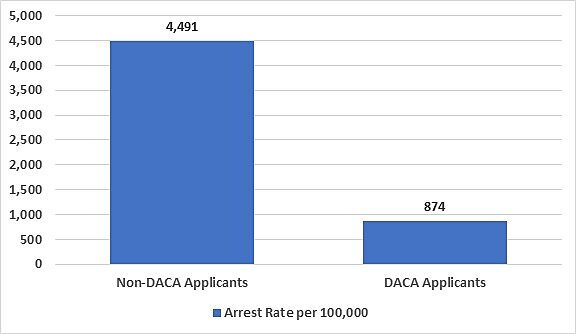
From 1993 to 2018, about 344.9 million total criminal arrests were made in the United States. Of those arrests, 202,025 arrests were of DACA applicants. The arrest rate for DACA applicants was 874 per 100,000 DACA applicants per year from 1993 through 2018 (Figure 1). The arrest rate for all others was 4,491 per every 100,000 per year. In other words, the arrest rate for all others was about 5.1 times as great as it was for DACA applicants. DACA applicants had an arrest rate 80 percent below that of all others.
Table 1

Annual Arrest Rates of DACA Applicants and All Others per 100,000, 1993-2018

USCIS Crime 2018_0

Sources: FBI, USCIS, and Author’s Calculations.
Note: Arrests per 100,000 for each subpopulation.
Even if all those arrests of DACA applicants took place from 2012-2018 (DACA was announced in 2012), their arrest rate would be 3,247 per every 100,000 DACA applicants per year. That is still below the arrest rate for all others of 3,429 per year during the same time. Excluding immigration arrests lower the relative arrest rates even more. For instance, excluding immigration arrests from the 1993-2018 period diminishes the DACA applicant arrest rate from 874 per 100,000 DACA applicants per year to 775 per 100,000.
No matter how you compare the arrest rate for DACA applicants to all others, the former group has a lower arrest rate. Since the USCIS report and this post just measure arrest rates, the criminal conviction rate is necessarily lower as there are more arrests than convictions – as I show in Texas. The USCIS report is just further evidence that illegal immigrants have a lower crime rate than native-born Americans.
Topics
ImmigrationTags
USCIS, DACA, Crime, arrest rates, 2019

This work is licensed under a Creative Commons Attribution-NonCommercial-ShareAlike 4.0 International License.

btn_donateCC_LG

Please Donate