I have a difficult time understanding the lack of outrage over the actions of “commander Chaos” and his drain circlers. History has shown the same actions were taken in the 1930’s when A. Hitler lied and cheated his way into German Government. Even though Germany was in poor financial shape due to an ill-advised war in which they lost, the people were aroused over untrue issues and against certain people who were deemed “unfit, not German enough or otherwise undesirable”. When called to task over the treatment of so-called non-Germans, MR. H decided to squeeze an easier target and proceeded to persecute anyone Jewish. He so thoroughly indoctrinated the population in hatred of Jews that everyday people ignored the brutality against the Jews and often joined in.
The plight of the Jewish community was widely reported by those who fled and newspapers in Europe, but no one listened or paid much attention except to the “outrageous” statements blaming the Jews for everything that he could. All of this while the general public needed relief from the poor economy left after losing the war and having to pay reparations.
Instead, while making Jews the target of attention, he began building his “war Machine”, the German people did not notice (or did not want to) because they had good jobs in the munition and steel factories that were producing war machine and materials. He went after books, trashed Jewish businesses, raided Jewish homes and took anything of value. Took the residents took work camps building the infrastructure for the war machines and the soon to be “camps’ for Jews and other so called unwanted people aka, gays, Hungarians or anyone who was not able to prove German citizenship.
Fast forward to 2024 Donald J Trump elected to the Presidency! After the fiasco of his first term and the extensive rhetoric leading up to this one, his supporters didn’t learn anything or did not pay attention when he stated exactly what he was going to and is doing it. His broad strokes do not discriminate, and all are encompassed in them. WE the people need to wake up and insist on action from our elected officials especially the supporters in Congress who are facilitating his actions.
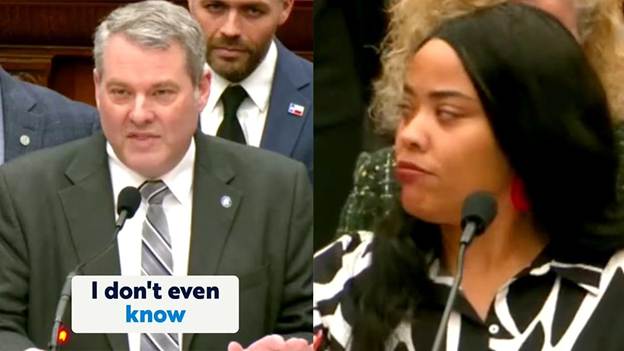
Comments Off on ‘Andy, that’s not true:’ Texas Republican mocked after admitting he doesn’t know what intersex is
Ryan Adamczeski- THEADVOCATE
(we do not elect the smartest people so what makes them electable? MA.)
Mon, April 14, 2025 at 2:59 PM CDT
3 min read
Texas House Democratic Caucus video discussing intersex education
A Republican representative in Texas is proving what LGBTQ+ advocates have been saying all along — conservatives don’t know a single thing about the queer community.
The state House of Representatives voted 118-26 to approve a $337 billion budget Friday morning, but not without first killing several amendments targeting LGBTQ+ and diversity, equity, and inclusion (DEI) initiatives. One such amendment, proposed by Republican Rep. Andy Hopper, aimed to eliminate state funding for the University of Texas at Austin over its LGBTQ+ and DEI programs and degree plans.
In debating the amendment, Democratic Rep. Lauren Ashley Simmons prodded Hopper until he made a stunning admission. The moment, which has since gone viral after being posted by the Human Rights Campaign and Texas Democrats, began with Simmons challenging Hopper after he stated “when you’re born, you have a set of chromosomes.”
“Are you speaking about biological sex? Or are you speaking about gender? ‘Cause one is scientific, one is a social construct,” Simmons said, adding, “‘Cause I have a follow up question after.”
“They’re one and the same, ma’am,” Hopper falsely asserted, grinning smugly.
“That’s not true, but moving on. So, in the same vein, what about intersex individuals?” Simmons questioned.
To which Hopper responded: “I don’t even know what that means, ma’am.”
The crowd in the room responded with a mix of surprise and laughter. When the noise died down, Simmons continued.
“You are not sure what intersex people are, if they exist or not, but you want to defund a program about something that you don’t understand,” she said. “That’s why I’m seeking clarification. … Then again, you haven’t yet answered my question about where intersex people fall into that equation?”
“Those intersex individuals are still XX or XY,” Hopper replied. “So, you can’t change that.”
The incorrect claim prompted Republican Rep. Valoree Swanson, the lead author of the state’s transgender sports ban who had been standing next to Hopper at the podium, to tug on his sleeve and say to him quietly — but loud enough for the microphone to pick up — “Andy, that’s not true.”
There are currently over 40 known intersex variations, according to the Intersex Society of North America, which can cause individuals to make more or less estrogen or testosterone than average, be more or less sensitive to those hormones, have different sizes and appearances of their genitals, and have variations in their X and Y sex chromosomes.
The most common intersex variations are due to differences in chromosomes, such as Klinefelter syndrome (XXY), Turner syndrome (X0), and triple X syndrome (XXX). About 2 in every 100 births have an intersex variation, according to multiplesources — around the same as the number of people with red hair.
Not all intersex people identify as LGBTQ+. They may identify as straight, gay, lesbian, bisexual, asexual, female, male, both, or neither.
Simmons filed a point of order against Hopper, and after over an hour of debate, the House ultimately voted against the amendment.
As the Financial Times reports, Trump Media and Technology Group (TMTG) revealed that it was planning to sell more than 142 million shares in a late Tuesday filing with the Securities and Exchange Commission.
Most notably, the shares listed in the document include Trump’s 114-million-share stake, which is worth roughly $2.3 billion and held in a trust controlled by his son Donald Trump Jr. Other insiders, including a crypto exchange-traded fund, and 106,000 shares held by US attorney Pam Bondi were also included in the latest filing.
While the filing doesn’t guarantee any future sale of shares, investors weren’t exactly smitten with the optics. Shares plunged eight percent in light of the news, according to the FT, and are down over 45 percent this year amid Trump’s escalating trade war.
The timing of the SEC filing is certainly suspect. Trump’s “liberation day” tariff announcement on Wednesday triggered a major selloff, causing shares of multinational companies and stock futures to crater.
Trump also vowed in September that he wasn’t planning to sell any of his TMTG shares, which caused their value to spike temporarily at the time.
Now that the shares are up for grabs, the president has seemingly had a change of heart — or, perhaps, is getting cold feet now that the economy is feeling the brunt of his catastrophic economic policymaking. It’s also possible Trump was always planning to cash out and leave investors exposed.
Meanwhile, Trump Media released a statement on Wednesday, accusing “legacy media outlets” of “spreading a fake story suggesting that a TMTG filing today is paving the way for the Trump trust to sell its shares in TMTG.” The company said this week’s filing was “routine.”
Experts have long pointed out that if Trump were to sell, it could lead to TMTG spiraling.
It’s still unclear whether the company — which reported a staggering $400 million loss in 2024, while only netting a pitiful $3.6 million revenue — will realize the mass sale of millions of shares.
But even just the suggestion appears to have spooked investors.
“In this offering it says the Trump trust could sell shares — it doesn’t necessarily mean that they will,” Morningstar analyst Seth Goldstein told ABC News. “It signals to the market that they could.”
“This leaves it up in the air if and when a share sale will happen,” he added.
In short, instead of building a viable business that generates meaningful revenue to reflect its valuation, TMTG still feels more like an enrichment scheme for Trump and his closest associates.
“Trump Media has been pretty unsuccessful at creating an operating business model, but they have been quite successful at selling their stock,” University of Florida finance professor Jay Ritter told ABC News.
Arlington Cemetery Erases Civil War in Hegseth DEI Purge
Nandika Chatterjee
Fri, March 14, 2025 at 4:21 PM CDT
3 min read
The Arlington National Cemetery has removed key information from its website about prominent Black, Hispanic, and female service members as well as historical topics like the Civil War.
The moves are part of a broader initiative by the Department of Defense to do away with diversity, equity, and inclusion (DEI), the Washington Post reported.
A spokesperson for the cemetery confirmed on Friday that, in compliance with new Pentagon directives, internal links leading to webpages about notable veterans who were minorities—such as Gen. Colin Powell, Supreme Court Justice Thurgood Marshall, and members of the all-Black, all-female 6888th Central Postal Directory Battalion—were taken down.
Educational material on the Civil War and Medal of Honor recipients has also been completely removed, leaving only a brief mention of the cemetery’s connection to the conflict.
These deletions follow a series of executive orders signed by President Donald Trump banning DEI across the federal government. In accordance with the directives, Pentagon leaders have been tasked with purging content that “promotes” DEI on military websites.
“We are proud of our educational content and programming and working diligently to return removed content to ensure alignment with Department of Defense instruction 5400.17 and Executive Orders issued by the President,” a cemetery spokesperson told the Post in a statement.
They added: “We remain committed to sharing the stories of military service and sacrifice to the nation with transparency and professionalism, while continuing to engage with our community in a manner that reflects our core values.”
Historian Kevin M. Levin first noted the removals in his Substack, “Civil War Memory,” which was further reported on by military news site Task & Purpose. The removals have drawn sharp criticism from educators and historians, who argue that the changes erase vital pieces of American history.
Levin, a Boston-based author and former teacher, expressed disappointment over the loss of accessible material about influential individuals like Captain Joy Bright Hancock, one of the military’s first woman officers, and Major General Marcelite Jordan Harris, the Air Force’s first female, African-American general officer.
“It’s incredibly unfortunate. This is just the kind of history that we want students to be learning, a history that allows students from different backgrounds to make a meaningful connection with one of our sacred sites,” Levin told the Post.
Some of the removed content is still accessible through active links to pages on “Prominent Military Figures” and “U.S. Supreme Court,” but the categories “African American History,” “Hispanic American History,” and “Women’s History” no longer appear prominently on the site.
The cemetery’s website, a key resource for educators and visitors, once provided lesson plans, walking tours, and detailed profiles of military heroes. Now, many of these resources have been scrubbed.
“This is a place where history comes alive, and you feel it when you’re there,” Levin said. “Even if you can’t bring your students there, you can bring the stories to them in the classroom. There’s a story there for everyone to connect to.”
Comments Off on Debunking Myth #8: “Corporate tax cuts create jobs” BUNK! Robert Reich
Debunking Myth #8: “Corporate tax cuts create jobs” BUNK! Robert Reich Friends, I’m tired of hearing Republicans claim that we should reduce taxes on corporations because corporate tax cuts create jobs. It’s untrue. Also untrue are the repeated Republican assertions that tax increases on corporations, and regulations requiring corporations to better protect the health and safety of their consumers and workers and the environment, are “job killers.” Here’s the truth: Most American jobs are created by poor, working, and middle-class people whose increased spending on goods and services causes businesses to create more jobs. If most Americans don’t have enough purchasing power to buy the stuff businesses produce, businesses will lay workers off. If Forwarded this email? Subscribe here for more Debunking Myth #8: “Corporate tax cuts create jobs” BUNK! Robert Reich Jul 19 READ IN APP (Please click on the above and see our video.) Friends, I’m tired of hearing Republicans claim that we should reduce taxes on corporations because corporate tax cuts create jobs. It’s untrue. Also untrue are the repeated Republican assertions that tax increases on corporations, and regulations requiring corporations to better protect the health and safety of their consumers and workers and the environment, are “job killers.” Here’s the truth: Most American jobs are created by poor, working, and middle-class people whose increased spending on goods and services causes businesses to create more jobs. If most Americans don’t have enough purchasing power to buy the stuff businesses produce, businesses will lay workers off. If they have more purchasing power, businesses will add jobs. In 1914, Ford boosted its workers’ wages. As a result, Ford employees — and the employees of other big firms who felt they had no choice but to raise their wages to compete in the job market with Ford — could afford to buy Model T Fords, enlarging the demand for Model T’s, thus creating more jobs at Ford (and at every other automaker). The Great Crash of 1929 ushered in the Great Depression of the 1930s because people didn’t have enough money to buy the goods and services the economy could produce. Which caused a vicious cycle of fewer jobs and even less money in the pockets of average people. The cycle ended only when the government stepped in through vast public spending on World War II. So when you hear that corporations need tax cuts in order to create more jobs, or that tax increases on corporations or regulations on corporations are job killers, know that this is baloney. The best way to create more jobs is to put more money into the pockets of more workers. Which is why we need a higher minimum wage, an expanded Earned Income Tax Credit, and stronger unions that can bargain for higher wages. All these will increase demand for the goods and services businesses produce, thereby creating more jobs. Remember, it’s working people who create jobs when they have enough money in their pockets to buy.they have more purchasing power, businesses will add jobs. In 1914, Ford boosted its workers’ wages. As a result, Ford employees — and the employees of other big firms who felt they had no choice but to raise their wages to compete in the job market with Ford — could afford to buy Model T Fords, enlarging the demand for Model T’s, thus creating more jobs at Ford (and at every other automaker). The Great Crash of 1929 ushered in the Great Depression of the 1930s because people didn’t have enough money to buy the goods and services the economy could produce. Which caused a vicious cycle of fewer jobs and even less money in the pockets of average people. The cycle ended only when the government stepped in through vast public spending on World War II. So when you hear that corporations need tax cuts in order to create more jobs, or that tax increases on corporations or regulations on corporations are job killers, know that this is baloney. The best way to create more jobs is to put more money into the pockets of more workers. Which is why we need a higher minimum wage, an expanded Earned Income Tax Credit, and stronger unions that can bargain for higher wages. All these will increase demand for the goods and services businesses produce, thereby creating more jobs. Remember, it’s working people who create jobs when they have enough money in their pockets to buy.
Cas Mudde, a political scientist who specializes in extremism and democracy, observed yesterday on Bluesky that “the fight against the far right is secondary to the fight to strengthen liberal democracy.” That’s a smart observation.
During World War II, when the United States led the defense of democracy against fascism, and after it, when the U.S. stood against communism, members of both major political parties celebrated American liberal democracy. Democratic presidents Franklin Delano Roosevelt and Harry Truman and Republican president Dwight D. Eisenhower made it a point to emphasize the importance of the rule of law and people’s right to choose their government, as well as how much more effectively democracies managed their economies and how much fairer those economies were than those in which authoritarians and their cronies pocketed most of a country’s wealth.
Those mid-twentieth-century presidents helped to construct a “liberal consensus” in which Americans rallied behind a democratic government that regulated business, provided a basic social safety net, promoted infrastructure, and protected civil rights. That government was so widely popular that political scientists in the 1960s posited that politicians should stop trying to court voters by defending its broadly accepted principles. Instead, they should put together coalitions of interest groups that could win elections.
As traditional Republicans and Democrats moved away from a defense of democracy, the power to define the U.S. government fell to a small faction of “Movement Conservatives” who were determined to undermine the liberal consensus. Big-business Republicans who hated regulations and taxes joined with racist former Democrats and patriarchal white evangelicals who wanted to reinforce traditional race and gender hierarchies to insist that the government had grown far too big and was crushing individual Americans.
In their telling, a government that prevented businessmen from abusing their workers, made sure widows and orphans didn’t have to eat from garbage cans, built the interstate highways, and enforced equal rights was destroying the individualism that made America great, and they argued that such a government was a small step from communism. They looked at government protection of equal rights for racial, ethnic, gender, and religious minorities, as well as women, and argued that those protections both cost tax dollars to pay for the bureaucrats who enforced equal rights and undermined a man’s ability to act as he wished in his place of business, in society, and in his home. The government of the liberal consensus was, they claimed, a redistribution of wealth from hardworking taxpayers—usually white and male—to undeserving marginalized Americans.
When voters elected Ronald Reagan in 1980, the Movement Conservatives’ image of the American government became more and more prevalent, although Americans never stopped liking the reality of the post–World War II government that served the needs of ordinary Americans. That image fed forty years of cuts to the post–World War II government, including sweeping cuts to regulations and to taxes on the wealthy and on corporations, always with the argument that a large government was destroying American individualism.
It was this image of government as a behemoth undermining individual Americans that Donald Trump rode to the presidency in 2016 with his promises to “drain the swamp” of Washington, D.C., and it is this image that is leading Trump voters to cheer on billionaires Elon Musk and Vivek Ramaswamy as they vow to cut services on which Americans depend in order to cut regulations and taxes once again for the very wealthy and corporations.
But that image of the American government is not the one on which the nation was founded.
Liberal democracy was the product of a moment in the 1600s in which European thinkers rethought old ideas about human society to emphasize the importance of the individual and his (it was almost always a “him” in those days) rights. Men like John Locke rejected the idea that God had appointed kings and noblemen to rule over subjects by virtue of their family lineage, and began to explore the idea that since government was a social compact to enable men to live together in peace, it should rest not on birth or wealth or religion, all of which were arbitrary, but on natural laws that men could figure out through their own experiences.
The Founders of what would become the United States rested their philosophy on an idea that came from Locke’s observations: that individuals had the right to freedom, or “liberty,” including the right to consent to the government under which they lived. “We hold these truths to be self-evident,” Thomas Jefferson wrote, “that all men are created equal, that they are endowed by their Creator with certain unalienable Rights, that among these are Life, Liberty and the pursuit of Happiness,” and that “to secure these rights, governments are instituted among men, deriving their just powers from the consent of the governed.”
In the early years of the American nation, defending the rights of individuals meant keeping the government small so that it could not crush a man through taxation or involuntary service to the government or arbitrary restrictions. The Bill of Rights—the first ten amendments to the Constitution—explicitly prohibited the government from engaging in actions that would hamper individual freedom.
But in the middle of the nineteenth century, Republican president Abraham Lincoln began the process of adjusting American liberalism to the conditions of the modern world. While the Founders had focused on protecting individual rights from an overreaching government, Lincoln realized that maintaining the rights of individuals required government action.
To protect individual opportunity, Lincoln argued, the government must work to guarantee that all men—not just rich white men—were equal before the law and had equal access to resources, including education. To keep the rich from taking over the nation, he said, the government must keep the economic playing field between rich and poor level, dramatically expand opportunity, and develop the economy.
Under Lincoln, Republicans reenvisioned liberalism. They reworked the Founders’ initial stand against a strong government, memorialized by the Framers in the Bill of Rights, into an active government designed to protect individuals by guaranteeing equal access to resources and equality before the law for white men and Black men alike. They enlisted the power of the federal government to turn the ideas of the Declaration of Independence into reality.
Under Republican president Theodore Roosevelt, progressives at the turn of the twentieth century would continue this reworking of American liberalism to address the extraordinary concentrations of wealth and power made possible by industrialization. In that era, corrupt industrialists increased their profits by abusing their workers, adulterating milk with formaldehyde and painting candies with lead paint, dumping toxic waste into neighborhoods, and paying legislators to let them do whatever they wished.
Those concerned about the survival of liberal democracy worried that individuals were not actually free when their lives were controlled by the corporations that poisoned their food and water while making it impossible for individuals to get an education or make enough money ever to become independent.
To restore the rights of individuals, progressives of both parties reversed the idea that liberalism required a small government. They insisted that individuals needed a big government to protect them from the excesses and powerful industrialists of the modern world. Under the new governmental system that Theodore Roosevelt pioneered, the government cleaned up the sewage systems and tenements in cities, protected public lands, invested in public health and education, raised taxes, and called for universal health insurance, all to protect the ability of individuals to live freely without being crushed by outside influences.
Reformers sought, as Roosevelt said, to return to “an economic system under which each man shall be guaranteed the opportunity to show the best that there is in him.”
It is that system of government’s protection of the individual in the face of the stresses of the modern world that Franklin Delano Roosevelt, Harry Truman, Dwight Eisenhower, and the presidents who followed them until 1981 embraced. The post–World War II liberal consensus was the American recognition that protecting the rights of individuals in the modern era required not a weak government but a strong one.
When Movement Conservatives convinced followers to redefine “liberal” as an epithet rather than a reflection of the nation’s quest to defend the rights of individuals—which was quite deliberate—they undermined the central principle of the United States of America. In its place, they resurrected the ideology of the world the American Founders rejected, a world in which an impoverished majority suffers under the rule of a powerful few.
Recently I was told about a younger friend who had foot amputated due to diabetes. This not unusual to have limbs removed due to the disease however in this case all symptoms were ignored for perhaps years. This is an issue with me in that Men in general fail to pay attention to their health and or ignore changes in their health. 20 years ago, I was diagnosed with prostate cancer, while the detection was early, and the disease contained in the gland itself I elected to have it surgically removed. At that time there were few options other than surgery, those options were, chemo, radiation and “radioactive” seed implants. Depending on general health, chemo, radiation can cause strokes or near strokes. There is the chance of the disease spreading with other remedies, surgical removal often offers the best remedy with one of its side effects being erectile dysfunction. Other side effects can occur but what most men are concerned about is ED -THERE IS A PILL FOR THIS! There is no pill or remedy for death if you do not monitor this health issue (or any other). Any other side effects usually can be addressed in some form by your physician (if you have one). I vehemently urge men to get physician you like and have regular visits to insure your health. Get real with your health and you will live a better life or just live! To paraphrase “Smokey Bear”- Only you can save your life with regular health visits!
Comments Off on Postal Malfeasance? or Political Ignorance?
Louis DeJoy (born June 20, 1957) is an American businessman serving as the 75th U.S. postmaster general. He was appointed in May 2020 by the Board of Governors of the United States Postal Service (USPS). Prior to the appointment, he was the founder and CEO of the logistics and freight company New Breed Logistics and was a major Republican Party donor and fundraiser for Donald Trump.[1] DeJoy is the first postmaster general since 1992 without any previous experience in the USPS.[2] His companies still hold active service contracts with the USPS, generating controversy over conflict of interest.[3]
DeJoy was criticized for cost-reduction policies enacted after assuming office in June 2020, including eliminating overtime, and banning late or additional trips to deliver mail. The Postal Service also continued responding to long-term declines in first class mail volume with ongoing decommissioning of hundreds of high-speed mail-sorting machines and removal of the lower-volume mail collection boxes from streets. These practices were also criticized as mail delivery became delayed. The changes took place during the COVID-19 pandemic and in the lead-up to the 2020 presidential election, raising fears that the changes would interfere with voters who used mail-in voting to cast their ballots, possibly intentionally. Congressional committees and the USPS inspector general investigated. In August of that year, amid public pressure, DeJoy said that the changes would be suspended until after the election,[4] and in October the USPS agreed to reverse all of them.[5]
In March 2021, DeJoy issued a 10-year plan called “Delivering for America” to stabilize the finances of the Postal Service by slowing first class mail delivery, optimizing transportation networks, cutting post office hours, and raising prices. The plan assumed Congress would relieve the USPS of the requirement to pre-pay retiree health care costs, which with DeJoy’s urging it did with the Postal Service Reform Act of 2022.
DeJoy attracted criticism and lawsuits from environmentalists and Democratic governments when he decided to purchase 90% gasoline-powered delivery vehicles in 2022, which he justified in part by the agency’s financial situation. After additional federal funding was provided by the Postal Service Reform Act of 2022 and Inflation Reduction Act, DeJoy revised these plans twice; the final version orders 83% electric vehicles through 2028 and 100% electric thereafter.
I put the current Postmaster general’s Bio to explain my comments (opinion). Mr. De Joy is a Trump crony who along with Trump has no idea how the postal service works. While the agency has and still has problems (all solvable). The agency requires someone who can look beyond the issues that do not plague ordinary businesses. The postmaster General cannot be fired by the Congress or the President. The Board of Governors have that authority. At this time there are 5 Republicans on the board and that may be the block to fire De Joy. Until some moderate board members are elected there will be a Dejoy in control with no real direction as to improving the postal service. There is no Joy in having DeJoy.
‘Trump isn’t fun anymore’: Columnist claims MAGA leader’s greatest charm has died
Story by Adam Nichols- RAW STORY
• 21h • 2 min read
The dancing, joking, story-telling persona that helped lure Donald Trump’s adoring MAGA base has become a casualty of Kamala Harris’ campaign, a columnist wrote Friday.
And she based the revelation on Trump’s emergence from days of Mar-a-Lago isolation to give a news conference Thursday that many commentators described as a chaotic event suggesting a flailing campaign.
“He was dour and angry and frankly is starting to look a whole lot older, just in the past few months,” Parton wrote.
“He’s not enjoying himself and it shows and, compared to the excited crowds greeting Harris and Walz this week, this sad, pathetic appearance seemed almost funereal.”
Parton wrote that the change was fully down to Biden stepping aside and Harris taking the mantle as the Democratic Party’s presidential candidate. Even facing possible prison time in four criminal prosecutions hadn’t dampened his spirits as much.
“Donald Trump is in a bad way,” she wrote.
Parton went on, “I think he’s considering for the first time that he might lose again and he is not psychologically equipped to deal with that reality.
“Sure, he’ll fight it and tell his supporters that it was stolen and perhaps even incite more violence. But deep down he knows he might actually lose just as he knows deep down that he lost in 2020. There’s a look of panic in his eyes right now.
“If he fails this time he might just break apart at the seams. “
Photo Illustration by Elizabeth Brockway/The Daily Beast/Getty
For two years, Steve Bannon has refused to pay the half-million dollars he owes his former lawyer. Now, his refusal to settle his debts has exposed him and his current attorney to potential sanctions.
“Bannon, with the aid of his counsel, has, for months, done nothing but intentionally stall and delay plaintiff’s enforcement of its valid money judgment,” the law firm that previously represented him wrote to a New York state judge last month, employing an underline to show their heightened frustration.
Bannon, who was once Donald Trump’s White House chief strategist and played an active role in the former president’s Jan. 6 coup attempt, is already trapped in a precarious position. He’s a convict trying to avoid serving his four-month prison sentence for ignoring a congressional subpoena that sought to question him over his role in the MAGA insurrection. And the Manhattan District Attorney is putting him on trial in May for duping nativist donors to “We Build The Wall” who wanted to support a privately built U.S.-Mexico border barrier.
But now he’s making it even worse on himself.
It’s been seven months since a New York state judge ordered the conspiracy-spewing right-wing political agitator to pay the $484,197 he owed the defense lawyer he stiffed, Bob Costello.
But since then, according to court filings, Bannon has been dodging the ordered judgment and ignoring follow-up subpoenas. That has put the aggrieved New York City law firm of Davidoff Hutcher and Citron in the awkward position of asking the judge to intervene yet again, citing what they called “a last ditch effort concocted by Bannon to game this court.”
In its attempt to get a readout of Bannon’s personal finances and his ability to pay the bill, the law firm tried to question him under oath and sent subpoenas to learn more about his businesses and what’s in his personal bank accounts. Emails show that Bannon’s new lawyer, Harlan Protass, initially agreed in November to schedule a deposition and turn over materials—provided that they first sign a “simple and straightforward” confidentiality agreement.
But as the months went by, nothing happened.
Then, in January, Bannon suddenly put up resistance and claimed he couldn’t possibly answer questions or turn over bank records. Doing so would potentially reveal evidence of fraud that could ruin his attempt to overturn his federal conviction or even bolster the Manhattan DA’s case.
“DHC’s taking of post-judgment discovery from Mr. Bannon poses a significant risk of compromising Mr. Bannon’s Fifth Amendment right against self-incrimination,” Protass wrote in court filings.
It was an unwelcome surprise. On Feb. 6, Costello’s law firm told the judge that Protass has been toying with them and engaging in “a feeble attempt at stalling.” Joseph N. Polito, a senior counsel at Costello’s firm, wrote that the excuse “is beyond any and all logic.”
Polito then took the relatively rare and aggressive approach of asking that New York Supreme Court Justice Arlene P. Bluth hit the right-wing influencer and his lawyer each with $10,000 sanctions—the highest allowable fine “for engaging in intentional dilatory litigation tactics.”
“Bannon’s intentional bad faith conduct has left plaintiff with no other choice but to seek civil contempt and sanctions. Without this relief, Bannon will be further emboldened to continue his dilatory tactics that have, and continue to, severely prejudice plaintiff in its efforts to satisfy the substantial money judgment that remains outstanding,” Polito wrote.
But Polito went even further, asking the judge to also tack on the cost he incurred “for having to address Bannon’s frivolity,” an eloquent insult used to describe the hours he’s wasted chasing down the conservative media figure.
Protass did not respond to a request for comment, but he is expected to file a formal reply in court records later this week. Polito did not reply to an email asking about the case.
You must be logged in to post a comment.