Skip navigation

Tag Archives: POLITICS


Summary Of Now

Heather Cox RichardsonDec 1


Cas Mudde, a political scientist who specializes in extremism and democracy, observed yesterday on Bluesky that “the fight against the far right is secondary to the fight to strengthen liberal democracy.” That’s a smart observation.

During World War II, when the United States led the defense of democracy against fascism, and after it, when the U.S. stood against communism, members of both major political parties celebrated American liberal democracy. Democratic presidents Franklin Delano Roosevelt and Harry Truman and Republican president Dwight D. Eisenhower made it a point to emphasize the importance of the rule of law and people’s right to choose their government, as well as how much more effectively democracies managed their economies and how much fairer those economies were than those in which authoritarians and their cronies pocketed most of a country’s wealth.

Those mid-twentieth-century presidents helped to construct a “liberal consensus” in which Americans rallied behind a democratic government that regulated business, provided a basic social safety net, promoted infrastructure, and protected civil rights. That government was so widely popular that political scientists in the 1960s posited that politicians should stop trying to court voters by defending its broadly accepted principles. Instead, they should put together coalitions of interest groups that could win elections.

As traditional Republicans and Democrats moved away from a defense of democracy, the power to define the U.S. government fell to a small faction of “Movement Conservatives” who were determined to undermine the liberal consensus. Big-business Republicans who hated regulations and taxes joined with racist former Democrats and patriarchal white evangelicals who wanted to reinforce traditional race and gender hierarchies to insist that the government had grown far too big and was crushing individual Americans.

In their telling, a government that prevented businessmen from abusing their workers, made sure widows and orphans didn’t have to eat from garbage cans, built the interstate highways, and enforced equal rights was destroying the individualism that made America great, and they argued that such a government was a small step from communism. They looked at government protection of equal rights for racial, ethnic, gender, and religious minorities, as well as women, and argued that those protections both cost tax dollars to pay for the bureaucrats who enforced equal rights and undermined a man’s ability to act as he wished in his place of business, in society, and in his home. The government of the liberal consensus was, they claimed, a redistribution of wealth from hardworking taxpayers—usually white and male—to undeserving marginalized Americans.

When voters elected Ronald Reagan in 1980, the Movement Conservatives’ image of the American government became more and more prevalent, although Americans never stopped liking the reality of the post–World War II government that served the needs of ordinary Americans. That image fed forty years of cuts to the post–World War II government, including sweeping cuts to regulations and to taxes on the wealthy and on corporations, always with the argument that a large government was destroying American individualism.

It was this image of government as a behemoth undermining individual Americans that Donald Trump rode to the presidency in 2016 with his promises to “drain the swamp” of Washington, D.C., and it is this image that is leading Trump voters to cheer on billionaires Elon Musk and Vivek Ramaswamy as they vow to cut services on which Americans depend in order to cut regulations and taxes once again for the very wealthy and corporations.

But that image of the American government is not the one on which the nation was founded.

Liberal democracy was the product of a moment in the 1600s in which European thinkers rethought old ideas about human society to emphasize the importance of the individual and his (it was almost always a “him” in those days) rights. Men like John Locke rejected the idea that God had appointed kings and noblemen to rule over subjects by virtue of their family lineage, and began to explore the idea that since government was a social compact to enable men to live together in peace, it should rest not on birth or wealth or religion, all of which were arbitrary, but on natural laws that men could figure out through their own experiences.

The Founders of what would become the United States rested their philosophy on an idea that came from Locke’s observations: that individuals had the right to freedom, or “liberty,” including the right to consent to the government under which they lived. “We hold these truths to be self-evident,” Thomas Jefferson wrote, “that all men are created equal, that they are endowed by their Creator with certain unalienable Rights, that among these are Life, Liberty and the pursuit of Happiness,” and that “to secure these rights, governments are instituted among men, deriving their just powers from the consent of the governed.”

In the early years of the American nation, defending the rights of individuals meant keeping the government small so that it could not crush a man through taxation or involuntary service to the government or arbitrary restrictions. The Bill of Rights—the first ten amendments to the Constitution—explicitly prohibited the government from engaging in actions that would hamper individual freedom.

But in the middle of the nineteenth century, Republican president Abraham Lincoln began the process of adjusting American liberalism to the conditions of the modern world. While the Founders had focused on protecting individual rights from an overreaching government, Lincoln realized that maintaining the rights of individuals required government action.

To protect individual opportunity, Lincoln argued, the government must work to guarantee that all men—not just rich white men—were equal before the law and had equal access to resources, including education. To keep the rich from taking over the nation, he said, the government must keep the economic playing field between rich and poor level, dramatically expand opportunity, and develop the economy.

Under Lincoln, Republicans reenvisioned liberalism. They reworked the Founders’ initial stand against a strong government, memorialized by the Framers in the Bill of Rights, into an active government designed to protect individuals by guaranteeing equal access to resources and equality before the law for white men and Black men alike. They enlisted the power of the federal government to turn the ideas of the Declaration of Independence into reality.

Under Republican president Theodore Roosevelt, progressives at the turn of the twentieth century would continue this reworking of American liberalism to address the extraordinary concentrations of wealth and power made possible by industrialization. In that era, corrupt industrialists increased their profits by abusing their workers, adulterating milk with formaldehyde and painting candies with lead paint, dumping toxic waste into neighborhoods, and paying legislators to let them do whatever they wished.

Those concerned about the survival of liberal democracy worried that individuals were not actually free when their lives were controlled by the corporations that poisoned their food and water while making it impossible for individuals to get an education or make enough money ever to become independent.

To restore the rights of individuals, progressives of both parties reversed the idea that liberalism required a small government. They insisted that individuals needed a big government to protect them from the excesses and powerful industrialists of the modern world. Under the new governmental system that Theodore Roosevelt pioneered, the government cleaned up the sewage systems and tenements in cities, protected public lands, invested in public health and education, raised taxes, and called for universal health insurance, all to protect the ability of individuals to live freely without being crushed by outside influences.

Reformers sought, as Roosevelt said, to return to “an economic system under which each man shall be guaranteed the opportunity to show the best that there is in him.”

It is that system of government’s protection of the individual in the face of the stresses of the modern world that Franklin Delano Roosevelt, Harry Truman, Dwight Eisenhower, and the presidents who followed them until 1981 embraced. The post–World War II liberal consensus was the American recognition that protecting the rights of individuals in the modern era required not a weak government but a strong one.

When Movement Conservatives convinced followers to redefine “liberal” as an epithet rather than a reflection of the nation’s quest to defend the rights of individuals—which was quite deliberate—they undermined the central principle of the United States of America. In its place, they resurrected the ideology of the world the American Founders rejected, a world in which an impoverished majority suffers under the rule of a powerful few.

Notes:

Megan Slack, “From the Archives: President Teddy Roosevelt’s New Nationalism Speech,” December 6, 2011, The White House, President Barack Obama, National Archives, https://obamawhitehouse.archives.gov/blog/2011/12/06/archives-president-teddy-roosevelts-new-nationalism-speech

Theodore Roosevelt, “The New Nationalism,” in The New Nationalism (New York: The Outlook Company, 1910), 3–33.

Bluesky:
casmudde.bsky.social/post/3lc3t5tehfk2j


Recently I was told about a younger friend who had foot amputated due to diabetes. This not unusual to have limbs removed due to the disease however in this case all symptoms were ignored for perhaps years. This is an issue with me in that Men in general fail to pay attention to their health and or ignore changes in their health. 20 years ago, I was diagnosed with prostate cancer, while the detection was early, and the disease contained in the gland itself I elected to have it surgically removed. At that time there were few options other than surgery, those options were, chemo, radiation and “radioactive” seed implants. Depending on general health, chemo, radiation can cause strokes or near strokes. There is the chance of the disease spreading with other remedies, surgical removal often offers the best remedy with one of its side effects being erectile dysfunction. Other side effects can occur but what most men are concerned about is ED -THERE IS A PILL FOR THIS! There is no pill or remedy for death if you do not monitor this health issue (or any other). Any other side effects usually can be addressed in some form by your physician (if you have one). I vehemently urge men to get physician you like and have regular visits to insure your health. Get real with your health and you will live a better life or just live! To paraphrase “Smokey Bear”- Only you can save your life with regular health visits!


Louis DeJoy (born June 20, 1957) is an American businessman serving as the 75th U.S. postmaster general. He was appointed in May 2020 by the Board of Governors of the United States Postal Service (USPS). Prior to the appointment, he was the founder and CEO of the logistics and freight company New Breed Logistics and was a major Republican Party donor and fundraiser for Donald Trump.[1] DeJoy is the first postmaster general since 1992 without any previous experience in the USPS.[2] His companies still hold active service contracts with the USPS, generating controversy over conflict of interest.[3]

DeJoy was criticized for cost-reduction policies enacted after assuming office in June 2020, including eliminating overtime, and banning late or additional trips to deliver mail. The Postal Service also continued responding to long-term declines in first class mail volume with ongoing decommissioning of hundreds of high-speed mail-sorting machines and removal of the lower-volume mail collection boxes from streets. These practices were also criticized as mail delivery became delayed. The changes took place during the COVID-19 pandemic and in the lead-up to the 2020 presidential election, raising fears that the changes would interfere with voters who used mail-in voting to cast their ballots, possibly intentionally. Congressional committees and the USPS inspector general investigated. In August of that year, amid public pressure, DeJoy said that the changes would be suspended until after the election,[4] and in October the USPS agreed to reverse all of them.[5]

In March 2021, DeJoy issued a 10-year plan called “Delivering for America” to stabilize the finances of the Postal Service by slowing first class mail delivery, optimizing transportation networks, cutting post office hours, and raising prices. The plan assumed Congress would relieve the USPS of the requirement to pre-pay retiree health care costs, which with DeJoy’s urging it did with the Postal Service Reform Act of 2022.

DeJoy attracted criticism and lawsuits from environmentalists and Democratic governments when he decided to purchase 90% gasoline-powered delivery vehicles in 2022, which he justified in part by the agency’s financial situation. After additional federal funding was provided by the Postal Service Reform Act of 2022 and Inflation Reduction Act, DeJoy revised these plans twice; the final version orders 83% electric vehicles through 2028 and 100% electric thereafter.

I put the current Postmaster general’s Bio to explain my comments (opinion). Mr. De Joy is a Trump crony who along with Trump has no idea how the postal service works. While the agency has and still has problems (all solvable). The agency requires someone who can look beyond the issues that do not plague ordinary businesses. The postmaster General cannot be fired by the Congress or the President. The Board of Governors have that authority. At this time there are 5 Republicans on the board and that may be the block to fire De Joy. Until some moderate board members are elected there will be a Dejoy in control with no real direction as to improving the postal service. There is no Joy in having DeJoy.


‘Trump isn’t fun anymore’: Columnist claims MAGA leader’s greatest charm has died

Story by Adam Nichols- RAW STORY

 • 21h • 2 min read

The dancing, joking, story-telling persona that helped lure Donald Trump’s adoring MAGA base has become a casualty of Kamala Harris’ campaign, a columnist wrote Friday.

Trump’s rallies have been full of jokes, sometimes cruel nicknames, cutting observations and performance theater that left his crowds charmed.

But, wrote Heather Digby Parton, Harris’ arrival on the scene has killed that side of him.

“Donald Trump isn’t fun anymore,” she stated in Salon.

And she based the revelation on Trump’s emergence from days of Mar-a-Lago isolation to give a news conference Thursday that many commentators described as a chaotic event suggesting a flailing campaign.

He was dour and angry and frankly is starting to look a whole lot older, just in the past few months,” Parton wrote.

“He’s not enjoying himself and it shows and, compared to the excited crowds greeting Harris and Walz this week, this sad, pathetic appearance seemed almost funereal.”

Parton wrote that the change was fully down to Biden stepping aside and Harris taking the mantle as the Democratic Party’s presidential candidate. Even facing possible prison time in four criminal prosecutions hadn’t dampened his spirits as much.

“Donald Trump is in a bad way,” she wrote.

Parton went on, “I think he’s considering for the first time that he might lose again and he is not psychologically equipped to deal with that reality.

“Sure, he’ll fight it and tell his supporters that it was stolen and perhaps even incite more violence. But deep down he knows he might actually lose just as he knows deep down that he lost in 2020. There’s a look of panic in his eyes right now.

“If he fails this time he might just break apart at the seams. “

Recommended Links:

Trump campaign makes fun of Joe Biden as he visits son Beau Biden’s grave

‘GOP has no bottom’: Internet erupts after Trump starts rally by mocking Biden’s stutter

CEOs startled that Trump ‘couldn’t keep a straight thought’ during meeting: reporter

Kayleigh McEnany gushes over ‘very charming’ Trump after his ‘unhinged’ attack on her

Trump’s insatiable ego is destroying the former president |


Could this be a forecast for Donald Trump?

Jose Pagliery

Thu, March 7, 2024 at 3:31 AM CST·3 min read

161

Photo Illustration by Elizabeth Brockway/The Daily Beast/Getty
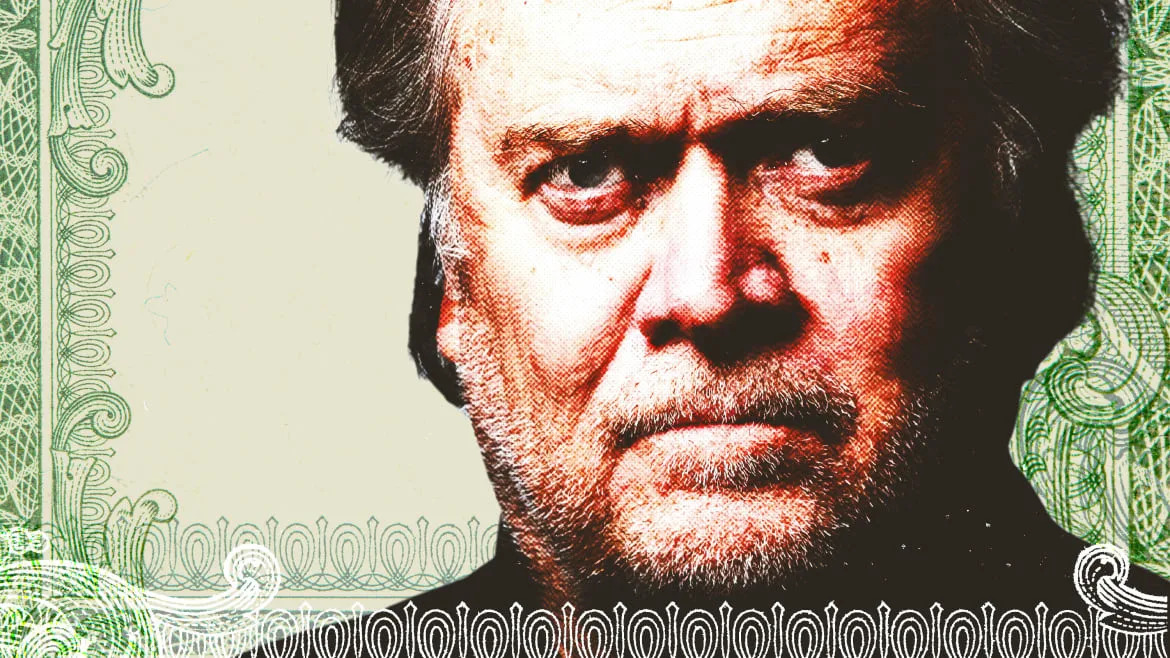
  • For two years, Steve Bannon has refused to pay the half-million dollars he owes his former lawyer. Now, his refusal to settle his debts has exposed him and his current attorney to potential sanctions.

“Bannon, with the aid of his counsel, has, for months, done nothing but intentionally stall and delay plaintiff’s enforcement of its valid money judgment,” the law firm that previously represented him wrote to a New York state judge last month, employing an underline to show their heightened frustration.

Bannon, who was once Donald Trump’s White House chief strategist and played an active role in the former president’s Jan. 6 coup attempt, is already trapped in a precarious position. He’s a convict trying to avoid serving his four-month prison sentence for ignoring a congressional subpoena that sought to question him over his role in the MAGA insurrection. And the Manhattan District Attorney is putting him on trial in May for duping nativist donors to “We Build The Wall” who wanted to support a privately built U.S.-Mexico border barrier.

But now he’s making it even worse on himself.

It’s been seven months since a New York state judge ordered the conspiracy-spewing right-wing political agitator to pay the $484,197 he owed the defense lawyer he stiffed, Bob Costello.

Steve Bannon Admits Bank Account May Have Evidence of Fraud

But since then, according to court filings, Bannon has been dodging the ordered judgment and ignoring follow-up subpoenas. That has put the aggrieved New York City law firm of Davidoff Hutcher and Citron in the awkward position of asking the judge to intervene yet again, citing what they called “a last ditch effort concocted by Bannon to game this court.”

In its attempt to get a readout of Bannon’s personal finances and his ability to pay the bill, the law firm tried to question him under oath and sent subpoenas to learn more about his businesses and what’s in his personal bank accounts. Emails show that Bannon’s new lawyer, Harlan Protass, initially agreed in November to schedule a deposition and turn over materials—provided that they first sign a “simple and straightforward” confidentiality agreement.

But as the months went by, nothing happened.

Then, in January, Bannon suddenly put up resistance and claimed he couldn’t possibly answer questions or turn over bank records. Doing so would potentially reveal evidence of fraud that could ruin his attempt to overturn his federal conviction or even bolster the Manhattan DA’s case.

“DHC’s taking of post-judgment discovery from Mr. Bannon poses a significant risk of compromising Mr. Bannon’s Fifth Amendment right against self-incrimination,” Protass wrote in court filings.

It was an unwelcome surprise. On Feb. 6, Costello’s law firm told the judge that Protass has been toying with them and engaging in “a feeble attempt at stalling.” Joseph N. Polito, a senior counsel at Costello’s firm, wrote that the excuse “is beyond any and all logic.”

Steve Bannon’s Lawyer Sues Him Over Unpaid Bills

Polito then took the relatively rare and aggressive approach of asking that New York Supreme Court Justice Arlene P. Bluth hit the right-wing influencer and his lawyer each with $10,000 sanctions—the highest allowable fine “for engaging in intentional dilatory litigation tactics.”

“Bannon’s intentional bad faith conduct has left plaintiff with no other choice but to seek civil contempt and sanctions. Without this relief, Bannon will be further emboldened to continue his dilatory tactics that have, and continue to, severely prejudice plaintiff in its efforts to satisfy the substantial money judgment that remains outstanding,” Polito wrote.

But Polito went even further, asking the judge to also tack on the cost he incurred “for having to address Bannon’s frivolity,” an eloquent insult used to describe the hours he’s wasted chasing down the conservative media figure.

Protass did not respond to a request for comment, but he is expected to file a formal reply in court records later this week. Polito did not reply to an email asking about the case.

Read more at The Daily Beast.

Get the Daily Beast’s biggest scoops and scandals delivered right to your inbox. Sign up now.

Stay informed and gain unlimited access to the Daily Beast’s unmatched reporting. Subscribe now. View comments (161)


Donald Trump’s recent public proclamations, in which he presents himself as a godly figure and explicitly threatens to behave like a dictator if re-elected, have raised concerns among experts and observers.

Trump’s behavior is indicative of what experts call a “God complex”, a deep-seated belief in one’s own infallibility and superiority. This is a classic element of a cult and a key ingredient of why and how Trumpism works among his followers. In this context, the profane and the sacred are conflated in the same way as the Nazis did.

This isn’t the initial instance of Donald Trump asserting divine authority. Over the past seven years, Trump has consistently professed to possess clandestine and omnipotent wisdom, urging his supporters to have faith in him over facts, reality, or anyone else. He purports to hold knowledge beyond anyone else’s grasp, makes daring future forecasts akin to a mystic or psychic, and overall maintains a belief in his omnipotence, considering himself beyond the law and any form of accountability.

During a speech in Iowa last weekend, Trump told his MAGA cultists that, “But I think if you had a real election and Jesus came down and God came down and said, ‘I’m going to be the scorekeeper here,’ I think we’d win there [in California], I think we’d win in Illinois, and I think we’d win in New York.”

Trump’s “narcissistic injury” following his loss in the 2020 election to President Joe Biden has escalated into a more severe threat to American democracy, as per psychology experts. His recent remarks about targeting judges, pardoning the traitorous individuals from Jan. 6, and removing his ‘enemies’ are not novel concepts, but rather indicate that his veneer of decency and normality is eroding under the pressure of being answerable for his actions for the first time in his life.

“Mr. Trump is an obvious and severe sociopath, an antisocial person lacking the capacity for honesty, empathy or respect for the rule of law,” said an anonymous psychology expert, who added that Trump’s mental illness made him dangerous, especially as his legal problems grow worse.

As Trump faces mounting pressure from his criminal and civil trials, he is now publicly declaring himself as the Chosen One, chosen by “god” and “Jesus Christ” to be the next President of the United States. This marks a notable departure from his previous rhetoric and raises concerns about his mental state and the potential influence on his followers and the wider political landscape.

The implications of Trump’s behavior are far-reaching. His claims to be god-like are terrifying on their own but made much worse by the rapidly deteriorating democracy crisis. His endless self-centered drive for power at any cost makes him an extreme risk of discarding democracy in favor of his personal rule.

The situation is further complicated by the fact that Trump’s followers appear to be buying into his narrative. For them, Trump does not come from the normal political system, he comes from the world they come from, he’s been hugely successful, he’s enormously flawed, but who gives a damn, he’s chosen to turn the political system upside down and make it work for them.

As the country grapples with these developments, it is clear that the situation is fluid and evolving. The full impact of Trump’s rhetoric and behavior remains to be seen.


David Lauter

Sun, December 17, 2023 at 4:33 PM CST·6 min read    

President Biden’s standing in polls is bad — generating panic among many Democrats and a raft of theories about what’s wrong.

He’s too conservative, say progressives; too liberal, according to centrists.

And, of course, nearly everyone mentions his age.

But what if all of that misses the real story? What if the main problem Biden faces isn’t Biden at all?

Biden is 81. No question that’s a problem politically. But if age were the sole driver of poll standing, what would explain the position of 51-year-old Canadian Prime Minister Justin TrudeauHis current approval rating — 31%, according to Canada’s Angus Reid Institute — makes Biden’s 38% in the FiveThirtyEight.com average of polls look almost balmy.

One could argue that Trudeau is a special case: He recently began his ninth year in office and may have worn out his welcome.

But if so, what is there to say about British Prime Minister Rishi Sunak? He’s been in office barely a year, and just 21% of Britons are satisfied with the job he’s doing, according to the latest Ipsos poll. The opposition Labor Party leads Sunak’s Conservatives 41%-24% in a hypothetical look at the next British election, which Sunak must call by January 2025.

Maybe Sunak’s problem is that his party has run out of steam after 13 years in power under five prime ministers. But that wouldn’t explain the travails of Germany’s Olaf Scholz. The governing coalition of his Social Democratic party, the Green party and the Free Democrats took power just two years ago. Only 17% of Germans approve of how they are doing, according to a new poll by Germany’s public broadcasting network.

Scholz, of course, suffers from the fallout of the war in Ukraine, which has strained his coalition and driven up prices in Germany. But that doesn’t explain the poor position of Japanese Prime Minister Fumio Kishida, whose approval rating dropped this week to a new low of 17%.

I could go on, but by now, the point should be clear: Around the world, leaders of wealthy, developed nations are struggling with poor approval ratings. For each one, there are individual factors often cited to explain their problems — age, lengthy tenure, domestic policy disagreements, a financial scandal in Japan. Those factors are all real and have an impact.

But stand back and look at the overall pattern, and it’s hard not to conclude that something larger is at work.

A similar pattern emerges if we look at the approval ratings of presidents over the last 70 years.

Starting with President Eisenhower and running through President George H.W. Bush, American leaders for 40 years spent most of their tenure with approval ratings above 50%. The periods when presidents dropped below 50% corresponded to major national traumas — escalation of the Vietnam War in the last few years of President Johnson’s tenure, the Watergate scandal for President Nixon and the Iran hostage crisis for President Carter.

The last 20 years — since President George W. Bush’s reelection in 2004 — shows the mirror image: Except for brief periods, including honeymoons at the beginning of their tenures, none of the presidents since then have popped above 50% for a sustained time. President Trump never got majority approval in his entire four years in office; Biden was above 50% for his initial months but soon dropped below.

As with the international comparison, one can pick out individual reasons why each president has failed to gain majority support, but the persistent pattern suggests a larger explanation.

The potential explanation isn’t a secret: Presidents like Eisenhower enjoyed majority approval during a period of sustained and widely shared economic growth that raised living standards for most Americans. Not long after that persistent growth gave way to income stagnation and rising inequality, the comfortable approval ratings for presidents became a thing of the past.

Globally, middle-income countries have seen big increases in living standards in the last couple of decades, and abject poverty around the world has declined a lot, but average living standards in many wealthy countries have plateaued.

Income stagnation isn’t the only problem wealthy countries have faced. High levels of immigration have brought enormous benefits and dynamism but have also increased social tension. Countries such as Japan, which resisted immigration, have suffered from rapid aging of their populations as birthrates declined. Changing gender roles and cultural diversity have brought more equality — and backlashes.

Those factors contributed to a sharp decline in the belief that political leaders are looking out for the interests of average citizens.

Trust in government has fallen in the U.S. as the share of Americans who think the country is on the wrong track rose, and partisan lines have hardened. All that leads to lower job approval for presidents.

Layer on top of that the continued impact of the COVID-19 pandemic. As I wrote recently, a lot of Americans have tried to put the pandemic behind them and have stopped talking about it. But the trauma it caused worldwide won’t go away so easily: We remain a society in recovery.

The fact that Biden shares his unpopularity with other leaders doesn’t make his difficulties any less real. The comparison with others should, however, make people a bit more skeptical of the belief that some other Democrat would do significantly better. If the underlying reality in all these countries is that unhappy voters punish whichever party is in power, then replacing Biden with someone else won’t necessarily solve anything.

Nonetheless, Biden does face serious difficulties, as the numbers from a new survey by the nonpartisan Pew Research Center show.

In GOP Contest, Trump Supporters Stand Out for Dislike of CompromisePew Research CenterDonald Trump has a wide lead for the Republican Party’s presidential nomination. His supporters stand out from R…

In Pew’s survey, just one-third of Americans approved of Biden’s job performance, and 64% disapproved. His standing has dropped significantly since the beginning of the year, especially among his fellow Democrats: Biden’s approval within his party has dropped from 73% late last year to just 61% now, Pew found.

Restiveness on the left — over the Israel-Hamas war, in particular — has gotten a lot of attention, but the Pew numbers suggest that’s not the main source of Biden’s troubles. Among Democrats who describe themselves as liberal, 66% approve of his performance; among those who identify as moderate or conservative 57% do.

Former President Obama went through a similar, although less deep, decline in support among fellow Democrats at this point in his presidency. He succeeded in rallying Democrats, in part by depicting his Republican opponent, Mitt Romney, as a plutocrat unsympathetic to the problems of ordinary Americans.

White House aides have made no secret of their plan to try to do likewise by focusing voters on Trump’s faults, and the former president has a knack for reminding voters of what they dislike about him. Once he’s more consistently in the spotlight, that’s likely to make a difference.

But Biden and his allies shouldn’t count on incumbency, itself, to deliver a victory: These days, it’s no longer clear that it’s even an advantage.


Michelle Obama on 2016 election: ‘What is going on in our heads where we let that happen’
Brooke Seipel 8 hrs ago

© Provided by The Hill
Michelle Obama on Saturday discussed the 2016 presidential election at the United State of Women summit, during which she said she is still reflecting on the outcome and asking how “we let that happen.”
“In light of this last election, I’m concerned about us as women and how we think,” she said at the event. “What is going on in our heads where we let that happen, you know?”
The former first lady was discussing encouraging young women to dream big, and how to reflect on standards for women after Democratic candidate Hillary Clinton lost the election and the United States didn’t elect its first woman president.

“When the most qualified person running was a woman, and look what we did instead, I mean that says something about where we are,” Obama said. “That’s what we have to explore, because if we as women are still suspicious of one another, if we still have this crazy, crazy bar for each other that we don’t have for men… if we’re not comfortable with the notion that a woman could be our president compared to… what, then we have to have those conversations with ourselves as women.”
She went on to add that she wished “girls could fail as bad as men do and still be ok.”
“Watching men fail up is frustrating. It is frustrating watching men blow it, and win,” she later added while discussing standards for women.
During her discussion as the keynote speaker at the United State of Women summit, Obama also touched on the importance of education for women and encouraging young girls to speak their minds.
The United State of Women describes itself on its website as a “national organization for any woman who sees that we need a different America for all women to survive and thrive.”
Thousands of women attended the summit, based in Los Angeles, this weekend which says its goal is to leave women “with new ideas and partners, hands-on training, and the tools and resources they need to make change at all levels.”

Please Donate


The beginning of the war on Americans is about to start. The Ruling administration will show us what the previously seeming anti everything Congress can do for us or to us. The rhetorical time is past and now the actual work should begin. We should remember that the buzzwords do not always translate into action due to existing systems and laws. Newton’s Third law: “For every action there’s an equal and opposite reaction” pretty well sums up how the government will run for the next several years. There are many non collective ideas in the air in Washington which may or may not land during this administration. The onus is on the Congress to do the work they have avoided for years. The old phrase: “put up or shut up” comes to mind as we now watch the events of government unfold. We as voters have an early opportunity in 2 years to change the tone and possibly the direction of the Congress no matter what party is in power. It is well for us to remember that we (voters) have the power to change our government no matter what the candidates for office tell us. If we just keep tabs on what our elected officials are doing, we have the ability to keep government honest(?). A point to remember is that Criminals wear suits too.

Please Donate

Please Donate


The beginning of a change has begun. The recent elections have brought protests across the country but more important is the reality of a Trump Presidency. There are many things the President can change unilaterally but as many or more that cannot be altered without Congress. The real issues (so to speak) are the statements made during the election, the alt-right and Racist groups emboldened by Trump along with the potential conflicts of interests with Trump’s business interests. It must be made clear that Donald Trump has dealings with  many of the countries that he has listed as the cause of lost jobs in America. The campaign rhetoric is out there and cannot be retracted or altered to suit. The issue now is preparing  or perhaps pushing for change in the Congress. The Congress is the real cause we all need to sign on to. The long serving Congress has the sense that their positions are a calling and not a service position (no difference than hotel worker). It is unfortunate that we cannot fire the Congress without an election where the lies sound good but hide what is really happening.  Look at some of the things our Congress has done to persuade (?) us that they are open and above board: C-Span-there is nothing happening on C-span that is of consequence, the real work ids done in the halls and back offices. You may or may not remember when the issue of cameras in the Senate and House of Representatives, there was much resistance to it by Congressional leaders but eventually the cameras were put in place. With the country satisfied on that issue the Congress went underground to continue doing THEIR business, not OURS. If we as ordinary people cannot see the fallacy of this past election and the gleeful hand wringing   of  a Congress that feels they have a shill to do what they want, then we are already lost. I am stating here and now that my goal is to vote against any politician who cannot definitively tell me what they have done good or bad. Sound bites and politispeak  will not work for me and they should not work for you. Congress should!

Please Donate

Please Donate