Skip navigation

Tag Archives: Posting From Others


HEATHER COX RICHARDSON

JUN 1, 2023

Tonight the House passed a bill to suspend the debt ceiling for two years, enabling the Treasury to borrow money to prevent a default. More Democrats than Republicans rallied to the measure, with 165 Democrats and 149 Republicans voting in favor, for a final vote of 314 to 117. Seventy-one Republicans and 46 Democrats opposed the bill. Now the measure heads to the Senate.

The votes revealed a bitter divide in the Republican Party, as the far-right House Freedom Caucus fervently opposed the measure; Representative Chip Roy (R-TX) for example, called it a “turd sandwich.” Florida governor Ron DeSantis also came out against it, saying it leaves the country “careening toward bankruptcy.”

The far right insists the measure does not provide the cuts they demand. Last night’s nonpartisan Congressional Budget Office scoring of the bill offered them ammunition when it said that the additional work requirement imposed on able-bodied people aged 18–54 without dependents to receive food benefits is outweighed by the expansion of those benefits to veterans, unhoused people, and children aging out of foster care. The CBO estimates that the measure will add 78,000 people a month to food assistance programs, adding $2.1 billion in spending over the next ten years.

Despite their fury, though, the far right in the House appears to be backing down from challenging Representative Kevin McCarthy’s (R-CA) speakership. Their angry news conferences seem mostly to be performances for their base, and to answer them, McCarthy today said on the Fox News Channel that he was creating a “commission” to “look at” cutting the budget that the president “walled off” from cuts, including the mandatory spending on Medicare and Social Security.

But, as Josh Marshall pointed out in Talking Points Memo today, the Republican base no longer seems to care much about fiscal issues. Instead, they are pushing the cultural issues at the heart of illiberal democracy: anti-LGBTQ laws, antiabortion laws, anti-immigration laws.

Former president Trump is making those themes central to his reelection campaign. Yesterday he released a video promising that on “Day One” of a new presidential term, he would issue an executive order that would end birthright citizenship. Our current policy that anyone born in the United States is a citizen, he claims, is “based on a historical myth, and a willful misinterpretation of the law by the open borders advocates.” He promises to make “clear to federal agencies that under the correct interpretation of the law, going forward, the future children of illegal aliens will not receive automatic US citizenship.”

Trump is picking up an idea from his presidential term that immigrants are flocking to the U.S. as “birth tourists” so their children will have dual citizenship, but the estimate from the immigration-restrictionist Center for Immigration Studies that birth tourism accounts for 26,000 of the approximately 3.7 million births in the U.S. each year has been shown to be wildly high. Trump’s attack on birthright citizenship is an attack on immigration itself, echoing people like Hungary’s prime minister, Viktor Orbán, who insists that immigration weakens a nation by diluting its native-born people with outsiders.

Trump’s attack on the idea of birthright citizenship as a “historical myth” is a perversion of our history. It matters. In the nineteenth century, the United States enshrined in its fundamental law the idea that there would not be different levels of citizenship in this country. Although not honored in practice, that idea, and its place in the law, gave those excluded from it the language and the tools to fight for equality. Over time, they have increasingly expanded those included in it.

The Republican Party organized in the 1850s to fight the idea that there should be different classes of Americans based on race—not only Black Americans, but also Irish, Chinese, Mexican, and Indigenous Americans faced discriminatory state laws. Republicans stated explicitly in their 1860 platform that they were “opposed to any change in our naturalization laws or any state legislation by which the rights of citizens hitherto accorded to immigrants from foreign lands shall be abridged or impaired; and in favor of giving a full and efficient protection to the rights of all classes of citizens, whether native or naturalized, both at home and abroad.”

In 1868, after the Civil War had ended the legal system of human enslavement, the American people added to the Constitution the Fourteenth Amendment, whose very first sentence reads: “All persons born or naturalized in the United States, and subject to the jurisdiction thereof, are citizens of the United States and of the State wherein they reside.” Congress wrote that sentence to overturn the 1857 Dred Scott v. Sandford decision, in which the Supreme Court ruled that people of African descent “are not included, and were not intended to be included, under the word ‘citizens’ in the Constitution, and can therefore claim none of the rights and privileges which that instrument provides for and secures to citizens of the United States.”

The Fourteenth Amendment legally made Black men citizens equal to white men.

But did it include the children of immigrants? In 1882, during a period of racist hysteria, the Chinese Exclusion Act declared that Chinese immigrants could not become citizens. But what about their children who were born in the United States?

Wong Kim Ark was born around 1873, the child of Chinese parents who were merchants in San Francisco. In 1889 he traveled with his parents when they repatriated to China, where he married. He then returned to the U.S., leaving his wife behind, and was readmitted. After another trip to China in 1894, though, customs officials denied him reentry to the U.S. in 1895, claiming he was a Chinese subject because his parents were Chinese.

Wong sued, and his lawsuit was the first to climb all the way to the U.S. Supreme Court, thanks to the government’s recognition that with the U.S. in the middle of an immigration boom, the question of birthright citizenship must be addressed. In the 1898 U.S. v. Wong Kim Ark decision, the court held by a vote of 6–2 that Wong was a citizen because he was born in the United States.

That decision has stood ever since, as a majority of Americans have recognized the principle behind the citizenship clause of the Fourteenth Amendment as the one central to the United States: “that all men are created equal” and that a nation based on that idea draws strength from all of its people. Over time, we have expanded our definition of who is included in that equality.

Now the right wing is trying to contract equality again, excluding many of us from its rights and duties. The Dobbs v. Jackson Women’s Health decision makes women a separate and lesser class of citizen; anti-LGBTQ legislation denigrates sexual minorities. Trump’s attack on birthright citizenship makes that attack on equality explicit, calling equality a “myth” and attempting to enshrine inequality as the only real theme of our history.

The concept of equality means we all have equal rights. It also means we all owe an equal allegiance to the country and that we all should be equal before the law, principles the former president has reason to dislike.

Today, Katelyn Polantz, Paula Reid, and Kaitlan Collins of CNN broke the story that federal prosecutors have an audio recording of the former president admitting he kept a classified Pentagon document about a potential attack on Iran. The material on the tape, which was recorded at his Bedminster, New Jersey, property and appears to indicate that the document was in his hands, shows that Trump understood he had taken a classified document and that he understood that there were limits to his ability to declassify records.

The recording also appears to suggest that at least one of the documents Trump took when he left office had enormous monetary value. As former Senior Foreign Service member Luis Moreno tweeted: “You can bet that if the TS/SCI dox involved military action against Iran, there would be a couple of countries willing to pay a king’s ransom for it.”

Notes:

https://www.cnn.com/2023/05/31/politics/work-requirements-debt-ceiling-cbo/index.html

https://www.washingtonpost.com/politics/2023/05/31/mccarthys-critics-shy-away-threat-oust-him/

https://www.politico.com/news/2023/05/29/desantis-debt-limit-deal-00099155

https://talkingpointsmemo.com/edblog/the-diehards-fold

https://www.reuters.com/article/us-usa-immigration-trump/trump-administration-rolls-out-new-rule-to-limit-birth-tourism-idUSKBN1ZM2G1

https://www.thedailybeast.com/russians-flock-to-trump-properties-to-give-birth-to-us-citizens

https://www.cdc.gov/nchs/fastats/births.htm

https://www.archives.gov/milestone-documents/chinese-exclusion-act

https://www.presidency.ucsb.edu/documents/republican-party-platform-1860

https://www.cnn.com/2023/05/31/politics/trump-tape-classified-document-iran-milley/index.html

Sean Hannity Staff, “MAGA PROMISE: Trump Vows to End Birthright Citizenship on Day One [WATCH]” at hannity DOT com, May 30, 2023.

https://www.archives.gov/milestone-documents/dred-scott-v-sandford

https://www.law.cornell.edu/supremecourt/text/169/649


COMMENCEMENT ADDRESS

“After the 2020 election and the attack of January 6th, my fellow Republicans wanted me to lie. They wanted me to say that the 2020 election was stolen, that the attack of January 6th wasn’t a big deal, and that Donald Trump wasn’t dangerous. I had to choose between lying and losing my position in House leadership. America cannot remain a free nation if we abandon the truth. So as you go out to change the world, resolve that you will stand in truth. Those who are trying to unravel the foundations of our republic, who are threatening the rule of law and the sanctity of our elections, know they can’t succeed if you vote. So Class of 2023, get out and vote. This means listening and learning, including – especially – from those with whom we disagree. This means running for office.  We need you to work to defend our Constitution and defeat those who deny the sanctity of our elections.  We are entrusting our nation – and the future of freedom – to your care.”


Plus: The Corruption of Lindsey Graham, a new e-book from The Bulwark

JOE PERTICONE

MAY 9, 2023

Good afternoon and welcome to Press Pass. There are two important items in today’s edition. First, my Bulwark colleague Will Saletan has just published a powerful, deeply researched, book-length project about Lindsey Graham’s descent into MAGA corruption following the rise of Donald Trump. It’s really a story about how authoritarianism grows within a liberal democracy like ours, and I encourage you to set aside a few hours to give it the attention it deserves. It’s available to read at TheBulwark.com/LindseyGraham but also via a PDF and Kindle edition.  I’ll say more about that below. 

But we’ll start off today with the peculiar case of a group of American lawmakers whose travels abroad included a meeting with an infamous right-wing demagogue. I wrote in January about the recent Republican love affair with Italian populist ultra-conservatives like Prime Minister Giorgia Meloni, who was elected as part of a far-right coalition that swept into power in the country’s September elections. Last week, traveling American lawmakers met with one member of this Italian political movement whose CV is extreme enough that taking the meeting amounted to an act of recklessness on the Americans’ part.

Subscribe to Press Pass. In your inbox every Tuesday and Thursday.

Join

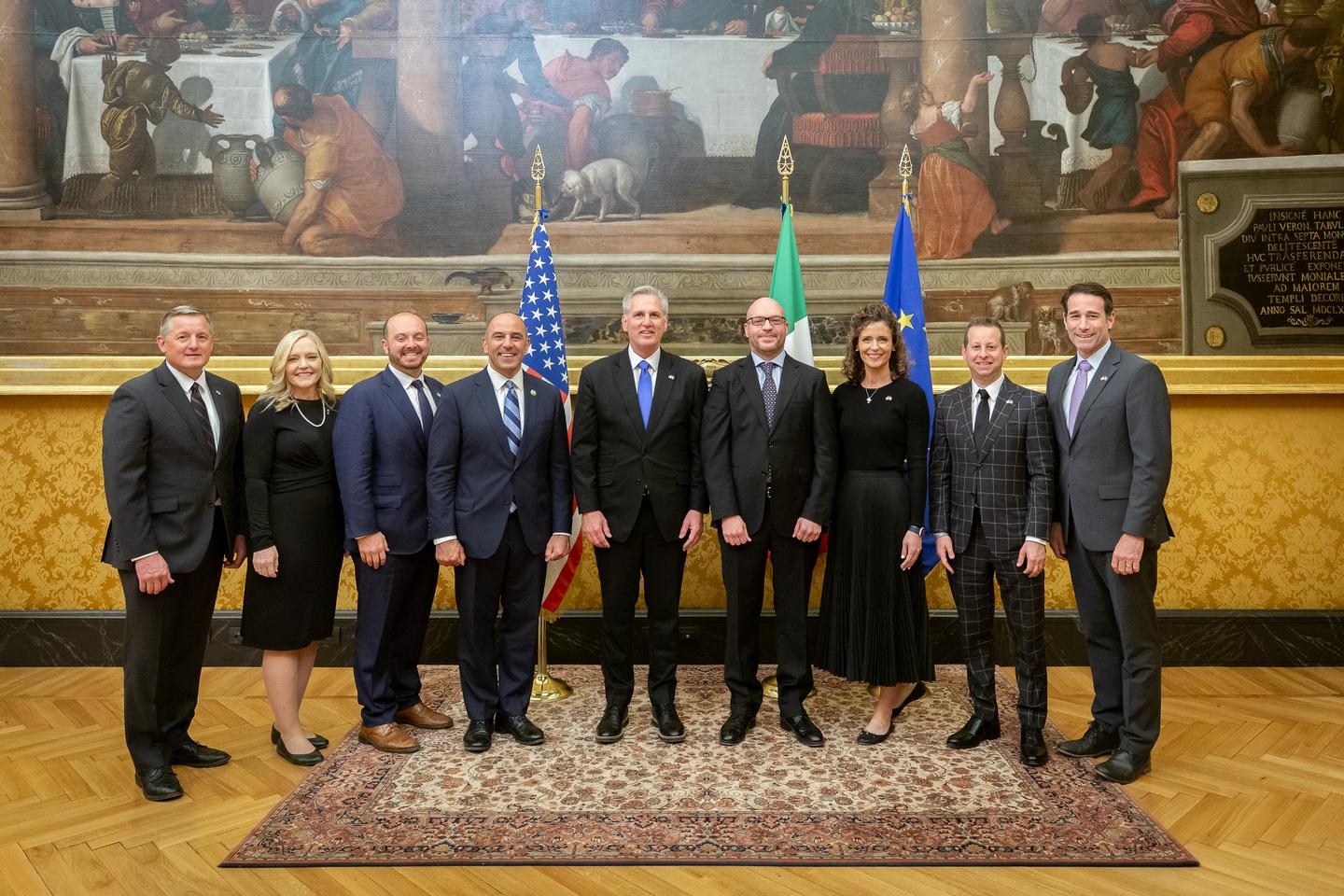
Credit: Office of Speaker Kevin McCarthy

Speaker Kevin McCarthy and a group of his fellow lawmakers met with a range of elected officials and important people during their recent two-week international congressional delegation, which included stops in Egypt, Israel, and Jordan. During a final leg in Italy last week, McCarthy and co. met with Pope Francis and Prime Minister Meloni.

But one of the other individuals the delegation met with in Italy was a man named Lorenzo Fontana. Fontana serves as the president of the Chamber of Deputies, which means that, as the speaker of Italy’s lower legislative house, he is McCarthy’s counterpart in Italian government. Fontana led McCarthy into the legislative chamber to raucous applause, and he also gave the speaker a gift: a copy of McCarthy’s grandfather’s original birth certificate. The whole of the American group—which included two Democrats, Reps. Jimmy Panetta of California (son of Leon Panetta, the former defense secretary who once held the same seat in Congress) and Jared Moskowitz of Florida—posed for a photo with Fontana. 

While meetings with a variety of international politicians made up the core of the congressional delegation’s itinerary, Fontana is different from other figures the Americans met during the trip. To be sure, he shares some beliefs in common with Prime Minister Meloni: Like her, he is an ultra-conservative who advocates the priority of the family, the upholding of tradition, the virtues of nationalism, and the importance of strict immigration policies.

What makes Fontana different from Meloni is that his right-wing populism goes far, far beyond hers. His views have pushed him to support some of the worst and most dangerous people across Europe, and he has also carved out a lane as one Italy’s leading homophobes.

Fontana is a member of Lega (the League), Italy’s very far-right party that formed a coalition with Meloni’s Fratelli d’Italia (Brothers of Italy) last year to win the fall election. While it’s understandable that an American Republican might see conservative groups abroad as fundamentally similar to the GOP, Lega is simply not comparable to the Republican party. If it were operating in the United States, Lega would represent just a sliver of the larger GOP, a faction to the right of the Freedom Caucus whose median member would be someone like Paul Gosar, and whose still-further-right wing might be represented by someone like Richard Spencer.

Here are some highlights from Fontana’s career:

  • He has embraced Golden Dawn, a Greek political party and neo-nazi group.
  • He called Vladimir Putin “a light for us Westerners, who live in a great crisis of values.”
  • During the 2014 Russian invasion of Crimea, he wore a “no to Russian sanctions” shirt. He was later invited to participate as an “election observer” in Crimea as part of Russia’s propaganda campaign justifying the invasion.
  • As the Minister for Families, Fontana fought to restrict adoption and surrogacy for gay couples. He has also said same-sex parents “don’t exist.”

To be clear, McCarthy’s meeting and photo-op with Fontana do not amount to an endorsement of the latter’s views. And yes, the protocols and niceties of diplomacy hold that officials usually meet with their counterparts when traveling abroad. But those protocols are not set in stone. And for McCarthy to meet with Fontana in this way was an act of carelessness, given the way these meetings are advertised to the public. Fontana’s profile will certainly be elevated by pictures of him welcoming an American congressional delegation and presenting a gift to the speaker of the House. Further, Fontana being able to refer to an account of the meeting published on McCarthy’s own official website—where Fontana is mentioned alongside the prime minister and the pope—will do much to further legitimize him as a figure of international standing.

A McCarthy spokesperson did not respond to a request for comment.

Vetting problems seem to be increasingly common for conservative lawmakers; many members of the House Republican Conference have been burned for posing with Proud Boys who were later convicted of sedition, unabashed white supremacists, and more. Of course, it’s possible that these problems might arise from more than simple negligence. Former Rep. Devin Nunes and some of Trump’s children are slated to share a stage with Hitler-praising internet personalities this coming weekend at Trump National Doral resort in Miami. It’s hard to take care to avoid associating with the hateful conspiratorial fringe if you just don’t care that much about it in the first place.

But the highest-ranking elected Republican currently in office should know better and do better, especially considering that during the same trip abroad, he showed that he won’t always take the far-right bait. Then, too, the rest of the international congressional delegation, including Panetta and Moskowtiz, should have had the foresight to have asked their staff to research the officials they met abroad to avoid exactly these problems. (Spokespeople for Panetta and Moskowitz also did not respond to requests for comment.)

Share Press Pass

The Corruption of Lindsey Graham

As I mentioned above, Bulwark writer Will Saletan has just published a remarkable deep dive on Lindsey Graham. Read it and you’ll come away with a clearer understanding of what it looks like when authoritarians corrupt liberal democracies—because you’ll know what it looked like, step by step, when it happened to ours.

Here’s a snapshot:

When an authoritarian rises to power in a democratic country, it can be a shock. But over time, the shock wears off. As the new leader tramples norms and rules, people get used to it. That’s part of what happened to Graham and his colleagues in Trump’s first year. They got used to the president’s behavior. It began to feel normal.

Normalization is corrosive. It numbs you to the authoritarian’s crimes. You stop noticing what’s happening. Or you no longer care. Or you get used to defending the leader’s abuses, as Graham did.

The second stage is more serious. Once the authoritarian’s allies have normalized his behavior, they rally around him just as they would rally around any other leader of their party. And they attack his opponents just as they would if he were a normal president.

Graham’s trajectory over the past eight years brought him very low as he sought power and influence with a leader he once despised, in the process becoming the same kind of demagogue he used to hate. Saletan’s account of this process uses Graham’s story to illustrate the mechanics of emerging authoritarianism. I hope you’ll give the whole thing a read. It is worth every minute you spend on it.

Subscribe to Press Pass

By The Bulwark  ·  Launched 4 months ago

In-depth reporting on Congress, campaigns, and the way Washington works.


May 2, 2023

HEATHER COX RICHARDSON

MAY 3, 2023

The end of the semester is always rough and I’ve had too many long nights, so tonight I am going to offer just one explanation about the debt clause in the Fourteenth Amendment: 

The debt ceiling crisis continues to dominate the news, with some speculation now that White House officials are wondering whether the Fourteenth Amendment to the Constitution might require the government to continue to pay its bills whether Congress actually raises the debt ceiling or not.

The fourth section of the Fourteenth Amendment reads: “The validity of the public debt of the United States, authorized by law, including debts incurred for payment of pensions and bounties for services in suppressing insurrection or rebellion, shall not be questioned.”

This statement was a response to a very specific threat. 

During the Civil War, the U.S. Treasury issued more than $2.5 billion in bonds to pay for the war effort. To make those bonds attractive to investors, Congress had made most of them payable in gold, along with their interest. That gold backing made them highly valuable in an economy plagued by inflation. 

In contrast, most working Americans used the nation’s first national currency, the greenbacks, introduced by Congress in 1862 and so called because they were printed with green ink on the back and black ink on the front—as our money still is; check out a dollar bill. Because greenbacks were backed only by the government’s ability to pay, their value tended to fluctuate. As Congress pumped more and more of them into the economy to pay expenses, inflation made their value decrease. 

National taxes funded the bonds, which meant that workers whose salary was paid in the depreciating greenbacks paid taxes to the government, which in turn paid interest to bondholders in rock-solid gold. After the war, workers noted that inflation meant their real wages had fallen during the war, while war contracts had poured money into the pockets of industrialists. 

Workers couldn’t do much about the war years and still faced years of paying off the wartime bonds. They began to call for repaying war bonds not in gold but in depreciated currency, insisting that taxpayers should not be bled dry for rich bondholders. Democrats, furious at wartime policies that had enriched industrialists and favored bankers, promised voters that if voters put them in control of Congress, they would put this policy into law.

Republican legislators who had created the bonds in the first place were horrified at the idea that Democrats were claiming the right to change the terms under which the debt had been sold. This, they said, was “repudiation” and would turn those who had invested in the United States against it. 

Bonds were about far more than just money. When the war broke out, the Treasury had turned to bankers to underwrite the war. But the bankers were notably reluctant to bet against the cotton-rich South and refused to provide the amount of help necessary. To keep the government afloat, Treasury officers had been forced to turn to ordinary Americans, who for four years had shouldered the financial burden of supporting their government. 

“It is your war,” Treasury Secretary William Pitt Fessenden wrote to the public in 1864. “Much effort has been made to shake public faith in our national credit, both at home and abroad…yet we have asked no foreign aid. Calm and self-reliant, our own means thus far have proved adequate to our wants. They are yet ample to meet those of the present and the future.” 

On April 3, 1865, the day the Confederate capital of Richmond, Virginia, fell, bond salesman Jay Cooke hung from his office window a sign that featured the nicknames of the two most popular bond issues, along with an even larger banner that read:

“The Bravery of our Army

The Valor of our Navy

Sustained by our Treasury

Upon the Faith and 

Substance of

A Patriotic People.”

The debt was a symbol of a newly powerful national government that represented ordinary Americans rather than the elite enslavers who had controlled it before the war. “There has never been a national debt so generously distributed among and held by the masses of the people as all the obligations of the United States,” wrote an Indianapolis newspaper in 1865. “This shows at once the strength of popular institutions, and the confidence the people have in their perpetuity.” 

Undermining the value of U.S. bonds was an attack not just on the value of investments, but on the nation itself. When Republican lawmakers wrote the Fourteenth Amendment in 1866, they recognized that a refusal to meet the nation’s financial obligations would dismantle the government, and they defended the sanctity of the commitments the government had made. When voters ratified that amendment in 1868, they added to the Constitution, our fundamental law, the principle that the obligations of the country “shall not be questioned.”

Notes:


April 23, 2023, 5:00 AM CDT

By Rosa DeLauro, representative for Connecticut’s 3rd congressional district

House Speaker Kevin McCarthy’s bill holds the economy hostage in exchange for slashing investments important to American families.

On Wednesday, Republican House Speaker Kevin McCarthy unveiled a bill he claims will fulfill our debt limit obligations. In truth, the bill holds the economy hostage in exchange for slashing investments important to American families.

In exchange for a short-term increase in the debt ceiling, the speaker’s proposal drastically cuts spending for 2024, then compounds those reductions by capping investments for the next 10 years. To be clear, Republicans are threatening a default on our debt unless we gut vital programs.

As the lead Democrat on the House Appropriations Committee, which oversees government funding, I have warned for months that cuts of this magnitude will be devastating, no matter how you slice them. Because Republicans have refused to specify the fallout of their indiscriminate cuts, earlier this year I asked federal agencies about the potential impact.

The cuts introduced by Republicans would endanger our public safety and our national security.

But McCarthy and his allies are moving ahead with their reckless plan, even after those agencies have laid out its disastrous consequences. This should outrage all of us.

For months, I have heard my Republican colleagues claim that defense, veterans’ health care and border security would be protected. This bill does not keep that pledge. It either puts this funding on the chopping block or forces further cuts to other critical government programs by more than 22%. As much as Republicans want to pretend otherwise, these caps are cuts. They would ensure that resources for critical programs remain below current levels for the next 10 years — all for less than one year of preventing a default.

Instead of building upon these investments to keep our communities safe, the cuts introduced by Republicans would endanger our public safety and our national security. They would make our borders less safe by allowing hundreds of thousands of pounds of drugs across our borders. They would cut law enforcement by taking thousands of cops off the streets. They put veterans’ health and well-being at risk by delaying access to health care and benefits they have earned. And they weaken our national security by undermining military readiness, damaging efforts to deter the Chinese Communist Party and decreasing our ability to recruit and retain service members.

Not only would Republicans make our communities less safe, but they would also increase costs for hardworking families at a time when families are struggling to get by. They would kick 300,000 children out of child care and Head Start, slash nutrition services for more than 1 million seniors and turn off the heat in 5 million low-income homes. They make health care more expensive and less accessible for 2 million vulnerable people who rely on community health centers. They make college more expensive by reducing the maximum Pell Grant award by nearly $1,000 for the 6.6 million recipients, as well as 80,000 who will no longer receive those grants. They make it more costly to run a small business, and they even make it more difficult and less safe to travel by shutting Federal Aviation Administration operations at 125 air traffic control towers and increasing Transportation Security Administration wait times to more than two hours at large airports.

McCarthy’s dangerous scheme would cause irreparable damage to our communities.

And to top it all off, these cuts undermine American workers by cutting jobs and job training programs, robbing workers of back pay, and making work environments less safe.

McCarthy wrongfully claims that this path would “restore fiscal discipline.” I know, and the American people know, that there is nothing disciplined about threatening the full faith and credit of the United States to force indiscriminate cuts to the yearly spending process — a process under which we funded critical programs with bipartisan support as recently as December. These annual bills lower costs, create jobs and support American communities.

McCarthy’s dangerous scheme would cause irreparable damage to our communities by gutting programs every single American relies on. This bill all but guarantees more chaos and increases the likelihood of going from one debt limit and government shutdown fight to the next. This is not what the American people elected us to do. I will continue to lead House Appropriations Democrats in rejecting these dangerous plans and protect American children and families with the urgency and focus they require. I urge my Republican colleagues to do the same.

Rosa DeLauro

Rep. Rosa DeLauro serves as ranking member of the House Appropriations Committee. She represents Connecticut’s 3rd Congressional District in the U.S. House of Representatives.


Further interest-rate hikes to fight inflation will worsen inequality. And they’re unnecessary.

Mar 7

Robert Reich

Mr. Powell,

As chairman of the Federal Reserve Board, you’re making your semi-annual policy report today to Congress.

I hope you don’t think me impertinent, but I have an urgent question for you that I hope one of the senators asks: How can you justify further rate hikes in light of America’s staggering inequality?

You and your colleagues on the Fed’s Open Market Committee are considering pushing interest rates much higher in your quest to get inflation down to your target of 2 percent. You believe higher interest rates will reduce consumer spending and slow the economy.

With due respect, sir, this is unnecessary, and it would be unjust.

Over the past year, you’ve raised interest rates at the fastest pace since the 1980s, from near zero to more than 4.5 percent.

But consumer spending isn’t slowing. It fell slightly in November and December but jumped 1.8 percent in January, even faster than inflation.

As a result, you’re now saying you may need to lift rates above 5 percent. A recent paper by a group of academic and Wall Street economists suggests that you will need to raise interest rates as high as 6.5 percent to meet your 2 percent target.

This would worsen America’s already staggering inequalities.

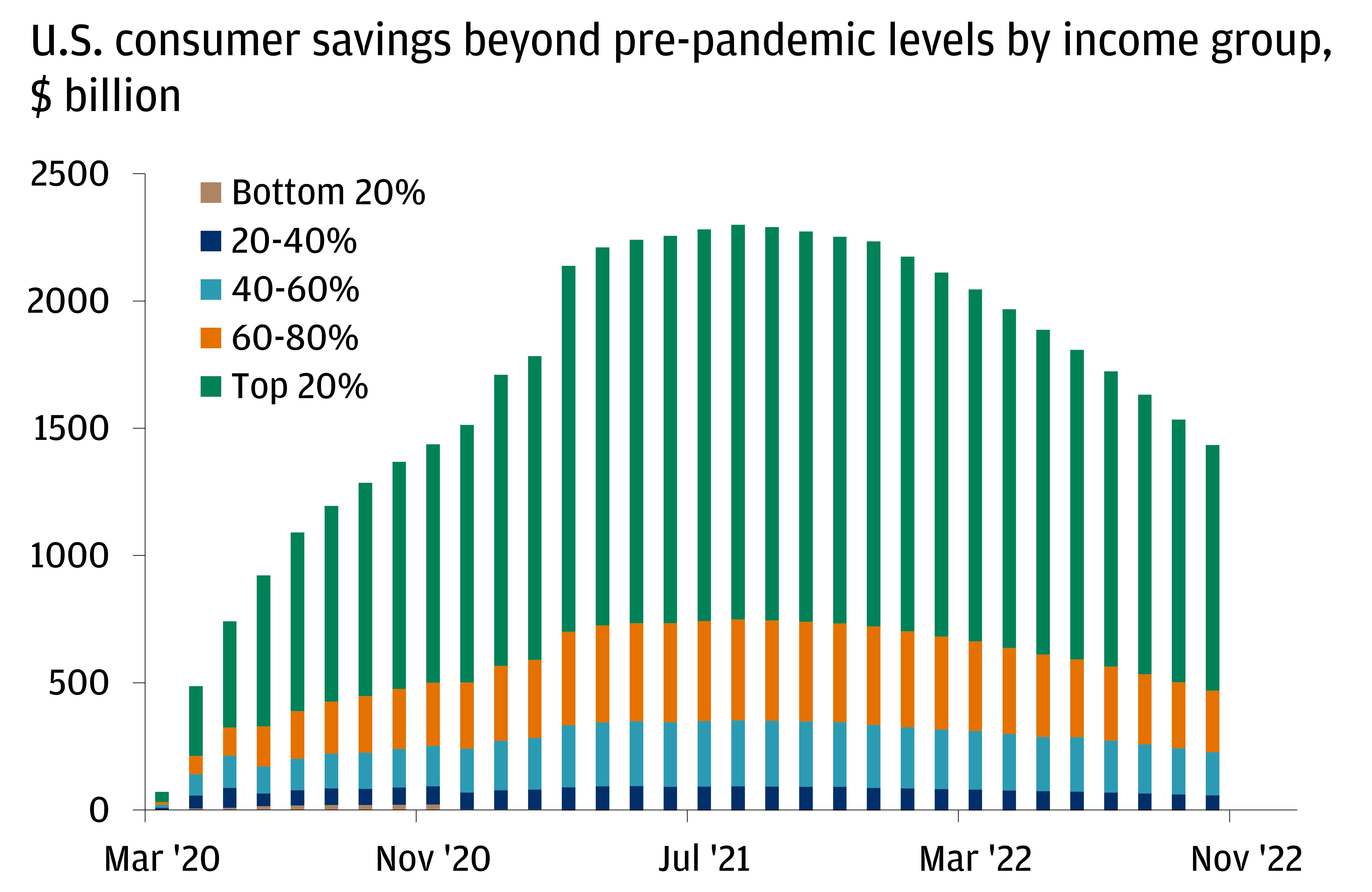
You see, the Americans who are doing most of the spending are not the ones who will be hit hardest by the rate increases. The biggest spenders are in the top fifth of the income ladder. The biggest losers will be in the bottom fifth.

Widening inequality has given the richest fifth a lot of room to keep spending. Even before the pandemic, they were doing far better than most other Americans.

Their current spending spree is a big reason you and your colleagues at the Fed are having so much difficulty slowing the economy by raising interest rates (in addition to the market power of many big corporations to continue raising prices and profit margins).

The higher rates are flowing back into the top fifth’s savings, on which they’re collecting interest.

The top fifth’s savings are still much higher than they were before the pandemic, so they can continue their spending spree almost regardless of how high you yank up rates. Take a look at this chart:

(Sources: J.P. Morgan Private Bank, Haver Analytics. Data as of October 2022.)

But yank up rates and you’ll impose big sacrifices on lower-income Americans. The study I mentioned a moment ago concludes that “there is no post-1950 precedent for a sizable central-bank-induced disinflation that does not entail substantial economic sacrifice or recession.”

There’s also no post-1950 precedent for the degree of income inequality Americans are now experiencing.

The people who will endure the biggest sacrifices as the economy slows will be the first to lose their jobs: mostly, those in the bottom fifth. Relying on further interest-rate hikes to fight inflation will only worsen the consequence of America’s near-record inequality.

There’s no reason for further hikes, anyway. Inflation is already slowing.

I understand your concern, Mr. Powell. What looked like a steady albeit gradual slowdown is now looking even more gradual.

But so what? It’s the direction that counts.

You should abandon your 2 percent target rate of inflation. There’s nothing sacrosanct about 2 percent. Why not 4? Getting inflation down to 2 percent is going to cause too much pain for the most vulnerable.

And you should suggest to Congress that it use other tools to fight inflation, such as barring corporations with more than 30 percent market share from raising their prices higher than the overall inflation rate — as recently proposed by New York’s attorney general.

May I be perfectly frank with you, sir? It would be terribly unjust to draft into the inflation fight those who are least able.

Thank you.

Robert Reich


The former President is still inserting himself into the everyday politics of the country in the same negative way that he did for 4 years. Since this is America, he is not restricted except for the messaging sites that have banned him due to inaccurate and false information. His ability to reach masses is greatly diminished yet he still manages to be seen and heard. His messaging has not changed and it is still about him and not about the country as it should be now and should have been during his tenure. TOTUS had many opportunities to be “mediocre” and he squandered those by self-aggrandizing executive orders and ongoing “campaign” speeches. Being President is exceedingly hard job along with being on duty 24/7 but TOTUS chose to delegate his duties to underlings who spoon fed him ideas and topics that he deemed prudent but were uninformed in relation to the needs of the country (that means ALL American voters). The Presidency is not a person but an institution that is guided by a person (hopefully someone with the “right stuff”). Essentially, we had 4 years of mediocracy instead of potential greatness and a show of American ability. The Presidency is about leading a country forward and being aware of the flaws and making some attempts to improve. Totus’s failures created a year of deaths due to poor reaction to a national health crisis which resulted in an initial loss of hundreds of thousand lives until someone gave him a buzzword that excited him (operation “warp speed”) which resulted in an acceleration of vaccine invention and production (a bit late but needed none the less). For 4 years the worst elements of government held sway behind the “curtain of TOTUS’ rhetoric and feckless leadership.

btn_donateCC_LG

Please Donate


Heather Cox Richardson from Letters from an AmericanMon 6/21/202

June 21, 2021Heather Cox RichardsonJun 22

Lawmakers today are jockeying before tomorrow’s test vote in the Senate on S1, the For the People Act. This is a sweeping bill that protects the right to vote, ends partisan gerrymandering, limits the influence of money in politics, and establishes new ethics rules for presidents and other federal officeholders.Passing election reform is a priority for Democrats, since Republican-dominated legislatures across the country have gerrymandered states to make it almost impossible for Democrats to win majorities and, since President Biden took office, have passed laws suppressing the vote and making it easier for Republican state officials to swing elections to their candidates no matter what voters want.But it is not just Democrats who want our elections to be cleaner and fairer. S1 is so popular across the nation—among voters of both parties—that Republican operatives agreed in January that there was no point in trying to shift public opinion on it. Instead, they said, they would just kill it in Congress. This conversation, explored in The New Yorker by Jane Mayer, happened just after it became clear that Democrats had won a Senate majority and thus Mitch McConnell (R-KY), who had previously been Senate Majority Leader, would no longer be able to stop any legislation Republicans didn’t like.Still, Republican senators can deploy the filibuster, which permits just 41 of the 50 Republican senators to stop the act from passing. It is possible for the Democrats to break a filibuster, but only if they are all willing. Until recently, it seemed they were not. Senator Joe Manchin (D-WV), a conservative Democrat in a Republican-dominated state, opposed some of the provisions in S1 and was adamant that he would not vote for an election reform bill on partisan lines. He wanted bipartisan support.Last week, Manchin indicated which of the measures in the For the People Act—and in the John Lewis Voting Rights Advancement Act—he will support. In a mixture of the priorities of the leadership of each party, he called for expanding access to voting, an end to partisan gerrymandering, voter ID, automatic registration at motor vehicle offices, making Election Day a holiday, and making it easier for state officials to purge voters from the rolls.Democrats across the ideological spectrum immediately lined up behind Manchin’s compromise. Republican leadership immediately opposed it, across the board. They know that fair voting practices will wreck them. Today, McConnell used martial language when he said he would give the measure “no quarter.”Tomorrow, Senate Majority Leader Chuck Schumer (D-NY) will bring up for a vote not the measure itself, but whether to begin a debate on such a measure. “Tomorrow, the Senate will also take a crucial vote on whether to start debate on major voting rights legislation,” Schumer said today. “I want to say that again—tomorrow the Senate will take a vote on whether to start debate on legislation to protect Americans’ voting rights. It’s not a vote on any particular policy.”Republicans can use the filibuster to stop a debate from going forward. Getting a debate underway will require 60 votes, and there is currently no reason to think any Republicans will agree. This will put them in the untenable spot of voting against talking about voting rights, even while Republicans at the state level are passing legislation restricting voting rights. So the vote to start a debate on the bill will fail but will highlight the hypocrisy of Republican lawmakers.Perhaps more to the point in terms of passing legislation, it will test whether the work the Democrats did over the weekend incorporating Manchin’s requests to the measure have brought him on board.If so, and if he gets frustrated with Republican refusal to compromise at all while the Democrats immediately accepted his watering down of their bill, it is possible he and Senator Kyrsten Sinema (D-AZ), who has also signaled support for the filibuster in its current form, will be willing to consider altering it. The Senate could, for example, turn it back into its traditional form—a talking filibuster—or carve out voting rights bills as they have carved out financial bills and judicial nominations.There are signs that the Democrats are preparing for an epic battle over this bill. Today White House Press Secretary Jen Psaki indicated that the administration hopes the vote will show that all 50 Senate Democrats are now on board and that they will find a new way forward if the Republicans do not permit a debate.More telling, perhaps, is an eye-popping op-ed published yesterday in the Wall Street Journal by Mike Solon, a former assistant to McConnell, and Bill Greene, a former outreach director for former House Speaker John Boehner; both men are now lobbyists. In order to defend the filibuster, they argue that the measure protects “political nobodies” from having to pay attention to politics. If legislation could pass by a simple majority, Americans would have to get involved. The system, they suggest, is best managed by a minority of senators.“Eliminating the Senate filibuster would end the freedom of America’s political innocents,” they write. “The lives that political nobodies spend playing, praying, fishing, tailgating, reading, hunting, gardening, studying and caring for their children would be spent rallying, canvassing, picketing, lobbying, protesting, texting, posting, parading and, above all, shouting.”The authors suggest misleadingly that the men who framed the Constitution instituted the filibuster: they did not. They set up a Senate in which a simple majority passed legislation. The filibuster, used to require 60 votes to pass any legislation, has been deployed regularly only since about 2008.But that error is minor compared to the astonishing similarity between this op-ed and a speech by South Carolina Senator James Henry Hammond in 1858, when he rose to explain to his colleagues that the American system was set up to make sure lawmakers could retain control no matter what a majority of Americans wanted. Hammond was one of the nation’s leading enslavers and was desperate to make sure his party’s policies could not be overridden by the majority.Voting only enabled people to change the party in charge, he said. “It was not for the people to exercise political power in detail… it was not for them to be annoyed with the cares of government.”Hammond explained that the world is made up of two classes: those who ”do the menial duties… perform the drudgery of life. That is, a class requiring but a low order of intellect and but little skill….. It constitutes the very mud-sill of society and of political government.” On them, he explained, rests “that other class which leads progress, civilization, and refinement.”It was imperative, he said, to retain these distinctions in politics. The South had managed such a thing, while the North, he warned, had not. “Our slaves do not vote. We give them no political power. Yours do vote, and, being the majority, they are the depositaries [sic] of all your political power. If they knew the tremendous secret, that the ballot-box is stronger than ‘an army with banners,’… where would you be? Your society would be reconstructed, your government overthrown, your property, divided, not… with arms in their hands, but by the quiet process of the ballot-box.”—-
btn_donateCC_LG

Please Donate


Here’s how you and your family can stay safer

by Mike Zimmerman, AARP, November 9, 2020 | 

En Espanol We don’t need more proof of how dangerous the coronavirus is.

We know that more than 237,000 Americans had died of the disease as of early November, and 95 percent of COVID-19 deaths in the U.S. have occurred among people who were 50 or older. We know preexisting conditions such as obesity, heart disease, autoimmune diseases and type 2 diabetes make coronavirus infection even riskier. We know COVID-19 can cause blood clotting that can ravage your lungs and inflammation that can damage your heart and organs; a viral attack on your pancreas can even cause “COVID diabetes.” And infections can sometimes linger for months in so-called “long haulers.”


For the latest coronavirus news and advice go to AARP.org/coronavirus.


Yet we’ve isolated ourselves for more than eight months now, and the psychological toll of COVID is real. A study from early in the pandemic found “moderate” and “severe” depression symptoms had tripled.

Now the holidays are here, and we’re missing our friends and loved ones more than ever. Can we safely celebrate the holidays and the end of a long, lousy year?

“We’re not out of the woods with COVID-19,” says Michael G. Ison, M.D., infectious disease specialist at Northwestern Medicine in Illinois. “The virus is still there. It’s still dangerous.”

To help us cope with the coming holidays, we queried top experts about navigating the season safely and warmly.

1. A relative had COVID-19 several weeks ago. Can he or she still make me sick?

People who have had the virus generally stop spreading it 10 to 14 days after exhibiting symptoms. But the more we learn about the coronavirus, the more twists and turns we discover. For that reason, anyone who has contracted the virus, or thinks he’s been exposed to it, should be cleared by a doctor before seeing anyone, says Sten Vermund, M.D., dean of the Yale School of Public Health.

That said, “those people are largely safe,” Vermund asserts. “ ‘Totally safe’ would be a slight exaggeration, but the functional reality is that a recovered coronavirus patient poses a minimal risk to others.”

2. I tested positive for COVID earlier this year. Does that mean I’m immune now?

Unfortunately, we don’t yet know the answer to that. People who recover from the virus do have some level of acquired immunity, but it’s difficult to know how much or for how long. Research is conflicting: A study of 1,100 COVID patients in the New England Journal of Medicine found that patients had no decline in antibodies four months after diagnosis. But a separate study found antibodies peaking 60 days after diagnosis and declining thereafter. And, of course, there have been a handful of widely reported cases of people contracting the virus more than once.

“When we look at immune responses, we look at how much antibody is in the blood,” Ison says. “With most viruses, that level goes down slowly over time, particularly with older people.” But the coronavirus is a whole new beast. “We’ve only known about this virus for about nine months,” Ison says. “Even for the earliest patients, all we can say is that immunity may last for nine months. Whether it lasts any longer, we can’t know yet.”

The severity of one’s infection may determine subsequent antibody levels and how long they last. One study of COVID-19 patients in China who had zero symptoms found significantly lower antibody levels than in patients with symptoms. Common sense would point to asymptomatic people being more vulnerable to reinfection because of low or no antibodies. But we simply don’t know enough about what antibody level is required to protect people from COVID-19.

3. Is catching the coronavirus linked to how much time we spend together?

The amount of exposure you have to the virus — both in terms of how sick another person is and how much time you spend with him or her — does appear to determine your risk, says Thomas Fekete, M.D., professor of microbiology and immunology at Temple University. That’s why so many health care providers have gotten sick, especially at the start of the pandemic, when they had inadequate personal protective equipment.

While there are no established guidelines, Fekete suggests modeling how you handle indoor spaces on the policies in place at Temple’s medical school: More than 15 minutes of exposure to another person is “meaningful,” while fewer than 15 minutes of exposure is less worrisome. “We’re less concerned if someone rides an elevator with someone for 30 seconds than if he or she shares a small space with someone for an hour,” he says. “Our policy also mandates wearing a mask and eye protection. That said, there are no guarantees.”

And that’s what makes holiday gatherings so problematic. An infected person will throw off more virus when talking than when breathing — and more still when singing Christmas carols or shouting to be heard.

4. We’ve already had a bad outbreak in my town. Have we reached herd immunity?

As the pandemic has progressed, you may have heard about getting the U.S. population to a point where enough people have been exposed to the virus — either by infection or vaccine — that it’s no longer a threat. This “herd immunity” is a real thing — the U.S. all but eradicated measles because an effective vaccine created herd immunity. Just don’t expect this to happen soon with COVID-19.

“Herd immunity requires somewhere in the neighborhood of 60 to 70 percent of the population having immunity,” Ison says. “The epidemiology studies have gone on to tell us that even in the worst areas like New York, it’s in the 20 percent range, and in most areas in the 3 to 10 percent range.”

A COVID-19 vaccine could change that, but again, we’re nowhere near that point. “As we’ve seen with other viruses, if people don’t get the vaccine, we get outbreaks,” he says. “So herd immunity not only takes an effective vaccine, but a willingness to get that vaccine.”

5. If I do host a holiday gathering, are there any rules I should put in place for my family?

Here’s a good one: Nobody gets to come to dinner unless he or she has had a flu shot. The reasons go far beyond the usual in 2020. Flu and COVID-19 symptoms are similar, so if you become ill with the flu, it could necessitate a trip to the doctor or even the hospital, which puts you at additional risk. And yes, it’s possible to get both, either one after the other, or simultaneously, Vermund says. Just imagine getting COVID after your lungs have already been dealing with the flu.

Vermund puts it bluntly: “It is essential for people to get the influenza vaccine. And I mean everybody: children, pregnant women, young adults, middle age, older adults, seniors, everyone.”

6. My whole family is in excellent health. Does COVID-19 really pose a threat to us?

The fact is, researchers cannot predict how sick any one person will get if infected by the coronavirus. Recent research out of Stanford suggests that patients with more severe COVID-19 symptoms tend to have higher levels of certain inflammatory molecules in their blood. This could help experts predict severity in the years to come. But right now?

“None of us are clear [about] what’s going to happen,” Fekete says. Which means even if you’re a “healthy” person, getting COVID-19 is a risk to yourself and everyone else.

“In the best of all worlds, [precautions] would reduce the impact of coronavirus, but also other respiratory viruses. If that’s the outcome, I think people will be relatively OK over the winter months,” Fekete argues. “Having said that, I’m expecting to see significant outbreaks in certain populations, such as nursing homes and adult living facilities, and also in immunosuppressed people.”


“We’ve had some terrible ageism creeping into politics and medicine,” Vermund says. “There are people who have an attitude, like, ‘Why should I suffer just to protect the elderly?’ And that’s a very unfortunate turn in American society.”

What can you do? Watch out for you and yours, of course, but set a strong example for others you know who may not be as enthusiastic as you are to prevent virus spread.

7. Are our holiday traditions ruined?

After more than six months of distancing and isolation, the pressure to gather for Thanksgiving and other holidays will be massive. But this is just one year, and it would be tragic to get even one family member or friend (or yourself!) sick. Remember: An August wedding in Maine was linked to 178 COVID cases and eight deaths — and none of those who died even attended the event.

“Thanksgiving is one of my favorite holidays, but this year it can’t be done safely in the usual sense,” Ison says. “We won’t just have COVID-19. We’ll have the flu and other respiratory viruses as well. So it has the potential to be a perfect storm, and we can’t let our guard down. We’ll have to get creative with the holidays, which will require more virtual visits.”

The good news: It’s temporary. “We’re not condemning people to a lifetime of this,” Vermund says. “I do have a great deal of optimism for 2021 because we’ve got more than 400 clinical trials of new antiviral drugs, new biologic agents like monoclonal antibodies, and different steroid strategies. We’ve got 10 vaccines now in phase 3 clinical trials, which is absolutely remarkable. And we can avoid circulating the virus. So I’m just trying to remind people that 2020 is not 2021. We probably can be closer to normal by the end of next year.”

btn_donateCC_LG

Please Donate


It is unfortunate that so many of us are single issue voters, this failing allows for the rise of poor performing legislators and leaders. The reduction of CIVICS instruction in schools is a possible factor but mass media is a greater mover of public opinion using “sound bites, dog whistles and tropes’ to explain or purvey ideas. Our job as voters is to gather information for ourselves and not leave it to other people or the media. MA

By Lauren Fox, CNN

Updated 8:15 PM ET, Tue July 21, 2020

(CNN)Despite severe shortages in coronavirus testing supplies and lags in results, the Trump administration is still sitting on billions of dollars in unused funding that Congress allocated months ago. Lawmakers on both sides of the aisle have questions about why the money has not been used as testing continues to fall well short of the national need.

“It’s probably a logistical problem as much as anything else, but yeah, it’s a concern,” said Republican. Sen. John Cornyn of Texas.

As negotiations have ramped up between the White House and Senate Republicans in recent days on whether to include more funding for testing in the next round of stimulus, the White House pushed against more money over the weekend, arguing that billions remain unspent. But lawmakers and aides — who estimate the remaining amount at about $7 billion to $8 billion — say they’ve been unable to get a clear answer to why that money hasn’t been touched in the first place.

In April, Congress passed legislation that included $25 billion in additional funds for testing and contact tracing. The money — which included $11 billion that went to states — was put into the Public Health and Social Services Emergency Fund at the Department of Health and Human Services. Months later, aides and lawmakers say they aren’t sure why so much still hasn’t been spent.

“They’ve never believed we should test,” Sen. Patty Murray, the top Democrat on the Health, Education, Labor and Pensions Committee, told CNN. “We’ve got to keep pushing.”

One Democratic aide familiar with discussions around the money said there was some speculation that it had been tied up at the Office of Management and Budget level, but there was no clear evidence whether the holdup had happened for any particular reason or was just a symptom of pushing billions out the door quickly.

Behind the scenes, lawmakers of both parties have asked the administration to explain why the money remains unused.FourDemocrats on the Senate Appropriations Committee sent a letter directly to President Donald Trump this week asking for answers.

“In April, Congress appropriated $25 billion through the Paycheck Protection Program and Health Care Enhancement Act specifically to expand testing capacity and conduct surveillance and contact tracing to ensure we were prepared for another spike in cases. Yet based on the latest information from the Department of Health and Human Services, three months later less than half of the money provided has been obligated by the federal government and gaps in testing capacity and contact tracing are pervasive,” said the Democrats’ letter, signed by Murray along with Sens. Patrick Leahy of Vermont, Richard Durbin of Illinois and Jon Tester of Montana.

The letter also demanded that the administration explain why billions in funding to build up the Strategic National Stockpile hadn’t been used as reports show that states are once again struggling to find adequate personal protective equipment to weather the pandemic.

“Yet nearly four months later, the Administration has obligated only half of the funds Congress provided for the SNS (and only a portion of this was spent on PPE) and the Department of Defensehas informed us that it intendsto use nearly 70 percent of the DPA funding for shipbuilding, aircraft development, and other defense programs,” the letter reads, referring to the Defense Production Act.

Republicans have urged the administration in recent weeks to ramp up its response to the coronavirus as polls have shown the President lagging in key swing states and dragging rank-and-file Republicans up for reelection down with him.

“We have to up our game in testing. This is a worldwide problem,” Sen. Lindsey Graham, a South Carolina Republican who’s a close ally of Trump’s, told reporters Tuesday.

Republicans also strongly rebuked the administration’s argument that more funding wasn’t needed for testing and contact tracing in the next stimulus bill, saying that position not only put the country’s testing capabilities at risk, but also ignored the political realities of the situation.

“You would have to try hard to come up with a more tone-deaf position,” one GOP aide said over the weekend.

On Monday, members flat-out pushed back against the Trump administration’s position that more money for testing wasn’t needed.

“I just think that’s wrong,” said Sen. Roy Blunt, a Missouri Republican.

btn_donateCC_LG

Please Donate