Seventy-five years ago, on June 5, 1947, Secretary of State George C. Marshall, who had been a five-star general in World War II, gave a commencement speech at Harvard University.
Rather than stirring, the speech was bland. Its long sentences were hard to follow. It was vague. And yet, in just under eleven minutes on a sunny afternoon, Marshall laid out a plan that would shape the modern world.
“The truth of the matter is that Europe’s requirements for the next three or four years of foreign food and other essential products—principally from America—are so much greater than her present ability to pay that she must have substantial additional help or face economic, social, and political deterioration of a very grave character,” he said. “It is logical that the United States should do whatever it is able to do to assist in the return of normal economic health in the world, without which there can be no political stability and no assured peace. Our policy is directed not against any country or doctrine but against hunger, poverty, desperation and chaos. Its purpose should be the revival of a working economy in the world so as to permit the emergence of political and social conditions in which free institutions can exist.”
In his short speech, Marshall outlined the principles of what came to be known as the Marshall Plan to rebuild Europe in the wake of the devastation of World War II. The speech challenged European governments to work together to make a plan for recovery and suggested that the U.S. would provide the money. European countries did so, forming the Organization for European Economic Co-operation (OEEC) in 1948. From 1948 to 1952, the U.S. would donate about $17 billion to European countries to rebuild, promote economic cooperation, and modernize economies. By the end of the four-year program, economic output in each of the countries participating in the Marshall Plan had increased by at least 35%.
This investment helped to avoid another depression like the one that had hit the world in the 1930s, enabling Europe to afford goods from the U.S. and keeping low the tariff walls that had helped to choke trade in the crisis years of the 1930s. Marshall later recalled that his primary motivation was economic recovery, that he had been shocked by the devastation he saw in Europe and felt that “[i]f Europe was to be salvaged, economic aid was essential.”
But there was more to the Marshall Plan than money.
The economic rubble after the war had sparked political chaos that fed the communist movement. No one wanted to go back to the prewar years of the depression, and in the wake of fascism, communism looked attractive to many Europeans.
“Marshall was acutely aware that this was a plan to stabilize Western Europe politically because the administration was worried about the impact of communism, especially on labor unions,” historian Charles Maier told Colleen Walsh of the Harvard Gazette in 2017. “In effect, it was a plan designed to keep Western Europe safely in the liberal Western camp.”
It worked. American investment in Europe helped to turn European nations away from communism as well as the nationalism that had fed World War II, creating a cooperative and stable Europe.
The Marshall Plan also helped Europe and the U.S. to articulate a powerful set of shared values. The U.S. invited not just Europe but also the Soviet Union to participate in the plan, but Soviet leaders refused, recognizing that accepting such aid would weaken the idea that communism was a superior form of government and give the U.S. influence. They blocked satellite countries from participating, as well. Forcing the USSR either to join Europe or to divide the allies of World War II put Soviet leaders in a difficult position and at a psychological disadvantage.
With a clear ideological line dividing the USSR and Europe, Europeans, Americans, and their allies coalesced around a concept of government based on equality before the law, secularism, civil rights, economic and political freedom, and a market economy: the tenets of liberal democracy. As Otto Zausmer, who had worked for the U.S. Office of War Information to swing Americans behind the war, put it in 1955: “America’s gift to the world is not money, but the Democratic idea, democracy.”
In the years after the Marshall Plan, European countries expanded their cooperative organizations. The OEEC became the Organization for Economic Co-operation and Development (OECD) in 1961 and still operates with 37 member countries that account for three fifths of world trade. And the U.S. abandoned its prewar isolationism to engage with the rest of the world. The Marshall Plan helped to create a liberal international order, based on the rule of law, that lasted for decades.
In his commencement speech on June 5, 1947, Marshall apologized that “I’ve been forced by the necessities of the case to enter into rather technical discussions.” But on the ten-year anniversary of the speech, the Norwegian foreign minister had a longer perspective, saying: “this initiative taken by Marshall and by the American Government marked the beginning of a new epoch in western Europe, an epoch of wider, and above all more binding, cooperation between the countries than ever before.”
Not bad for an eleven-minute speech.
—
Notes:
Carlyle Holt, “Do You Know What Marshall Plan Is?” Boston Globe, July 11, 1947, p. 1.
James Birchfield, “Why Plan Was Announced at Harvard,” Boston Globe, June 9, 1957, p. A12.
Otto Zausmer, “Santa Claus to the Whole World,” Boston Globe, December 25, 1955, p. 2A.
“Europeans Hail Marshall, Say Plan Saved Nations,” Boston Globe, June 6, 1957, p. 16.
In 1981, Reagan Republicans took power with the plan of cutting the government back to the form it took in the 1920s. But Americans like a basic social safety net and protection for consumers and workers, so to win votes for tax cuts and deregulation, Republican leaders warned that white Christian men who just wanted to work hard for their own success were under attack by a government in thrall to minorities, women, lazy organized workers, and secularists who were destroying traditional values and turning the country over to socialism.
As wealth concentrated upward and it became harder and harder for ordinary Americans to rise, Republican leaders demonized Democrats and, when voters kept electing them, delegitimized elections themselves. Increasingly, they talked of the need for violence to protect individualism from an overreaching government.
Finally, as of January 6, 2021, they have rejected the idea of democracy and have convinced their followers—and perhaps themselves—that the only way to save America is to destroy it.
Today, Maggie Haberman reported in the New York Times that on January 5, Marc Short, then–vice president Mike Pence’s chief of staff, told Pence’s lead Secret Service agent that Trump was about to turn against Pence publicly and that the vice president could be in danger. Clearly, members of the administration anticipated violence on January 6 and, astonishingly, expected it because of the actions of the U.S. president.
President Joe Biden took office with what appeared to be the idea that he could wean Republicans away from their growing fascination with authoritarianism by creating a government that rebuilt the economy to work for ordinary people.
His American Rescue Plan enabled the U.S. to come out of the pandemic with the strongest economy among any of the liberal democracies that make up the Group of Seven (G7)—Canada, France, Germany, Italy, Japan, the United Kingdom, and the United States—and the nation’s economy is on track to grow faster this year than China’s for the first time since 1976.
Today’s jobs report shows that employers are still adding jobs: there were 329,000 new non-farm jobs in May. Unemployment held steady at 3.6%, with Black Americans showing the highest gains in labor force participation. With almost two job openings available for every unemployed person, wages continue to rise, up .4% since April. Wage growth for the year is over 5%. The stock market responded by dropping, likely a reflection of an expectation that the strong jobs report will mean the Fed will raise interest rates again soon.
Biden celebrated the numbers but said, “There’s no denying that high prices, particularly around gasoline and food, are a real problem for people. But there’s every reason for the American people to feel confident that we’ll meet these challenges.”
That inflation has been driven by a number of factors: increased demand, increased savings, supply chain snarls, and even the rising wages that are putting money into the pockets of those unaccustomed to economic gains. And since February, Russian president Vladimir Putin’s war on Ukraine has further disrupted oil markets, supply chains, and, increasingly, food.
Inflation has also been driven by the concentration of industry in the past several decades, which provided economies of scale but now sees us hamstrung as vital industries are controlled by a few operators. Notably, the pandemic shifted consumer preferences to online shopping, and the recovering economy kept that buying active. Shipping containers piled up on wharves with goods undelivered, and since just nine carriers control 80% of the global shipping market, they have been able to raise prices to triple their profits in 2021. The price for moving a container to the U.S. from China is now 12 times higher than it was before the pandemic.
Global oil production is also still out of whack with the rebounding global economy. Production dropped dramatically during the pandemic, with oil-producing nations cutting production by about 10% globally. Producers have been slow to increase production to keep up with the global recovery, not least because they are making record profits. Last month, Shell, which is Europe’s largest energy company, reported its largest quarterly profit ever, at $9.1 billion. It said it would use the windfall to buy back shares of the company, increasing the value of its stock.
The baby formula crisis has also been exacerbated by this concentration of industry. In the U.S, 90% of infant formula is produced by four firms, and they are protected from foreign competition by high tariffs. When one of the four, Abbott Nutrition, closed its Sturgis, Michigan, plant to deal with contamination, it sparked a true crisis.
Biden has tried to deal with these issues with the power he wields in the executive branch. He negotiated deals with U.S. carriers to clear out the pileup of containers in vital ports and asked Congress to pass legislation to increase competition in the carrying trade. (Both the House and the Senate have passed such bills, but they have not yet reconciled them to make one bill Biden can sign.) He released oil from the strategic reserve and asked Saudi Arabia to increase production, a request its leaders refused, but yesterday OPEC+ (the 13 members of the Organization of Petroleum Exporting Countries plus 10 oil-producing countries not in OPEC) agreed to begin ramping up their output back to where it was before the U.S. got them to reduce production in April 2020.
The administration has tried to increase the supply of infant formula by easing the way for more imports, worked with Abbott Nutrition to reopen their Sturgis plant safely, flown in two planeloads of formula from Europe, and arranged for a third planeload donated by United Airlines to arrive on June 9. On May 18, President Biden delegated authority to U.S. Health and Human Services secretary Xavier Becerra to address the shortage of infant formula. Becerra has invoked the Defense Production Act for the third time to increase infant formula supplies. It is not clear how bad the shortage remains. While store shelves are empty, buying is up 13% since April, suggesting that people may be stocking up.
Biden has emphasized that he wants to move more manufacturing back to the U.S. to stop the sorts of disruptions that have caused inflation. On Wednesday, he pointed out that the U.S. has added 545,000 manufacturing jobs since he took office and that the U.S. created more manufacturing jobs in 2021 than in almost any year in 30 years. “This didn’t happen by accident,” he said. “This is a direct result of my economic plan to grow the economy from the bottom up and middle out.” He called on Congress to pass the Bipartisan Innovation Act to support domestic manufacturing.
On Tuesday, Biden published an op-ed in the Wall Street Journal touting his economic successes and explaining how he plans to transition from the red hot economy of the past year to stable, steady growth. He promised to work with anyone “willing to have an open and honest discussion that delivers real solutions for the American people.”
Will any Republicans take him up on it? Something else Biden wrote makes me doubt it: “I ran for president because I was tired of the so-called trickle-down economy. We now have a chance to build on a historic recovery with an economy that works for working families.”
The big news today is that former Trump aide Peter Navarro was arrested on two counts of contempt of Congress. The House Select Committee to Investigate the January 6th Attack on the U.S. Capitol had subpoenaed Navarro to hear testimony and read documents about his participation in the attack on our government. Although he has talked openly about the plan to overturn the election, he refused to comply with the subpoena.
Navarro was livid at being arrested and handcuffed and put in a cell, saying that if they had just called him and said they needed him down at court, he’d have shown up. (He appeared to miss the point that the subpoena he ignored is basically a call that says, “Hey, we need you down at the court….”) He claims that authorities have violated the Constitution.
Reacting to the arrest, Representative Louie Gohmert (R-TX) told Newsmax, “If you’re a Republican, you can’t even lie to Congress or lie to an FBI agent or they’re coming after you.” He claimed that the grand jury acquitted lawyer Michael Sussman of lying to the FBI about his contact with Hillary Clinton’s 2016 campaign with the argument that “[o]f course you’re gonna lie. Everybody lies!” but that is, of course, not true. The jury said that the Department of Justice, which brought the suit against Sussman, did not prove its case. It is against the law to lie to Congress or to the FBI. Navarro has not been tried yet; he has simply been indicted.
And on Wednesday, as the horrific murders of schoolchildren and teachers in Uvalde, Texas, have been followed by several more mass killings, Fox News Channel personality Tucker Carlson claimed that Democratic efforts to promote gun safety are not about public health. Instead, he said, Democrats want to disarm the people because they’re afraid of a popular uprising against them because “they know they rule illegitimately.”
Comments Off on Mitch McConnell Is Pulling His Favorite Move After Mass Shootings
It is apparent that The GOP will stick together at the cost of Democracy. This is all about power pure and simple. If the GOP gains control of the House and Senate we will have real problems, look at the most vocal members who ignore the desires of the voters. A better government begins with the voters (us). MA
Jackie Kucinich
Sat, May 28, 2022, 10:21 PM
Tom Williams/Getty
The mass murder of 19 children and two of their teachers in Texas last week prompted Senator Minority Leader Mitch McConnell to say he’s hopeful Senators can find “a bipartisan solution” to the problem. But if that sort of response sounds familiar—and not particularly inspiring—that’s because he’s said it before, only to close the door later.
McConnell told CNN that he “encouraged” Sen. John Cornyn (R-TX) to engage with Democrats Sens. Chris Murphy (CT) and Sen. Krysten Sinema (AZ) about potential areas of agreement on new gun laws.
“I am hopeful that we could come up with a bipartisan solution,” he said.
While it is notable that McConnell signaled his willingness to talk about changes to laws that regulate gun ownership in the United States, in McConnell’s case, it’s only a small step above immediately dismissing action on guns.
Time and again, McConnell’s “hope” for a bipartisan solution has simply prolonged the inevitable: inaction.
In June 2016, after a man with a gun murdered 49 people at the Pulse Night Club in Orlando, McConnell told reporters “nobody wants terrorists to have firearms.”
“We’re open to serious suggestions from the experts as to what we might be able to do to be helpful,” he said.
But when a bill that would have given the Department of Justice the ability to “deny the transfer of firearms or the issuance of firearms and explosives licenses to known or suspected dangerous terrorists” was put for a vote, it failed along party lines with the exception of one vote. McConnell was one of the 53 Republican senators who voted no.
In August 2019, after mass shootings within 24 hours at a Walmart in El Paso and a nightclub in Dayton, then-President Donald Trump expressed support for “really common-sense, sensible, important background checks.”
“Today, the president called on Congress to work in a bipartisan, bicameral way to address the recent mass murders which have shaken our nation,” McConnell said in a statement on Aug. 5. “Senate Republicans are prepared to do our part.”
“Only serious, bipartisan, bicameral efforts will enable us to continue this important work and produce further legislation that can pass the Senate, pass the House, and earn the president’s signature,” he said. “Partisan theatrics and campaign-trail rhetoric will only take us farther away from the progress all Americans deserve.”
“What we can’t do is fail to pass something,” McConnell said during an interview on WHAS radio a few days later. “The urgency of this is not lost on any of us.”
Even Trump bought into McConnell’s words.
“I am convinced that Mitch wants to do something,” Trump told reporters on Aug. 13, 2019.
But a month later, as Trump’s passion for the issue faded, McConnell changed course.
“My members know the very simple fact that to make a law you have to have a presidential signature,” he told reporters on Sept. 10.
No vote was ever taken.
McConnell’s office declined to comment for this report.
McConnell’s habit of deferring to some theoretical, distant concept of a bipartisan solution has the same effect as politicians offering their “thoughts and prayers” to victims—only it’s less recognizable as an empty gesture of change. McConnell, however, hasn’t always been above offering those thoughts and prayers.
In June 2015, after a white supremacist shot and killed nine people at a church in Charleston, South Carolina, McConnell took to the Senate floor to let “the American people to know the Senate is thinking of them today and the victims that they loved.”
“We’re also thinking of the entire congregation at this historic church,” he said.
No legislative change ever came from the Charleston shooting.
The same can be said of the mass shootings later in 2015 at the Umpqua Community College in Oregon that killed 10 and the San Bernardino shooting that killed 16. McConnell was sympathetic for the victims and their families, but he was quick to criticize President Barack Obama’s proposed solutions in early 2016 as partisan.
“In the wake of the President’s vow to ‘politicize’ shootings, it’s hard to see today’s announcement as being about more than politics,” McConnell said.
In the days after the Las Vegas shooting, when 59 people were killed at a concert, McConnell told reporters it was “inappropriate to politicize an event like this.”
“The investigation has not even been completed, and I think it’s premature to be discussing legislative solutions if there are any,” he said.
Still, after 17 people at a high school were murdered in Parkland, Florida, McConnell was instrumental in passing one piece of reform legislation: the so-called Fix NICS Act, which helped ensure criminal record information was entered into the National Instant Criminal Background Check System (NICS) by state and federal authorities. McConnell also oversaw the passage of a STOP School Violence Act, which provided funding to help prepare and prevent school gun violence.
But those reforms were far from the sweeping changes that most advocates believe are necessary to actually reduce gun violence. And more often than not, McConnell’s willingness to engage on issues that might regulate or augment current firearms laws has been fleeting.
Of course, McConnell doesn’t always just defer to a bipartisan solution that doesn’t exist.
After the shocking Sandy Hook shooting in 2012, McConnell told reporters days later that the entire Congress was “united in condemning the violence in Newtown and on the need to enforce our laws. As we continue to learn the facts, Congress will examine whether there is an appropriate and constitutional response that would better protect our citizens.”
But by January, in an interview on ABC, McConnell made it clear his focus was elsewhere when asked by host George Stephanopoulos about whether Republicans would be open to suggestions by a new task force on gun violence headed by then-Vice President Joe Biden.
“Well, first, we need to concentrate on Joe Biden’s group, and what are they going to recommend?,” McConnell said. “And after they do that, we’ll decide what, if anything, is appropriate to do in this area.”
“But the biggest problem we have at the moment is spending and debt,” he continued. “That’s going to dominate the Congress between now and the end of March. None of these issues, I think, will have the kind of priority that spending and debt are going to have over the next two or three months.”
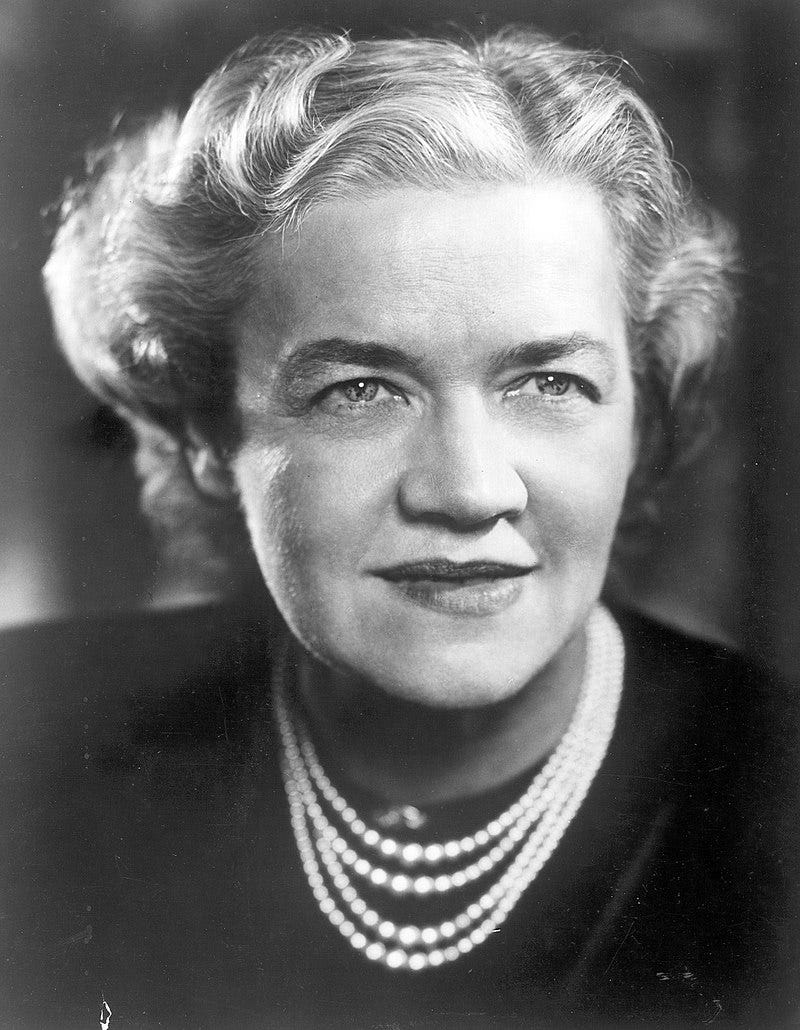
Today, with the radical right the most loyal voting bloc in the party, Republican leaders refuse to call out even the most extreme statements from their followers. But once upon a time, Republican politicians were the champions of reason and compromise. Famously, on June 1, 1950, Senator Margaret Chase Smith, a Republican from Maine, stood up against Republican Senator Joe McCarthy of Wisconsin and his supporters, who were running roughshod over American democracy.
Born in Skowhegan in 1897, the oldest child of a barber and a waitress, Smith was a teacher and a reporter who got into politics through her husband, Clyde Smith, who was a state legislator and newspaperman. Soon after they married in 1930, she was elected to the Maine Republican State Committee and served until 1936, when Maine voters elected Clyde to Congress.
Once in Washington, Margaret worked as her husband’s researcher, speechwriter, and press secretary. When Clyde died of a heart attack in April 1940, voters elected Margaret to finish his term, then reelected her to Congress in her own right. They did so three more times, always with more than sixty percent of the vote. In 1948, they elected her to the Senate with a 71% majority.
When she was elected to Congress, the U.S. was still getting used to the New Deal government that Democratic president Franklin Delano Roosevelt had ushered in first to combat the Great Depression and then to fight for victory in World War II. Smith’s party was divided between those who thought the new system was a proper adjustment to the modern world and those determined to destroy that new government.
Those who wanted to slash the government back to the form it had in the 1920s, when businessmen ran it, had a problem. American voters liked the business regulation, basic social safety net, and infrastructure construction of the new system. To combat that popularity, the anti–New Deal Republicans insisted that the U.S. government was sliding toward communism. With the success of the People’s Liberation Army and the declaration of the People’s Republic of China in October 1949, Americans were willing to entertain the idea that communism was spreading across the globe and would soon take over the U.S.
Republican politicians eager to reclaim control of the government for the first time since 1933 fanned the flames of that fear. On February 9, 1950, during a speech to a group gathered in Wheeling, West Virginia, to celebrate Abraham Lincoln’s birthday, an undistinguished senator from Wisconsin named Joe McCarthy claimed that he had a list of 205 communists working for the State Department and that the Democrats refused to investigate these “traitors in the government.”
The anti–New Deal faction of the party jumped on board. Sympathetic newspapers trumpeted McCarthy’s charges—which kept changing, and for which he never offered proof—and his colleagues cheered him on while congress members from the Republican faction that had signed onto the liberal consensus kept their heads down to avoid becoming the target of his attacks.
All but one of them did, that is. Senator Smith recognized the damage McCarthy and his ilk were doing to the nation.
On June 1, 1950, only four months after McCarthy made his infamous speech in Wheeling, Smith stood up in the Senate to make a short speech.
She began: “I would like to speak briefly and simply about a serious national condition. It is a national feeling of fear and frustration that could result in national suicide and the end of everything that we Americans hold dear…. I speak as a Republican, I speak as a woman. I speak as a United States Senator. I speak as an American.”
Referring to Senator McCarthy, who was sitting two rows behind her, Senator Smith condemned the leaders in her party who were destroying lives with wild accusations. “Those of us who shout the loudest about Americanism in making character assassinations are all too frequently those who, by our own words and acts, ignore some of the basic principles of Americanism,” she pointed out. Americans have the right to criticize, to hold unpopular beliefs, to protest, and to think for themselves. But attacks that cost people their reputations and jobs were stifling these basic American principles. “Freedom of speech is not what it used to be in America,” Senator Smith said. “It has been so abused by some that it is not exercised by others.”
Senator Smith wanted a Republican victory in the upcoming elections, she explained, but to replace President Harry Truman’s Democratic administration—for which she had plenty of harsh words—with a Republican regime “that lacks political integrity or intellectual honesty would prove equally disastrous to this nation.”
“I do not want to see the Republican Party ride to political victory on the Four Horsemen of Calumny—Fear, Ignorance, Bigotry and Smear.”
“I doubt if the Republican Party could do so,” she added, “simply because I do not believe the American people will uphold any political party that puts political exploitation above national interest. Surely we Republicans are not that desperate for victory.”
“I do not want to see the Republican Party win that way,” she said. “While it might be a fleeting victory for the Republican [P]arty, it would be a more lasting defeat for the American people. Surely it would ultimately be suicide for the Republican [P]arty and the two-party system that has protected our American liberties from the dictatorship of a one-party system.”
“As an American, I condemn a Republican Fascist just as much as I condemn a Democrat Communist,” she said. “They are equally dangerous to you and me and to our country. As an American, I want to see our nation recapture the strength and unity it once had when we fought the enemy instead of ourselves.”
Smith presented a “Declaration of Conscience,” listing five principles she hoped her party would adopt. It ended with a warning: “It is high time that we all stopped being tools and victims of totalitarian techniques—techniques that, if continued here unchecked, will surely end what we have come to cherish as the American way of life.”
Six other Republican senators signed onto Senator Smith’s declaration.
There were two reactions to the speech within the party. McCarthy sneered at “Snow White and the Six Dwarves.” Other Republicans quietly applauded Smith’s courage but refused to show similar courage themselves with public support. In the short term, Senator Smith’s voice was largely ignored in the public arena and then, when the Korean War broke out, forgotten.
But she was, of course, right. Four years later, the Senate condemned McCarthy. And while Senator Smith was later awarded the Presidential Medal of Freedom, McCarthy has gone down in history as a disgrace to the Senate and to the United States of America.




 Michael1942's Blog
You must be logged in to post a comment.