The past number of months in the Presidential campaign has clearly shown that our Democracy is in trouble. We have legislators bent on revenge rather than fulfilling their duty. Some who have no understanding of what it takes to maintain a democracy. The Far-right side of the GOP is busily following the “former guy.” whose sole objective is to sow dissent and disorder. His Presidency is a wide open testament to his petulance and ineptitude. His followers are no more than pawns and have no clear concept of what Governing is. As we approach the national elections, the ongoing trials of DJT keeps surfacing while the topic needs to be a non-issue! The formation of parties and the sub sects of them has created more confusion over the real collective issues we face daily, while fomenting divisions that should not exist or perhaps should not take high priority in Governing. Nationality, Race, ethnicity are not indicative of a person’s qualities but appear to color our everyday. The election of DJT aka, TOTUS, LOTUS, Orange Guy” or whatever you want to name him is a recipe for disaster. This is not about politics as much as it is about who is capable of running the country. The last thing we need is folks like MTG, AOC raging over nothing rather than being serious about governing. We need people who will address the High court’s integrity by perhaps term limits, a code of ethics (that should also apply to Congress as well). This should be the goal, achieving or approaching those goals will allow for the correction needed to truly make America the country everyone thinks we are!
The one remaining problem can’t be dealt with through higher interest rates. It needs vigorous antitrust enforcement.
ROBERT REICH FEB 2 Friends, It’s the economy, stupid. Thus spoke my friend James Carville, one of Bill Clinton’s campaign managers, in 1992. He was correct then and he’s been right ever since. Today, the Labor Department’s Bureau of Labor Statistics reported that the U.S. economy added 353,000 jobs in January, and the unemployment rate remains at 3.7 percent. The BLS also revised upward the two prior months, bringing the average monthly job gain in 2023 to 255,000. Even manufacturing, which has been in the doldrums, added 23,000 positions. Average hourly earnings grew 0.6 percent from December. Few economists expected job gains to remain this strong when high interest rates were needed to bring down inflation. But inflation is way down. Larry Summers (with whom I worked in the Clinton administration) predicted that the Fed would have to cause excessive joblessness to tame inflation (Summers also called the 2021 American Rescue Plan the “least responsible” fiscal policy in 40 years). He was wrong. Jobs growth continues to roar. Economic growth is good. Wages are moving in the right direction. Yet despite all the good news, 71 percent of Republicans say the economy is getting worse, and Donald Trump is once again claiming that the unemployment numbers are fake. Trump and Republicans are focusing on the only real remaining economic problem: Although inflation is down, prices haven’t come down. Why not? Because of corporate pricing power. Consider Pepsi. In 2021, PepsiCo, which makes all sorts of drinks and snacks, announced it was forced to raise prices due to “higher costs.” Forced? Really? The company reported $11 billion in profit that year. In 2023 PepsiCo’s chief financial officer said that even though inflation was dropping, its prices would not. Pepsi hiked its prices by double digits and announced plans to keep them high in 2024. If Pepsi had lots of competitors, consumers would just buy something cheaper. But PepsiCo’s only major soda competitor is Coca-Cola, which – surprise, surprise – announced similar price hikes at about the same time as Pepsi, and also kept its prices high in 2023. With just one or a few competitors, it’s easy for giant corporations to coordinate price increases and prevent price cuts, to keep their profits up while shafting consumers. The CEO of Coca-Cola claimed that the company had “earned the right” to push price hikes because its sodas are popular. Popular? The only thing that’s popular these days seems to be corporate price gouging. Pepsi and Coca-Cola dominate the soft drink market. They own most of the brands that appear to be competitors. This corporate pricing power isn’t just happening with Coke and Pepsi. Take meat products. At the end of 2023, Americans were paying at least 30% more for beef, pork, and poultry products than they were in 2020. Why? Just four companies now control processing of 80 percent of beef, nearly70 percent of pork, and almost 60 percent of poultry. So of course, it’s easy for them to coordinate price increases and prevent price cuts. In 75 percent of U.S. industries, fewer companies now control more of their markets than they did twenty years ago. Which is why the Biden administration is taking on this monopolization with the most aggressive use of antitrust laws in half a century. It’s taken action against alleged price fixing in the meat industry. It’s also suing Amazon for using its dominance to artificially jack up prices — one of the biggest anti-monopoly lawsuits in a generation. It successfully sued to block the merger of JetBlue and Spirit Airlines, which would have made consolidation in the airline industry even worse. But given how concentrated American industry has become, there’s still a long way to go. Inflation is down. But many people don’t feel it because prices are still high, and in some cases are still rising because of continued price gouging. That’s given Trump and his Republican lapdogs an excuse to tell Americans that the economy remains bad. The truth is, the economy is remarkably good, but too many big corporations have too much power over prices. The answer is to break them up — but I don’t expect Trump and the Republicans to say this. Do you?
Observing and listening to the political news from multiple sources, one could be persuaded to avoid voting. Politics is a dirty business and possibly the most disingenuous. Remembering the spelling of poLItics, the 2 middle letters are ” LI”. While this is not the exact spelling of the word the meaning is clear. We have been historically warned about the “negative or misguided” ideas of politicians and some major news figures. Churchill warned about striking a deal with Hitler prior to WWII, Gen. Patton warned about appeasing or allying with Russia after WWII and Gen. Macarthur warned about China after WWII. This is all historic information, yet many have embraced the extreme left and right of center politics that led up to the Several wars experienced since the turn of the century (1900 till now).
The availability of information through mass media gives several views of information that can confuse and befuddle but if we use our common sense and avoid personal (and sometimes erroneous) conceptions of what we have learned, we can elect better people to represent us and hopefully make laws that advantage all of us. There will never be a “perfect” solution to the many issues that we face daily but with reasonable electees and our knowledge of the facts we can potentially rise above the mire we exist in re now.
At the end of the day, you have to wonder if Texans are comfortable being a part of the United States.
I’m not just talking about the Dallas Cowboys, who have choked so often in the NFL playoffs that they need the Heimlich maneuver when they step on the field, particularly at home against the Green Bay Packers. I mean, in general, you have to question it.
Governor “Hey, Abbott!” – with apologies to Lou Costello – Greg Abbott is certainly among those who think that Texas is still its own country. He has stood stupidly defiant against the federal government for the last few months on the issue of Southern border security and kept the Border Patrol from doing its job while claiming the state of Texas has the right to defend its “sovereignty.”
Abbott’s “Operation Lone Star” has bused more than 35,000 immigrants to Washington, D.C, New York City, Chicago, Philadelphia, Denver and Los Angeles since April of 2022. He claims that the operation “continues to fill the dangerous gaps created by the Biden administration’s refusal to secure the border.” More on that in a moment.
Now Abbott seems to be making the case for going it alone again in the Lone Star state.
Two of my sons were born in Texas, and I am often reminded that anyone can become an American, but you have to be born a Texan. I used to think that was cute and funny – like the businessman I knew in the early 90s whose wife went into premature labor while they were visiting New York. He had a San Antonio neighbor overnight him 10 pounds of dirt from his backyard that he then placed into a container, so when his son was born he could legitimately say his son’s ass first touched Texas soil. Turns out, what I find cute and funny is deadly serious in Texas. They take their state pride seriously – even if there are (or once were) a sizable number of people in Texas who don’t support much of the lunacy from the state’s Republican Party. When it comes to Texas, they still fully believe they live in their own country.
As recently as December, Newsweek reported on a strong separatist movement in the Lone Star state. The Texas Nationalist Movement, an organization that supports Texas’ independence from the U.S., warned the GOP they have enough signatures to force a vote on the question of whether Texans support secession. Texas nationalists have for years pushed for a referendum on Texas secession, despite the fact there is no provision in the U.S. Constitution for a state to do so. Of course, that hasn’t kept the wildly independent Texans from doing whatever they want. The state first seceded from Mexico in 1836 and spent nine years as its own nation (remember the Alamo!) before it became the 28th U.S. state on Dec. 29, 1845. Texas also seceded from the U.S. in 1861 before being readmitted following the end of the Civil War.
Now Abbott seems to be making the case for going it alone again in the Lone Star state. There’s little practical chance of that, however. The federal government owns and operates 15 military bases in the state with an economic impact of more than $100 billion. San Antonio alone has four bases, with others being scattered from Corpus Christi to El Paso, and other points north and south throughout the state.
Still, it’s a touchy subject for Abbott. I tried all this week to get someone to speak to the issue in the governor’s office. My emails were ignored and when I finally reached someone by phone in Abbott’s press office, they hung up on me. Nothing like transparency in Texas. But, this isn’t unusual, I once got thrown out of the Texas Senate for asking a senator to move so my station’s news photographer could get a better shot. Texans can be arrogant and ignorant – and in government they are often that way all the time.
The Biden administration is deeply frustrated with Abbott’s moves – and while he continues to play politics with a very serious issue, the federal government – including the U.S. Border Patrol which is far from a bastion of liberals – has tried to get Abbott and Texas to see reason. The general counsel for the Department of Homeland Security recently sent state officials a letter, portions of which read, “Texas’s actions are clearly unconstitutional and are actively disrupting the federal government’s operations. We demand that Texas cease and desist its efforts to block Border Patrol’s access in and around the Shelby Park area and remove all barriers to access in the Shelby Park area,” of Eagle Pass.
DHS gave Texas until January 17 to “cease and desist” its efforts to block the Border Patrol’s access to the park and to remove all barriers to access to the U.S. – Mexico border before referring the matter to the Department of Justice “for appropriate action and (to) consider all other options available to restore Border Patrol’s access to the Border.”
Sounds ominous, but what other options are there? Abbott certainly doesn’t think the Border Patrol will fire upon Texas law enforcement working the border, does he? No rational human being thinks so. That would be disastrous, and yet, we are still at a tipping point in Texas. God only knows what the lunatics may do – and there are plenty of gun-happy lunatics in Texas.
During the 80s I was assigned to cover a story when members of the KKK showed up on the border after President Reagan claimed godless Sandinistas were just a two-hour plane ride away from our southern border. There were many guns on the border on that day. And Texans, of course, love to take matters into their own hands. There’s a long history of that.
As the current drama in Texas was playing out, The Hill reported, “The House on Wednesday approved a resolution condemning the Biden administration’s border and immigration policies, a move by GOP lawmakers to maintain pressure on the politically polarizing issue in the weeks ahead. The legislation pins the blame on President Biden’s “open-border policies”, highlighting the stark partisanship behind immigration and border policy. It passed 225-187, with 14 Democrats voting in favor.”
The Biden administration has angrily accused the GOP of duplicity, noting that Biden has proposed reforms to immigration that include hiring more Border Patrol agents, but the GOP has refused to take up the issue. Of course, it’s hard to get the GOP to do anything in Congress – they can barely pass legislation for funding the government.
On Wednesday, Biden met with members of Congress to talk about additional funding for Ukraine – something GOP House Speaker Mike Johnson said is linked to immigration reform. After the meeting, Biden was asked – as he walked to Marine One on the South Lawn – what the sticking points were on immigration reform. Biden said, “I don’t think we have any sticking points left.”
When Johnson and other members of Congress came out to the sticks on the North Lawn to talk to reporters, Johnson shut the door on “comprehensive immigration reform,” telling reporters, “I don’t think now is the time for comprehensive immigration reform, because we know how complicated that is.”
Of course, there won’t be reform – it would ruin the GOP’s chances to run on that issue if they solved the problem. This is a true do-nothing Congress. The GOP doesn’t want to solve problems – it wants to blame Democrats for problems in order to get elected.
You’ve got a better chance of the Dallas Cowboys winning the Superbowl than finding any common sense in Congress as Republicans continue to speak out of both sides of their mouth. While Johnson said there obviously won’t be any long term reform he also said, “We must insist that the border be the top priority. I think we have some consensus around the table. Everyone understands the urgency of that.” Try to wrap your mind around that lack of logic.
Senator Chuck Schumer saw things differently. He told reporters, “We also talked about the border and how it’s so important to deal with the border. The President himself said over and over again that he is willing to move forward on the border. And so we said we have to do both. There were a couple of people in the room that said let’s do the border first. We said we have to do both together.”
The response in Texas?
Texas authorities arrested migrants at Shelby Park in Eagle Pass, Texas, late Wednesday evening and charged them with criminal trespassing, marking the first arrests of migrants since the state took control of the area at the US-Mexico border last week, an official said. In response to the federal government’s cease-and-desist letter, Texas Attorney General Ken Paxton admitted that Border Patrol has “warrantless access to land within 25 miles of the border, but only ‘for the purpose of patrolling the border to prevent the illegal entry of aliens into the United States.’”
Texas is inching closer to a confrontation and a clash that can never occur and both sides do not want to recognize the root cause of the problem: American politics.
Illegal immigration has been a problem for nearly half a century because of the Mexican oil economy crash in the 70s as well as the US demand for cheap labor and cheap drugs. In the 1980s the US, during the Reagan administration, made some steps toward solving the problem, but there has been nothing done since then by both political parties. The truth is Big Business wants and demands cheap labor – as do most Americans. No one wants to pay $10 for a tomato, and the demand for cocaine, heroin and even fentanyl remains huge, so Big Business holds up a welcome sign while politicians act disingenuously about solving a problem they all had a part in creating.
Thus, Abbott is willing and able to use the poor and downtrodden to skewer Democrats by saying immigrants are lazy and living off of the welfare state, while at the same time claiming they take all of the jobs. The Christian Republicans scream the loudest about this – ignoring the teachings of the Jesus they claim to worship and ignoring the fact that the nation was built by immigrants – or as Bill Murray reminded us in Stripes, “We’re Americans, with a capital ‘A’, huh? You know what that means? Do ya? That means that our forefathers were kicked out of every decent country in the world. We are the wretched refuse. We’re the underdog. We’re mutts!” And those that weren’t immigrants were brought here as slaves, but that’s another issue.
American hypocrisy has never been so evident as in how we deal with new arrivals to our shores.
Protect our borders from caravans of foreign illegal immigrants? When Native American tribes tried to stem the tide of illegal immigration it didn’t go so well – and it won’t go well for us now either.
Friday, top U.S. and Mexican officials met in Washington to discuss strengthening cooperation and continuity in addressing the migration issues at the U.S.-Mexico border. This occurred as several Border Patrol sectors on the Southern Border, including Tucson and parts of Texas are reporting a decline in illegal immigration during the last few weeks. The decline is widely attributed to Mexican government efforts, and while the Biden administration wasn’t promising anything concrete from the Friday meetings, they were “cautiously optimistic,” that things will continue to get better on the border.
“That’s the irony of the Texas situation,” a Biden official told me on background. “They’re doing this when the numbers are relatively low.”
This matters little in the world of politics today.
Maybe at the end of the day, the federal government ought to send in Matt LeFleur and the Green Bay Packers. Governor Abbott wouldn’t stand a chance. Like the Dallas Cowboys, he’s all hat and no cattle!
Right after his victory in Iowa, where he received 53% of the evangelical and born-again Christian vote, Donald Trump traveled to New York to plead his case — literally. He was in federal court today, where he’ll soon find out how much he’ll have to pay for defaming a woman he’s also been found liable for sexually abusing. You may want to think about that for a moment. And let us remember it’s only January. There are more trials to come starring the leading GOP presidential candidate.
Here’s the quick backstory: Trump has already been found to have sexually abused and defamed columnist E. Jean Carroll. The jury in this current trial is only determining how much Trump will pay in compensatory and punitive damages. The contentious day in court — the judge threatened to toss Trump from the courtroom for his antics — is in sharp contrast to the warm and fuzzy reception he received from Iowa’s Republicans, especially the state’s evangelicals.
It is no secret that Donald Trump is the political choice of white evangelical Christians, albeit a counterintuitive one. He is a three-times married, twice divorced, admitted sexual abuser who is mired in six civil and criminal cases either in court now or headed for trial this year. Not exactly the picture of morality. But to the modern evangelical, that doesn’t seem to matter anymore.
Why this is true remains for many an open question.
Once upon a time, evangelicals believed in the teachings of Jesus Christ, in the moral imperative of helping one’s neighbors, of being a “compassionate conservative.” But we are living in an up-is-down, black-is-white world in which a man who admitted to grabbing women by their genitalia is embraced by one of the largest religious groups in the United States. What accounts for this dichotomy? What accounts for the growth of Trump’s popularity among this group? According to Ruth Graham and Charles Homans of TheNew York Times, “Today, [EVANGELICAL] is often used to describe a cultural and political identity: one in which Christians are considered a persecuted minority, traditional institutions are viewed skeptically and Mr. Trump looms large.”
They care more about opposing abortion and curtailing LGBTQ+ and minority rights than about the teachings of their savior — the original one. Many see Trump as a modern savior, “rescuing” the country from Democrats, drag queens, and immigrants. Inexplicably, they do see him as a person of faith, more so than any other politician. In a November poll of Republican voters by HarrisX, Trump ranked highest as a person of faith at 64%, higher than profoundly religious former Vice President Mike Pence (56%), higher than Mormon leader Senator Mitt Romney (34%), and significantly higher than weekly church-going Catholic President Joe Biden (13%).
It may not be surprising that the number of evangelicals who regularly attend church has dropped; 40% go to church once a year or less. But that’s against a backdrop of church attendance generally declining among Americans and in Western civilization as a whole.
A group of Trump supporters recently produced a video called “God Made Trump” in which he is depicted as the second coming. It has quickly made its way around the MAGA-sphere.
Perhaps it was Romney who best put this all in perspective. “I think a lot of people in this country are out of touch with reality and will accept anything Donald Trump tells them,” Romney told CNN. “You had a jury that said that Donald Trump raped a woman. And that doesn’t seem to be moving the needle. There’s a lot of things about today’s electorate that I have a hard time understanding.”
So it is with many Americans as we ponder in this election year what our country has become, where it appears to be headed, and why.
As always, we welcome your comments and thoughts.
The Steady newsletter is supported by the Steady community. Please consider subscribing if you aren’t already a member.
America needs a new sane Republican Party, and here’s who should lead it
ROBERT REICH
SEP 18
Friends,
Last Tuesday, former Wyoming Representative Liz Cheney tweeted this in response to Russian President Vladimir Putin’s claim that the criminal indictments of Trump are politically motivated:
“Putin has now officially endorsed the Putin-wing of the Republican Party. Putin Republicans & their enablers will end up on the ash heap of history. Patriotic Americans in both parties who believe in the values of liberal democracy will make sure of it.”
In reality, the Putin wing of the Republican Party has taken over the Republican Party. The GOP no longer believes in the values of liberal democracy. It has become a cesspool of authoritarian nihilism.
As Mitt Romney told the Atlantic’s McKayu Coppins, “a very large portion of my party really doesn’t believe in the Constitution.”
The GOP is now a rogue elephant — increasingly dangerous, out of control, and on a rampage.
Knowing that most of the American public rejects it, it’s busily repressing votes through extreme partisan gerrymandering and new barriers to voting.
Notwithstanding zero evidence of any wrongdoing by Joe Biden, it’s seeking to impeach him.
Even though there’s still no basis for Trump’s big lie that he won the 2020 election, most Republican lawmakers continue to support it.
A growing number of House and Senate Republicans are questioning America’s commitment to defending Ukraine.
House Republicans are about renege on the deal they made before the debt ceiling was lifted, and shutter the U.S. government.
Meanwhile, Wisconsin Republicans are threatening to impeach a State Supreme Court justice who disagrees with their agenda. Tennessee Republicans have expelled Democratic lawmakers who supported an anti-gun protest.
Alabama Republicans are denying Black voters the opportunity to elect another representative to Congress. Florida Republicans have suspended an elected official because they don’t like their policies.
The GOP engaged in authoritarian antics before Trump (see: Gingrich, Newt), but Trump has pushed the Party over the edge, morally and politically.
Trump has so profoundly poisoned the Republican Party — filling it with election deniers, bigots, paranoids, and anti-democracy zealots — that it won’t recover its capacity to govern even after Trump leaves the stage.
Frankly, I don’t give a fig about the Republican Party. But I do care deeply about this nation. And America needs two major political parties capable of governing. Right now, only the Democratic Party has that capacity.
As long as the Trump Republican Party exists, it poses a profound danger to American democracy.
What should be done, and who should do it?
America needs a third party that stands for all the things conservative Republicans stood for before Gingrich and Trump — limited government, fiscal prudence, a strong defense against dictators and autocrats, and the stability and integrity of the nation’s major institutions.
Is Mitt Romney the person to start such a Real Republican Party? He’s now basking in the adulation of the Washington establishment because he had the courage to utter some truths about Trump when the former president was in power and just announced he won’t be running again.
But Romney is too elitist and too, well, 2012.
The person to lead it is Liz Cheney. She should run for president on a third-party Real Republican ticket.
I’m sure there are plenty of anti-Trump Republicans willing to support this effort. Some of them, I expect, have enough money to get the Real Republican Party on the ballot in most states. There’s still time.
Don’t get me wrong. I’m not endorsing Liz Cheney for president. I’ve disagreed with too many of her policy ideas and votes over the years.
I’m merely suggesting that it would be good for all of us if she took the reins of a new Republican Party — good for Republicans, good for Democrats, good for democracy, good for America.
When it comes to the survival of American democracy, Liz Cheney has displayed more courage and integrity than any other member of her party.
Six days after the January 6, 2021, attack on the Capitol — when no other Republican in the House or Senate was willing to rebuke Trump — Cheney charged on the House floor that “the president of the United States summoned this mob, assembled the mob, and lit the flame of this attack. Everything that followed was his doing.”
The next day, Cheney joined just nine other House Republicans and 222 Democrats in voting to impeach Trump. (Few, if any, of these principled Republicans remain in the House today. Most have resigned or been purged.)
Then, as vice chair of the House of Representatives’ January 6 committee investigating the causes of the January 6 attack, Cheney ceaselessly and tirelessly helped lay out the case against Trump.
To get revenge, Trump did everything possible to end Cheney’s career. He selected Cheney’s opponent in the 2022 Wyoming Republican primary, Harriet Hageman — who rallied behind Trump and amplified his false claims that the 2020 election was stolen — and made sure Hageman won.
I think it would be a fitting rebuke to Trump — as fitting politically as his criminal convictions will be legally — to have Liz Cheney create a new Real Republican Party that replaces the squalor of Trump’s (and Putin’s) GOP.
The richest nation in the history of the world has chosen to impoverish millions of our children.
SEP 14, 2023
Friends,
Poverty is a policy choice. We have chosen to have a significant percentage of our population impoverished, including — especially — our nation’s children.
When I say we’ve chosen this, I mean that it doesn’t have to be this way. There is no law of nature or principle of economics or Constitutional provision that dictates such a high number of people in poverty within the richest nation in the history of the world.
Census data released Tuesday provides clear evidence of the choice we’ve made. The number of people with incomes below the poverty line in 2022 rose by 15.3 million. The poverty rate for children more than doubled — from an historic low of 5.2 percent in 2021 to 12.4 percent in 2022.
The United States has just experienced the largest spike in child poverty since the current models for measuring economic distress were developed in 2009. All of the record gains made against child poverty over the previous two years have been erased.
The reason for this extraordinary rise in poverty? Not the pandemic. Not a vicious recession. Not an economic depression. Not a huge increase in the numbers of people unemployed. In fact, employment is high.
The reason, according to the Census Bureau, is the refusal by Congress to renew the enhanced child tax credit that was developed during the Covid-19 pandemic. That expiration was a policy choice.
Poverty has shot upwards because we as a nation (through our representatives in Congress) decided to eliminate a relatively modest monthly bump in federal support — $250 to $300 per month for households with children.
In the previous year, that modest bump had the astounding effect of reducing the rate of child poverty by nearly half. When lawmakers expanded the child tax credit in 2021, fewer kids lived in poverty. When they failed to continue the expansion in 2022, child poverty more than doubled.
Ergo, two policy choices by Congress — one that dramatically cut child poverty, followed by a second that dramatically increased it.
Who exactly in Congress made this choice? Republicans and a handful of Democrats such as West Virginia Senator Joe Manchin and Arizona Senator Kyrsten Sinema. They rejected efforts by the Biden administration and most congressional Democrats to maintain the enhanced child tax credits.
Although House Democrats backed the proposed extension of the credits, Senate Democrats needed all 50 members of their caucus to pass the legislation via the reconciliation process. Manchin refused to go along unless his colleagues accepted a scheme to penalize parents with work requirements and other restrictions.
Sinema also refused, as has been noted by the campaign of US Representative Ruben Gallego, an Arizona Democrat who is running to replace Sinema in 2024. (Let’s do everything we can to make sure he does.)
Ending poverty is not difficult, especially for wealthy nations such as the United States. We know exactly how to do it. We did it. Then we undid it. In effect, the United States is now making a concerted effort to impoverish millions of our children.
As John Nichols of The Nationreminds us, our success at reducing poverty is similar to what occurred in the 1930s, when President Franklin Delano Roosevelt responded to the Great Depression with the myriad job creation, rural development, and social safety net programs (including Social Security) that formed the New Deal.
When FDR took office in 1933, the unemployment rate in the US was close to 25 percent. After eight years of federal interventions by the Roosevelt administration, it was down to around 10 percent when World War II began.
Similarly, just before Lyndon Johnson got Congress to enact Medicare and Medicaid in 1965, 22 percent of Americans were impoverished. When Johnson left office, it was around 13 percent. Why the drop? Because Medicare and Medicaid addressed a key driver of poverty among the elderly—medical costs. And other Great Society initiatives, such as expanded nutrition and housing programs, contributed to the decline.
This is not rocket science. The expanded Child Tax Credit cut child poverty nearly in half. Sinema, Manchin, and the GOP let it expire and child poverty spiked.
This is not only a policy choice. It is a moral choice. In the richest country in the world, it is inexcusable that millions of our children are living in poverty. They don’t have to be.
Friends, expanding the Child Tax Credit should be the top tax policy priority both this year and during the 2025 tax debate. Period.
My father called himself a liberal Republican in the days when such creatures still roamed the earth. He voted for Thomas Dewey in 1948 (canceling my mother’s vote for Harry Truman) and then for Dwight Eisenhower in 1952 and 1956 (canceling my mother’s votes for Adlai Stevenson), and he thought highly of New York’s Republican governor, Nelson Rockefeller, and its Republican senator, Jacob Javits — neither of whom would last a nanosecond in today’s GOP.
But Ed Reich could not abide political bullies. He gave up on the Republican Party when Nixon became president. He would have detested Trump. (My father died in 2016, two weeks before his 102nd birthday, and nine months before Trump was elected.)
Ed thought anyone who had to bully someone else to feel good about himself was despicable. If they did their bullying through politics, they were doubly despicable. In his mind, political bullying had led to the Holocaust.
In 1947, Ed moved us from Scranton, Pennsylvania, to a small town some 60 miles north of New York City called South Salem, to be within driving distance of his two women’s clothing stores, in Norwalk, Connecticut, and Peekskill, New York.
Soon after we moved in, a delegation of older men came by our house. When they knocked on the door, my mother thought they were a welcoming committee and opened it with a big “hello!” But when she saw the expressions on their faces, she became alarmed.
She invited them into the living room and asked if they’d like coffee. They declined.
My father greeted them stiffly, suggesting they sit down. They did not.
“What’s this about?” he asked. “What’s happened? Is there a problem?”
“Mr. and Mrs. Reich,” one of them spoke gravely, “we’ve come to inform you that South Salem is a Christian community.”
There was a long pause. I could see my father redden.
“So, we’re not welcome here?” His voice was tight.
“Legally, you have a right to be here, of course,” the speaker said. (New York state had just enacted a law prohibiting homeowners from including “restrictive covenants” in their deeds that barred sales to “Negroes or Hebrews.”) “But we don’t think you and your family will be happy here.”
“Thank you for coming by,” my father said flatly, opening the front door for them. Then he exploded: “Now get the hell out of my house!”
That was the day Ed Reich decided we’d stay put in South Salem forever. “I showed those sons of bitches,” he said some years later.
“Son of a bitch” was the worst epithet Ed could hurl at someone. It burst out of him like a volcanic eruption. For many years, I didn’t know it contained separate English words, including a term many would find offensive today. To my young ears it was one word — sonofaBITCH — that might have been Russian or Yiddish, but whatever language it was, it was huge and frightening.
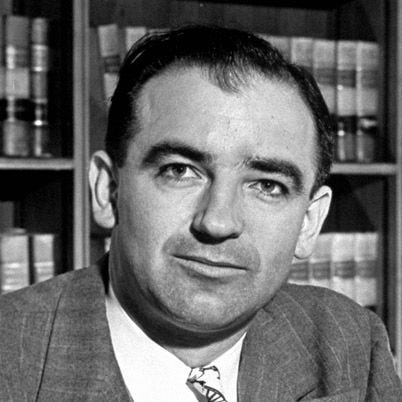
WISCONSIN SENATOR JOE McCARTHY HAD A SPECIAL PLACE in Ed Reich’s pantheon of horrible people. McCarthy didn’t just bully those he claimed were members of the Communist Party. He attacked them with malice. McCarthy ridiculed the “pitiful squealing” of “those egg-sucking phony liberals” who “would hold sacrosanct those Communists and queers.”
Every time McCarthy’s image came across the six-inch screen of the Magnavox television in our living room, my father would shout “son-of-a-BITCH” so loudly it made me shudder.
McCarthyism was the byproduct of the Republican Party’s postwar effort to eradicate the New Deal by linking it to communism. The GOP had portrayed the midterm election of 1946 as a “battle between Republicanism and communism.” The Republican National Committee chairman claimed that the federal bureaucracy was filled with “pink puppets.”
Southern segregationist Democrats joined in the red baiting. Mississippi Senator Theodore Bilbo, a Klansman who had filibustered to block anti-lynching legislation, described multiracial labor unions’ advocacy for civil rights as the work of “northern communists.” Representative John Elliott Rankin, a racist and antisemitic Mississippi Democrat who helped establish the House Un-American Activities Committee, called the CIO’s southern organizing campaign “a communist plot” and charged it would give more voting rights to Black people. “We’re asleep at the switch,” he warned. “They’re taking over this country; we’ve got to stop them if we want this country.”
The tactic was temporarily successful. In the 1946 midterms, Democrats lost control of both the Senate and the House. Wisconsin ended its era of progressive Republican La Follettes and sent Joe McCarthy to the Senate. California replaced New Dealer Jerry Voorhis with a young Republican lawyer who had already figured out how to use red baiting as a political tool. His name was Richard Nixon.
In December 1946, at the founding convention of the Progressive Citizens of America, FDR’s former vice president Henry Wallace called the red scare a tool used by the most powerful economic forces in America and warned America not to give in to it. “We shall … repel all the attacks of the plutocrats and monopolists who will brand us as Reds,” he said, adding:
“If it is traitorous to believe in peace — we are traitors. If it is communistic to believe in prosperity for all — we are communists. If it is unAmerican to believe in freedom from monopolistic dictation — we are unAmerican. We are more American than the neo-fascists who attack us. The more we are attacked the more likely we are to succeed, provided we are ready and willing to counterattack.”
But there was no counterattack. The red baiting escalated, encouraged by J. Edgar Hoover, the first director of the FBI.
President Truman succumbed to the mounting hysteria. On March 21, 1947, he signed Executive Order 9835, the “Loyalty Order.” It ushered in loyalty oaths and background checks and created the Attorney General’s List of Subversive Organizations.
As the 1950 election approached, a Times headline announced that the “Left is Silent in Campaign.” Even the American Civil Liberties Union, whose roots lay in the Red Scare of the World War I era, was reluctant to take the lead in opposing the threat to civil liberties in the second Red Scare of the 1950s.
California Representative Helen Gahagan Douglas — dubbed the “Pink Lady” for her supposed communist sympathies — tried for the Senate in 1950. She survived a bitter primary battle only to be beaten in November by red-baiter Richard Nixon.
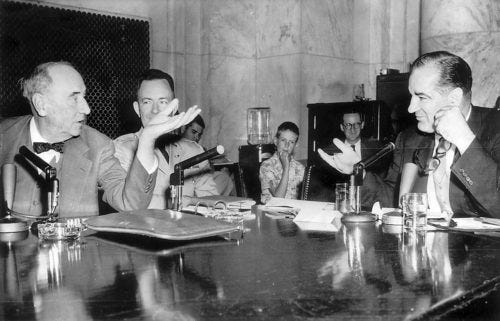
ON JUNE 9, 1954, I SAT AT MY FATHER’S SIDE ON OUR LIVING ROOM COUCH, watching the Army-McCarthy hearings. McCarthy had accused the U.S. Army of having poor security at a top-secret facility.
Joseph Welch, a private attorney, was representing the Army. McCarthy charged that one of Welch’s young staff attorneys was a communist. Such a charge was likely to end the young man’s career.
“Son-of-a-BITCH,” my father shouted. I hid my head.
As McCarthy continued his attack on Welch’s staff attorney, Welch broke in. “Until this moment, Senator, I think I never really gauged your cruelty or your recklessness.”
I was only eight years old, but I was spellbound.
McCarthy didn’t stop. “Son-of-a-BITCH!” Ed Reich shouted even more loudly. The earth seemed to shake.
At this point, Welch demanded that McCarthy listen to him. “Let us not assassinate this lad further, Senator,” he said. “You have done enough. Have you no sense of decency?”
Almost overnight, McCarthy imploded. His national popularity evaporated. Three years later, censured by his Senate colleagues, ostracized by his party, and ignored by the press, McCarthy drank himself to death, a broken man at the age of 48.
During the Army-McCarthy hearings, McCarthy’s chief counsel was Roy Cohn. Cohn became one of America’s most notorious bullies.
Cohn had gained prominence as the Department of Justice attorney who successfully prosecuted Julius and Ethel Rosenberg for espionage, leading to their execution in 1953. (Evidence made public decades after the execution confirmed that Julius was a spy, but that Ethel, while aware of her husband’s activities, was not.)
In public, Cohn was homophobic. Privately, he was gay at a time when being gay was a crime. A character in Tony Kushner’s epic Angels in America describes him as “the polestar of human evil. The worst human being who ever lived … the most evil, twisted, vicious bastard ever to snort coke at Studio 54.” His bullying was particularly vicious, I think, because he was filled with self-loathing.
The Rosenberg trial brought the 24-year-old Cohn to the attention of J. Edgar Hoover, who convinced Joe McCarthy to hire Cohn as chief counsel for McCarthy’s Senate Permanent Subcommittee on Investigations. Cohn became known for his aggressive questioning of suspected communists.
My father thought Roy Cohn almost as despicable as Joe McCarthy. “Son-of-a BITCH!” my father shouted whenever Cohn’s name was in the news.
After McCarthy’s downfall, it was assumed that Cohn’s career was also over. Yet Cohn reinvented himself as a power broker in New York. Despite scandals and indictments, along with accusations of tax evasion, bribery, and theft, Cohn survived.
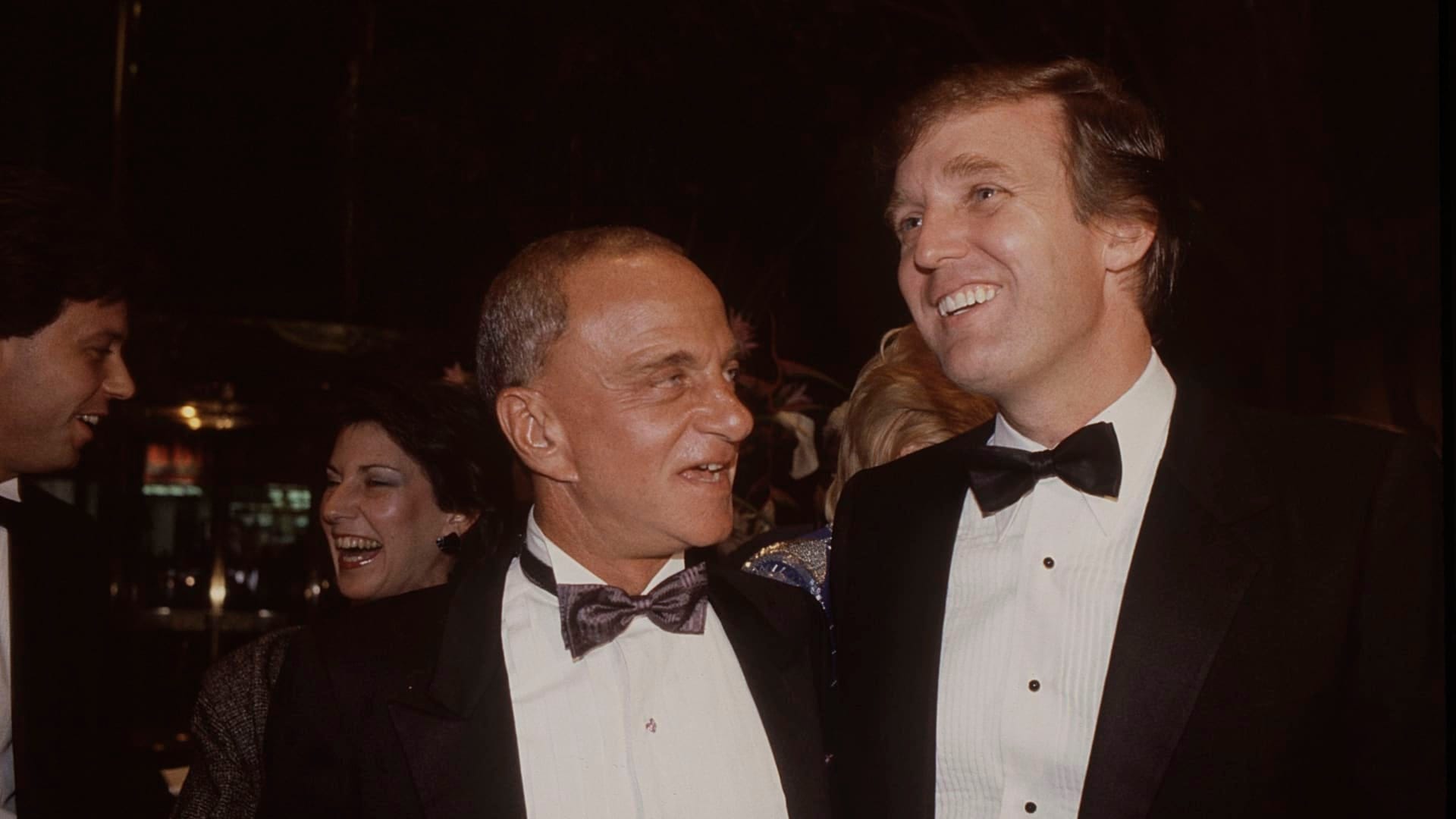
COHN PROVED HIMSELF USEFUL TO A YOUNG REAL ESTATE DEVELOPER NAMED DONALD TRUMP. Fred Trump had started his son’s career by bringing him into the family business of renting apartments in Brooklyn and Queens.
Cohn established Donald in Manhattan by introducing him to New York’s social and political elite. Donald was undertaking several large construction projects in Manhattan and needed both a fixer and mentor. Cohn filled both roles, and along the way bequeathed to Trump a penchant for ruthless bullying, profane braggadocio, and opportunistic bigotry.
Like Trump, Cohn was utterly without principle. Like Trump, his priority was personal power that could be leveraged for wealth, influence, and celebrity.
In 1973, the Justice Department accused Trump Management Inc., its 27-year-old president, Donald, and chairman, Fred, of violating the Fair Housing Act of 1968 in 39 of his properties — alleging that the company quoted different rental terms and conditions to prospective tenants based on their race and made false “no vacancy” statements to Black people seeking to rent.
Trump employees had secretly marked the applications of Black people with codes, such as “C” for “colored,” according to accounts filed in federal court. The employees allegedly directed Black people away from buildings with mostly white tenants, steering them toward properties that had many Black tenants.
Representing the Trumps, Roy Cohn filed a countersuit against the government for $100 million, asserting that the charges were “irresponsible and baseless.” Although the countersuit was unsuccessful, Trump settled the charges out of court in 1975, asserting he was satisfied that the agreement did not “compel the Trump organization to accept persons on welfare as tenants unless as qualified as any other tenant.”
Three years later, when the Trump Organization was again in court for violating terms of the 1975 settlement, Cohn called the charges “nothing more than a rehash of complaints by a couple of planted malcontents.” Donald Trump denied the charges.
Cohn was also involved in the construction of Trump Tower, helping secure concrete during a citywide Teamster strike via a union leader linked to a mob boss.
At about this time, Cohn introduced Trump to another of Cohn’s clients, Rupert Murdoch.
During Ronald Reagan’s 1980 presidential campaign, Cohn helped another young man named Roger Stone.
As Stone later recounted, Cohn gave him a suitcase filled with money that Stone dropped off at the office of a lawyer influential in Liberal Party circles. “I paid his law firm. Legal fees. I don’t know what he did for the money.” In fact, the money was used to get New York’s Liberal Party to nominate Illinois Congressman John Anderson — thereby splitting New York’s opposition to Reagan. It worked. Reagan carried the state with 46 percent of the vote. (Ed Reich voted for Jimmy Carter.)
In 1986, Cohn was disbarred by the New York State Bar for unethical conduct after attempting to defraud a dying client by forcing the client to sign a will amendment leaving Cohn his fortune. (Cohn died five weeks later from AIDS-related complications.)
In his first and best-known book, The Art of the Deal, Trump drew a distinction between integrity and loyalty. He preferred the latter.
For Trump, Roy Cohn exemplified loyalty. Trump compared Cohn to “all the hundreds of ‘respectable’ guys who make careers out of boasting about their uncompromising integrity but have absolutely no loyalty … What I liked most about Roy Cohn was that he would do just the opposite.”
Army Chief of Staff General James McConville, the 40th person to hold that position, retired today. Because Senator Tommy Tuberville (R-AL) has put a hold on military promotions for the past 8 months, there is no Senate-confirmed leader to take McConville’s place. There are eight seats on the Joint Chiefs of Staff, the group of the most senior military officers who advise the president, homeland security officials, the secretary of defense, and the National Security Council. Currently, two of those seats are filled by acting officials who have not been confirmed by the Senate.
Politico’s defense reporter Paul McLeary wrote that as of today, there are 301 senior military positions filled by temporary replacements as Tuberville refuses to permit nominations to go through the Senate by the usual process. Two more members of the Joint Chiefs of Staff will retire before the end of September.
Politico’s Pentagon reporter Lara Seligman illustrated what this personnel crisis means for national security: “U.S. forces are on high alert in the Persian Gulf,” she wrote today. “As Tehran attempts to seize merchant ships in the Strait of Hormuz, the U.S. is sending warships, fighter jets and even considering stationing armed troops aboard civilian vessels to protect mariners. Yet two of the top senior officers overseeing the escalating situation aren’t where they’re supposed to be.”
Two days ago, Defense Secretary Lloyd Austin wrote in a memo that the “unprecedented, across-the-board hold is having a cascading effect, increasingly hindering the normal operations of this Department and undermining both our military readiness and our national security.” Today he reiterated: “The failure to confirm our superbly qualified senior uniformed leaders undermines our military readiness.” He added, “It undermines our retention of some of our very best officers. And it is upending the lives of far too many of their spouses, children and loved ones.”
Tuberville, who did not serve in the military, likes to say “there is no one more military than me.” And yet, thanks to him and the Republican conference that is permitting him to hold the nominations, we are down two chiefs of staff tonight.
Meanwhile, on July 26, when soldiers took charge in Niger, a country central to the fight against Islamic terrorists and the security of democracy on the African continent, the U.S. had no ambassador there. Senator Rand Paul (R-KY) was blocking the confirmation of more than 60 State Department officials the same way that Tuberville was blocking the confirmation of military officials.
Paul claimed he was blocking State Department confirmations because he wanted access to information about the origins of COVID, but Secretary of State Antony Blinken said the department had “been working extensively” with Paul, providing the documents and other information he had requested. “But unfortunately, he continues to block all our nominees.” Paul complained that he had been only given private access, and wanted to “take those documents out.”
As of July 17, the current Senate had confirmed only five State Department nominees. On that day, Blinken wrote to each senator to express “serious concern” about the delays. He told reporters that he respects and values the Senate’s “critical oversight role…[b]ut that’s not what is happening here. No one has questioned the qualifications of these career diplomats. They are being blocked for leverage on other unrelated issues. It’s irresponsible. And it’s doing harm to our national security.”
Ambassadors “advance the interests of our country,” he said, and not having confirmed ambassadors “makes us less effective at advancing every one of our policy priorities—from getting more countries to serve as temporary hubs for [immigrant visa] processing, to bringing on more partners for global coalitions like the one we just announced to combat fentanyl, to support competitive bids for U.S. companies to build…critical infrastructure projects around the world.”
Our adversaries benefit from these absences, not only because they offer an opening to exploit, but also because “[t]he refusal of the Senate to approve these career public servants also undermines the credibility of our democracy. People abroad see it as a sign of dysfunction, ineffectiveness—inability to put national interests over political ones.”
Blinken noted that “[i]n previous administrations, the overwhelming majority of career nominees received swift support to advance through the Senate by unanimous consent. Today, for reasons that have nothing to do with the nominees’ qualifications or abilities, they are being forced to proceed through individual floor votes.” More than a third of the nominees had been waiting for more than a year for their confirmation.
Late on July 27, the day after the conflict began in Niger and the day before the senators left for their summer recess, Paul lifted his hold, tweeting that the State Department and the United States Agency for International Development (USAID), an independent agency that administers foreign aid, had agreed to release the documents he wanted. The Senate then confirmed career diplomat Kathleen A. FitzGibbon as ambassador to Niger, as well as ambassadors to other countries including Rwanda, the United Arab Emirates, Georgia, Guyana, Ethiopia, Jordan, Uganda, and Italy.
But FitzGibbon did not arrive in Niger before the U.S. government on Wednesday ordered “non-emergency U.S. government personnel” and their families to leave the country out of concerns for their safety.
The attack on our nation by individual Republicans seems to be a theme these days. After yesterday’s arraignment on charges that he conspired to defraud the United States, conspired and attempted to obstruct an official proceeding, and conspired to overturn Americans’ constitutionally protected right to vote, Donald Trump today flouted the judge’s warning not to try to influence jurors. He posted on social media: “IF YOU GO AFTER ME, I’M COMING AFTER YOU!”
Prosecutors from the office of Special Counsel Jack Smith tonight alerted the court to Trump’s threat when they asked the court for a protective order to stop him from publishing information about the materials they are about to deliver to his lawyers. They expressed concern that publishing personal information “could have a harmful chilling effect on witnesses” or taint the jury pool by telling potential jurors too much before the trial.
It is back to school. Students of all ages flock to campuses and classrooms. Fleeting memories of summer are quickly replaced by tests and textbooks.
Getting into the swing of a new semester has always included an adjustment period, but this is a particularly difficult time for many of our nation’s students and their parents, guardians, teachers, and others entrusted with the education of young minds.
The pandemic wreaked havoc with the emotional, intellectual, and social development of America’s youth. Dismal test scores provide depressing data of yawning learning deficits. Talk to anyone in or around schools and you hear stories of setbacks and struggle — heaps of qualitative data suggesting a staggering scale of generational loss.
As usual, those who were already the most marginalized have paid the heaviest price. The pandemic exacerbated existing disruptions and placed greater strain on finances and time, particularly in large urban districts and small rural ones tasked with educating children from families struggling economically.
We like to tell ourselves that the United States is a great meritocracy, but wealth and levels of family education continue to play outsized roles in dictating a child’s likelihood of academic success long before she learns her ABCs. The simple truth is that kids come to school from widely different circumstances, and these influence their ability to thrive, independent of whatever innate intelligence or drive they may possess. The pandemic made these differences more acute.
The United States does possess a system (or more accurately, a collection of thousands of systems) that, if nurtured and respected, could foster greater equality of opportunity. And it is exactly the institution that is now struggling the most: public education. America’s public schools were once the envy of the world as engines of opportunity and upward mobility. If the nation had the will, they could return to that status once again.
Our public schools certainly weren’t perfect in the past, especially during legal racial segregation, when the lie of “separate but equal” (separate is never equal) helped enshrine white supremacy. The segregated schools of the Jim Crow Deep South were a shameful injustice and a stain on our national identity. They were inconsistent with our founding documents, which spoke eloquently about equality among people. Of course there was (and remains, to some extent) de facto segregation throughout America based on who lives in what neighborhoods. Well-financed suburban schools were often part of the draw of “white flight” from urban districts.
The very ethos of public education should be one of inclusion for America’s diverse population. It should be a place where children of different backgrounds come together to learn both from teachers and from each other. Our schools should be places that allow students to wrestle with what it means to be part of this great country, including understanding America’s uneven and often bloody road to greater equality.
Sadly, in recent years, we have seen a grave regression from these noble goals. Our schools and school districts have become fiercely contested frontlines in an era of stepped-up culture wars. As reactionary political forces target what we teach our children, it is no accident that truth, empathy, and our democratic values have become casualties.
A chief concern is how and what we teach about our history, particularly the Black experience, and race and ethnicity more generally. We have written here before about the shameful whitewashing of racial violence and injustice, including slavery, by Florida Governor Ron DeSantis. But this effort is not limited to him or that state. There is a national movement to not tell the full — and unfortunately tragic — reality of race in American history and how it continues to shape the nation.
Another serious concern is the othering of LGBTQ+ students and teachers. After years of progress, we see a wave of intolerance spread across America, including in our schools.
Few institutions in American life are as essential to the continuation of our democracy as the public schools. In a time of ascendent autocracy, attacks on our schools — how they are run, what they teach, what books they have in their libraries — are among the most pernicious, pathetic, and painful assaults on the health of our nation.
Several months back, Texas Monthly ran a striking piece of journalism with the headline, “The Campaign to Sabotage Texas’s Public Schools.” It tells a story that extends beyond the raucous school board meetings and book banning campaigns that have gotten the most attention. There is a movement afoot, and not just in Texas, to destroy public schools more generally, to privatize education through vouchers and other means.
In this context, the various culture fights become battles in a larger war over the very future and viability of public education:
Taken individually, any of these incidents may seem like a grassroots skirmish. But they are, more often than not, part of a well-organized and well-funded campaign executed by out-of-town political operatives and funded by billionaires in Texas and elsewhere. “In various parts of Texas right now, there are meetings taking place in small and large communities led by individuals who are literally providing tutorials—here’s what you say, here’s what you do,” said H. D. Chambers, the recently retired superintendent of Alief ISD, in southwest Harris County. “This divisiveness has been created that is basically telling parents they can’t trust public schools. It’s a systematic erosion of the confidence that people have in their schools.
The ideal of quality, integrated public schools for all children in the United States epitomizes the promise of our country’s founding as a place of equality and opportunity for all. It thus makes sense that would-be autocrats and protectors of privilege would seek to undermine our public schools by whatever means necessary. We must see this as what it is: as much a threat to the nation as was the violent storming of our Capitol.
The future of the United States depends on an educated and empathetic citizenry. It requires us to share a sense of common purpose and recognize our common humanity. It requires an environment that allows every child to thrive and see themselves included in the American story. It requires quality public education. Full stop.
A historic battle to save this institution and the very idea of good public schools has been underway for some time. It is now intensifying. Attention must be paid.






You must be logged in to post a comment.