Skip navigation

Category Archives: Trumpedation


The Administrations boot lickers are putting us all at risk with their unfaltering faith in an inept megalomaniac. MA

For the Love of God, Why Is the Trump Administration Blocking Medicaid Access to Fight Coronavirus?

Luke Darby

GQMarch 13, 2020, 11:46 AM CDT

Early Friday morning, Donald Trump took to Twitter to let the world know exactly who was responsible for the U.S.’s disastrous response to the on-going coronavirus outbreak—the Centers for Disease Control and former president Barack Obama. He claimed that the CDC knew it “would always be inadequate and slow for a large scale pandemic” and that Obama “made changes that only complicated things further.” This is after, in 2018, his administration dismantled the global health security team left in place by the Obama administration to confront pandemics like this, and cut 80 percent of the CDC’s efforts to prevent global outbreaks.

But Trump claims that under his leadership, the CDC is now in shipshape: “Their response to H1N1 Swine Flu was a full scale disaster, with thousands dying, and nothing meaningful done to fix the testing problem, until now. The changes have been made and testing will soon happen on a very large scale basis. All Red Tape has been cut, ready to go!”

Like many of Trump’s statements about how his administration is handling the COVID-19 outbreak, this isn’t accurate. The Department of Health and Human Services, for example, has been imposing extremely strict guidelines for who can and can’t access the limited coronavirus tests available, essentially guaranteeing that people only get tested once they’ve already developed symptoms and causing delays that likely resulted in hundreds more people getting infected.

It’s particularly ironic that Trump brings up the H1N1 outbreak of 2009 though, which the Obama administration declared a national emergency. Commonly called swine flu, it was a kind of influenza that resulted in 12,000 deaths in the U.S. alone. As states struggled to deal with the spread of the disease, the federal government loosened restrictions so that state governments could use Medicaid funds to help with testing. Right now, the Trump administration is stonewalling that same process for the coronavirus, according to the Los Angeles Times.

Medicaid is the federal and state program that helps poor people get health care, and it’s a massive safety net with tough restrictions for how it can be used. The Trump administration hasn’t taken any steps to help states access the funds for the coronavirus outbreak, despite the fact that it’s been made available in the past for other disasters, like after the 9/11 terrorist attacks, Hurricane Katrina, and the H1N1 outbreak. Per the Times:

One reason federal health officials have not acted appears to be President Trump’s reluctance to declare a national emergency. That’s a key step that would clear the way for states to get Medicaid waivers to more nimbly tackle coronavirus, but it would conflict with Trump’s repeated efforts to downplay the seriousness of the epidemic. Another element may be ideological: The administration official who oversees Medicaid, Seema Verma, head of the government’s Centers for Medicare and Medicaid Services, has been a champion of efforts by conservative states to trim the number of people enrolled in Medicaid.

Seema Verma was appointed to head the Centers for Medicare & Medicaid Services (CMS) after a stint working as a consultant for vice president Mike Pence back when he was governor of Indiana. In Pence’s Indiana, she helped push a plan that expanded access to Medicaid for childless adults, but only under a waiver that allowed the state to start charging premiums. Verma has spent years helping conservatives find ways to undermine public health programs like Medicaid, as Mother Jones exhaustively detailed last year. Her work at CMS so far has consisted largely of finding ways to let states avoid using Medicaid money, like inventing state-imposed spending caps, which constrict the flow of funds without the administration explicitly cutting the budget for Medicaid. Under her leadership, CMS has approved multiple requests by Republican-led states to start imposing work requirements for Medicaid, and in Arkansas alone that’s expected to strip health care from 30,700 to 48,300 people.

Speaking to Fox News on Thursday night, Verma repeatedly refused to answer whether or not America would be facing a shortage of ventilators and intensive care units as the current outbreak escalates. Health professionals coordinating the outbreak response in Italy recently published a letter saying that hospitals there were overwhelmed due to “a very high number of ICU admissions, almost entirely due to severe hypoxic respiratory failure requiring mechanical ventilation.” Each time Verma was explicitly asked about equipment shortages, she responded instead by praising Trump.  

According to the Times, state leaders are likely unwilling to criticize Trump’s coronavirus response out of fear that he’ll lash out at them personally or even deny their state funds in the future. In February, Washington state governor Jay Inslee, a Democrat, tweeted, “I just received a call from @VP Mike Pence, thanking Washington state for our efforts to combat the coronavirus. I told him our work would be more successful if the Trump administration stuck to the science and told the truth.” Speaking to reporters later at the CDC in Atlanta, Trump said, “I told [Mike Pence] not to be complimentary of that governor because that governor is a snake. So Mike may be happy with him but I’m not, OK?”


TOTUS refuses to meet with Speaker Pelosi regarding a potentially National Health issue. Apparently the miscreant child can’t get over his easily bruised ego. This action clearly shows that his focus is on his own self aggrandizement and not on the best actions for the country- you know the people and Nation he took an oath to protect and serve. MA


Trump reportedly won’t meet with Pelosi on a coronavirus bill, or for any reason, because he’s mad at her

Peter Weber
The Week

President Trump traveled to Capitol Hill on Tuesday to discuss a coronavirus economic stimulus package with Senate Republicans. Any bill would have to be approved by the Democratic-led House, where Trump’s big idea, a payroll tax cut, is a nonstarter. So why didn’t he also meet with House Speaker Nancy Pelosi (D-Calif.)? “Trump and Nancy Pelosi aren’t exactly on speaking terms,” Politico reports, “so he’s deputized Treasury Secretary Steven Mnuchin to handle talks with the speaker.”

Senate Republicans are also leery of the payroll tax cut, especially as Trump gave the impression he wants the taxes used to fund Social Security and Medicare slashed to zero, permanently, The Washington Post reports. Pelosi’s caucus is already putting together its own bill funding paid sick leave for workers and lunches for students whose schools are closed during the outbreak. Mnuchin “is going to have ball control for the administration, and I expect that will speak for us as well,” Senate Majority Leader Mitch McConnell (R-Ky) said after meeting with Trump. “We’re hoping that he and the speaker can pull this together.”

On MSNBC Tuesday, CNBC’s Eamon Javers said the White House doesn’t think it “would end well” if Trump met with Pelosi. “It’s a tragic statement that because he’s so wounded — I mean, we’re in the middle of a national crisis, and he can’t get in a room with the speaker of the House?” host Nicole Wallace asked. “What the White House would say is, that’s Pelosi’s fault,” Javers said. “Because she ripped up his speech, she’s been tough on him, she impeached him, and therefore the president has every right to not want to be in a room with her.”

In fact, White House spokesman Judd Deere said Monday that Trump had declined Pelosi’s invitation to attend the annual St. Patrick’s Day lunch — a bipartisan tradition that started in 1983 as a fence-mending gathering hosted by House Speaker Thomas “Tip” O’Neill (D-Mass) for President Ronald Reagan — because “the speaker has chosen to tear this nation apart with her actions and her rhetoric.”

“You know, Bill Clinton built part of his political narrative by saying ‘I feel your pain,'” former Rep. David Jolly (R-Fla.) told Wallace on Tuesday. “Donald Trump is asking the nation to feel his, and it is a weird leadership quality in a moment of crisis.”

btn_donateCC_LG

Please Donate


A spokesperson for Vice President Mike Pence denied the unnamed official’s claim, calling it “complete fiction.”

NEW YORK (AP) — The White House overruled health officials who wanted to recommend that elderly and physically fragile Americans be advised not to fly on commercial airlines because of the new coronavirus, a federal official told The Associated Press.

The Centers for Disease Control and Prevention submitted the plan this week as a way of trying to control the virus, but White House officials ordered the air travel recommendation be removed, said the official who had direct knowledge of the plan. Trump administration officials have since suggested certain people should consider not traveling, but they have stopped short of the stronger guidance sought by the CDC.

The person who spoke to the AP on condition of anonymity did not have authorization to talk about the matter. The person did not have direct knowledge about why the decision to kill the language was made.

In a tweet, the press secretary for Vice President Mike Pence, Katie Miller, said that “it was never a recommendation to the Task Force” and called the AP story “complete fiction.”

On Friday, the CDC quietly updated its website to tell older adults and people with severe medical conditions such as heart, lung or kidney disease to “stay home as much as possible” and avoid crowds. It urges those people to “take actions to reduce your risk of exposure,” but it doesn’t specifically address flying.

Pence, speaking Saturday after meeting with cruise ship industry leaders in Florida, targeted his travel advice to a narrower group: older people with serious health problems.

“If you’re a senior citizen with a serious underlying health condition, this would be a good time to practice common sense and to avoid activities including traveling on a cruise line,” Pence said, adding they were looking to cruise line officials for action, guidance and flexibility with those passengers.

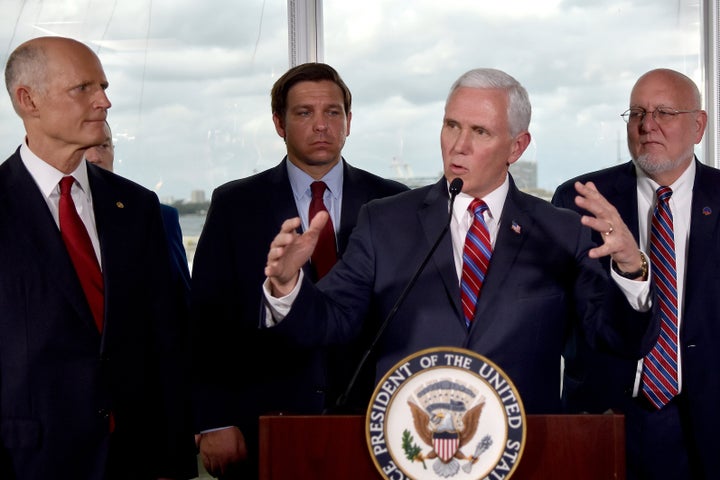
Vice President Mike Pence, center, along with Florida Sen. Rick Scott, far left, and Gov. Ron DeSantis, left, and CDC Directo

Vice President Mike Pence, center, along with Florida Sen. Rick Scott, far left, and Gov. Ron DeSantis, left, and CDC Director Dr. Robert Redfield, right, speaks to the media after a meeting with cruise line company leaders to discuss the efforts to fight the spread of the COVID-19 coronavirus, at Port Everglades, Saturday March 7, 2020, in Fort Lauderdale, Fla.

Health and Human Services Secretary Alex Azar suggested older Americans and those with health problems should avoid crowds “especially in poorly ventilated spaces.”

For most people, the flu-like viral illness causes only mild or moderate symptoms, such as fever and cough. But — like the flu — it can cause pneumonia and be much more lethal to people made frail by old age and by conditions that make it harder for their bodies to fight infections.

Dr. Peter Hotez, dean of tropical medicine at Baylor College of Medicine, this week warned U.S. lawmakers against minimizing the viruses risk for vulnerable people. During a Congressional hearing, he said the coronavirus “is like the angel of death for older individuals.”

Some experts this week said clearer and louder guidance should be made to vulnerable people, so they take every possible step to avoid settings where they might more easily become infected.

“The clear message to people who fit into those categories is; ‘You ought to become a semi-hermit. You’ve got to really get serious in your personal life about social distancing, and in particular avoiding crowds of any kind,’” said Dr. William Schaffner, a Vanderbilt University expert on infectious diseases.

That can include not only avoiding essential commercial travel but also large church services and crowded restaurants, he added.

Dr. Tom Frieden, a former CDC director, said whether to recommend the frail and elderly avoid air travel is “a difficult question,” but clearly this is a time when such conversations should be taking place.

“At this point the risk in the U.S. remains low, but we are seeing it spread rapidly. We are going from the calm before the storm to the beginning of the storm,” said Frieden, who now heads Resolve to Save Lives, an organization promoting global public health.

The new virus is a member of the coronavirus family that can cause colds or more serious illnesses such as SARS and MERS. Health officials think it spreads mainly from droplets when an infected person coughs or sneezes, similar to how the flu spreads.

The virus first emerged late last year in mainland China, but this year has increasingly been spreading around the world. More than 100,000 illnesses have been reported globally, in more than 90 countries and territories. the count includes more than 3,500 deaths.

For weeks, cases in the U.S. remained very low, but the count has been accelerating in the last several days.

President Donald Trump visited the CDC in Atlanta on Friday, where he defended his administration’s handling of the outbreak and tried to reassure Americans that the government had the virus under control. But Trump also detoured from that message, calling Washington state’s governor a “snake” and saying he’d prefer that people exposed to the virus on a cruise ship be left aboard so they wouldn’t be added to the nation’s tally.

___

Associated Press writers Lynn Berry in Washington and Kelli Kennedy in Fort Lauderdale, Florida, contributed to this report.

___

The Associated Press Health and Science Department receives support from the Howard Hughes Medical Institute’s Department of Science Education. The AP is solely responsible for all content.

btn_donateCC_LG

Please Donate


TOTUS is taking a page from China’s book of propagandizing a problem rather than solving it. MA

KEN MORITSUGU
Associated Press

BEIJING (AP) — As the rest of the world grapples with a burgeoning virus outbreak, China’s ruling Communist Party has deployed its propaganda playbook to portray its leader as firmly in charge, leading an army of health workers in a “people’s war” against the disease.

The main evening news on state TV regularly shows President Xi Jinping and his underlings giving instructions on the outbreak or touring related facilities. Coverage then segues to doctors and nurses on the front lines, drawing on a tradition of upholding model workers and the importance of sacrifice on behalf of the people and the party.

For the Communist Party, the epidemic is both a risk and an opportunity. It seeks to avoid blame for any mishandling of the outbreak, notably a slow initial response that allowed the virus to take hold. Conversely, it seeks credit for overcoming the crisis, enhancing the legitimacy of its rule.

State media, a tightly controlled internet and mass mobilization campaigns have all been harnessed for the effort.

“Upbeat, if emotional, state messaging leaves the impression that self-sacrificing citizens, national unity, and enlightened leadership will inevitably triumph in China, as the fight against the virus shifts beyond the country’s borders,” said Ashley Esarey, a specialist on the Chinese media at the University of Alberta.

The tried and true formula appears to remain effective at promulgating the party’s version of events, though the rise of social media is an ever-present challenge. A growing minority has long questioned the party line, but even many of them accept it out of habit or a lack of alternatives.

Most passively embrace a narrative that is repeated over and over, said Steve Tsang, director of the China Institute at the University of London’s School of Oriental and African Studies.

Li Desheng, a 22-year-old student who said news webcasts are his main source of information, commended the response of the party and the government, saying they had proven effective at stopping the spread of the virus.

“There is a Chinese idiom that says, ‘Point to a deer, call it a horse,’” the philosophy major said in an interview conducted via instant message. “If you say a deer is a horse, then that is a distortion of fact. When watching a news webcast … at least at present, I think a deer is still called a deer, and a horse is called a horse, so I believe the report.”

It’s not just a matter of what’s shown, though — it’s also what’s omitted. State media trumpeted the throwing up of new medical facilities in a fortnight without reporting on the woes of people unable to find a hospital bed that necessitated the Herculean effort.

It touted crackdowns on wild animal markets and plans to shut them down, without questioning why they hadn’t been sufficiently regulated since SARS, a similar virus outbreak in 2002-03.

June Teufel Dreyer, a China expert at the University of Miami, said the party may have lost credibility with what she called “engaged public opinion,” but that it’s difficult to know what portion of China’s 1.4 billion people that represents.

Zhou Songyi, another 22-year-old student, said she doesn’t find any useful information on the epidemic from the official People’s Daily newspaper or state broadcaster CCTV, citing stories that, even if true, have a PR agenda rather than seeking to inform the public.

Social media has given her digital-savvy generation almost instant feedback on some state-media reports, though critical comments are often removed by the country’s internet censorship.

“The battle for truth-telling on the internet is another sign that people do not simply trust in the government,” said Elizabeth Economy, director of Asia studies at the Council on Foreign Relations in New York. She added, though, that the propaganda works on those who believe in the party and want to be comforted and persuaded.

The core of the approach is to stifle any criticism while providing positive role models and showing the party as China’s only real hope.

China has barred citizen journalists from popular social media platforms after they reported on overcrowded hospitals and other problems. Non-state media outlets such as the magazine Caixin have done some independent reporting but stopped short of criticizing the leadership.

“The medics are portrayed as heroes not because of their dedication as health professionals, but because they are party members,” said Anthony Saich, a China expert at Harvard University. He believes the crisis has damaged confidence in Xi’s leadership to a degree but won’t have a lasting impact.

The health workers form the basis of the people’s war, a term adopted early on by Xi. A recent CCTV evening news broadcast showed him visiting military health units. Everyone maintained a safe distance from each other, following the government-ordered protocol, their mouths and noses covered by protective masks.

“Wars invite people to cast aside their squabbles and dissent and to come together,” said David Bandurski of the China Media Project at the University of Hong Kong. “Wars make heroes — and heroes are the stuff propaganda thrives upon.”

Nationalist campaigns have worked before, channeling anger away from the party in the SARS outbreak, territorial disputes with Japan, last year’s Hong Kong protests and the ongoing trade war with the U.S.

This time, the official coverage of the virus may help blunt any lasting political damage to Xi and the party’s authority, even as the social and economic costs of the outbreak exact a rising toll. More than 3,000 people have died in China from the virus.

“The leadership has been very eager to write the happy ending to this story before anyone really knows what the world is dealing with,” Bandurski said.

___

Associated Press researcher Chen Si in Shanghai contributed to this report.

___

The Associated Press receives support for health and science coverage from the Howard Hughes Medical Institute’s Department of Science Education. The AP is solely responsible for all content.

btn_donateCC_LG

Please Donate


A reminder of how poorly thus Administration is functioning under TOTUS. MA

Adriana BelmonteAssociate Editor
Yahoo Finance

Homelessness is a national issue that has become part of the 2020 election landscape.

And according to the Department of Housing and Urban Development (HUD)’s Annual Homeless Assessment Report to Congress, there were roughly 553,000 people experiencing homelessness on a single night in 2018. This was a 0.3% increase from the year before.

In the State of Homelessness Report by the White House Council of Economic Advisers (CEA), the administration released a list of issues and solutions surrounding homelessness in the U.S. The proposal was met with scathing criticism from several housing advocates, including the National Low Income Housing Coalition (NLIHC).

“This administration, President Trump and [HUD Secretary Ben] Carson, have repeatedly proposed policy changes that would worsen homelessness in our country,” NLIHC President and CEO Diane Yentel told Yahoo Finance. “But in almost all, if not all, cases we’ve been able to defeat those proposals.”

US President Donald Trump takes part in a cabinet meeting in the Cabinet Room of the White House in Washington, DC on November 19, 2019 as Ben Carson, Secretary of Housing and Urban Development looks on. (Photo by MANDEL NGAN / AFP) (Photo by MANDEL NGAN/AFP via Getty Images)

A ‘legacy’ of harmful proposals

Yentel has been especially critical of Carson’s time as HUD Secretary, particularly in regards to how he’s addressed homelessness.

“He’s put forward a number of really harmful proposals that could exacerbate the housing crisis and increase homelessness,” she said. “Since he’s been HUD secretary, every year he’s been there, he and the administration have proposed severe cuts to HUD’s budget … which would result in dramatically cutting or even eliminating several programs that provide affordable, accessible homes to the lowest income people.”

Yentel cited Carson’s proposals “to triple rents for the lowest-income subsidized renters and to raise rents for all other residents of HUD-subsidized homes… to force so-called mixed-status immigrant families to separate or be evicted from federally-assisted housing… allowing shelters to refuse to serve transgender and other LGBTQ people experiencing homelessness, and … to discourage immigrants from accessing housing programs.”

HUD Secretary Ben Carson speaks during a news conference after touring the Hollins House, a high rise building housing seniors and persons with disabilities. (Photo: AP Photo/Julio Cortez)

Consequently, she argued that Carson’s legacy “has been one of proposing changes that could do real harm to some of the lowest-income and most vulnerable renters in our country.”

A HUD spokesman refuted these assertions in a statement to Yahoo Finance.

“These claims are a complete distortion of the real work our Department is doing to preserve the rights of all Americans, uphold our laws, and house our country’s most vulnerable population,” the spokesman said. “We remain committed to working with whomever is willing to improve the lives of all Americans.”

There is some evidence to back up Yentel’s claims. After Carson assumed control of HUD in 2017, the organization’s website “removed links to documents that guided emergency shelters on how best to comply with agency regulations and serve transgender people facing homelessness,” according to the Washington Post, and “it also withdrew proposals that would have required HUD-funded emergency shelters to post notices informing people of LGBTQ rights and protections.”

A RV vehicle is parked next to a tent on the streets in an industrial area of Los Angeles, Wednesday, July 31, 2019. (AP Photo/Damian Dovarganes)

The Post reported that Carson told staff that “our society is in danger when we pick one issue (such as gender identity) and say it does not matter how it impacts others because this one issue should override every other common-sense consideration.”

The White House CEA report states that “policies intended solely to arrest or jail homeless people simply because they are homeless are inhumane and wrong. At the same time, when paired with effective services, policing may be an important tool to help move people off the street and into shelter or housing where they can get the services they need, as well as to ensure the health and safety of homeless and non-homeless people alike.”

A CEA spokesman explained to Yahoo Finance that “the CEA report states that arresting or jailing homeless people simply because they are homeless is ‘inhumane and wrong.’ Additionally, the report explains that police should work together with social service providers with the goal of getting people into shelter or housing. It should not be controversial to want to get extremely vulnerable people off the streets so they can receive the help they desperately need.”

San Francisco police officers wait while homeless people collect their belongings in San Francisco in 2016. (Photo: AP/Ben Margot)

‘Criminalization would certainly do real harm’

Yentel argued that the administration’s proposals are “about hiding homelessness” and not about solving it.

“It’s about attempting to move people who are sleeping on the streets or in cars or in RVs to jails or prisons or other inappropriate, unsafe, and harmful places as a way to lessen visible homelessness,” she said, stressing that the “underlying cause of homelessness is the lack of affordable, accessible homes for the people who need them.”

Consequently, according to Yantel, approaches involving criminalization “would certainly do real harm to low-income people who are on the cusp of or experiencing homelessness. Not only is the criminalization of homelessness unconstitutional and cruel, it also wastes public resources that should otherwise be spent on solutions.”

Adriana is an associate editor for Yahoo Finance. Follow her on Twitter @adrianambells.

btn_donateCC_LG

Please Donate


 Mar. 6, 2020, 10:09 AM


  • Trump said at a Fox News town hall forum that he was intending to reduce funding for Social Security and Medicare, two of the largest federal entitlement programs.
  • “Oh, we’ll be cutting,” he said. “We’re also going to have growth like you’ve never seen before.”
  • The move would be a reversal from Trump’s pledge to leave those programs untouched in a second term.
  • He previously expressed a willingness to reduce funding for Social Security and Medicare in a second term.
  • Visit Business Insider’s homepage for more stories.

President Trump said at a Fox News town hall forum that he intended to cut entitlement programs like Social Security and Medicare.

Trump was asked during the interview about the $23 trillion national debt, which has continued surging under his watch. He campaigned on 2016 on wiping it out but instead passed laws like the 2017 tax cuts, which piled more onto it.

At the town hall, Fox News host Martha MacCallum told the president that if “you don’t cut something in entitlements, you will never really deal with the debt,” and Trump immediately responded.


“Oh, we’ll be cutting,” he said to the Scranton, Pennsylvania, audience. “We’re also going to have growth like you’ve never seen before.”

The comments appear to be a reversal from Trump’s promise to leave the two largest federal government programs untouched in a second term. In a CNBC interview last month, Trump expressed a willingness to cut funding for both programs.

“At the right time, we will take a look at that. You know, that’s actually the easiest of all things, if you look,” he told CNBC’s Joe Kernen.

He rowed back on those remarks and did the same after the Fox News town hall.

Trump tweeted on Friday morning: “I will protect your Social Security and Medicare, just as I have for the past 3 years. Sleepy Joe Biden will destroy both in very short order, and he won’t even know he’s doing it!”


White House Press Secretary Stephanie Grisham also defended the president on Twitter, saying that Trump was speaking “about cutting deficits, NOT entitlements.”

Social Security and Medicare represent a major chunk of government spending, and they constituted almost 40% of the federal budget in 2018. Social Security alone makes up nearly a quarter of all federal spending.

The Congressional Budget Office has projected that both programs will cost $30 trillion over the next decade. But any efforts at reform would likely encounter resistance from Democrats pledging to shield Social Security and Medicare from future cuts.

btn_donateCC_LG

Please Donate


It would be prudent for TOTUS’s handlers(?) to advise him against mentioning Ukraine given the mire he has personally created and the ensuing impeachment inquiry regardless of the outcome (thanks Botch). MA
Tim Pearce
President Trump plans to use former Vice President Joe Biden’s history with Ukraine against him in the general election should Biden win the Democratic nomination for president.

Donald Trump wearing a suit and tie© Provided by Washington ExaminerTrump spoke with Fox News host Sean Hannity on Friday night about the president’s campaign strategy after Biden took the lead in the Democratic primary with 566 delegates following Super Tuesday. Trump said that he plans to bring up allegations of corruption against Biden and his son, Hunter Biden, “all the time.”

“It’s not a campaign issue for the Democrats. They don’t want to bring it up. They were obviously told, ‘You can’t bring that up,'” Trump said. “That wouldn’t happen with the Republicans, I can tell you. I’m not saying good, bad, or indifferent.”

Biden oversaw the U.S. foreign policy to Ukraine under the Obama administration at the same time that his son sat on the board of a Ukrainian energy company, a position that critics say Hunter Biden was given in 2014 in exchange for access to the vice president.

In 2016, Biden threatened to withhold $1 billion in U.S. loan guarantees from Ukraine if the government did not fire its prosecutor general Viktor Shokin, widely believed to be corrupt. At the time, Shokin was weighing launching an investigation into Burisma.

“That will be a major issue in the campaign. I will bring that up all the time,” Trump said.

Trump’s personal attorney Rudy Giuliani traveled to Ukraine last year to attempt to uncover evidence of corruption against the Bidens in Ukraine. Giuliani’s investigation helped launch a push by Democrats to impeach Trump after Trump froze U.S. military aid to Ukraine. Democrats alleged that Trump froze the aid to secure a Ukrainian government investigation into Biden and his son.

btn_donateCC_LG

Please Donate


USA TODAY Opinion
Michael J. Stern, Opinion columnist
USA TODAY Opinion

“The Real Housewives” have nothing on the Department of Justice when it comes to drama. I don’t mean to be flippant. But if I can’t marvel at the absurdity of the nuclear meltdown that is gripping the institution to which I dedicated my professional career, I’m afraid I will cry.

I was concerned when the punchline “Donald Trump” came to be preceded by the title “president.” But my beloved DOJ was filled with career prosecutors whose dedication and integrity would keep the ship on course — even if the storm lasted four years.

I was confident that the traditions that made the Justice Department the most respected law enforcement organization in the world would surely allow it to weather any attorney general Trump could install.

But Trump has commandeered the department and sent a clear message: “Investigate me or people close to me and I will undercut years of your hard work, trash your reputation on Twitter, and create a Hobson’s choice between your integrity and your ability to earn a living. And if you pick the former, I will issue a pardon and undo all you worked for anyway.”

Unholy alliance of Trump and Barr

Since Republican senators refused to remove Trump from office, there’s nothing in his path. Trump is certainly getting no push back from Attorney General William Barr, who has revealed himself to be the second coming of Roy Cohn — Trump’s former personal attorney who was disbarred due to his sleazy legal tactics.

Barr’s first order of business was to release a misleading summary of Special Counsel Robert Mueller’s report — effectively urinating on what should have been a bonfire that burned Trump’s presidency to the ground. Then, Barr stonewalled congressional efforts to do what an honest reading of Mueller’s report should have done.

Things have only gotten worse since Trump survived his Senate impeachment trial. For a start, Barr has said he must personally approve any investigation into corruption by a presidential candidate or campaign. That’s the DOJ equivalent of a GPS warning: “Red light camera ahead.”

President Donald Trump at the White House on Jan. 29, 2020, and Attorney General William Barr at the Justice Department on Jan. 13, 2020.

No agent or prosecutor is going to tap the attorney general on the shoulder and ask permission to investigate the man Barr lives to protect. That means Trump and his campaign can solicit assistance from foreign adversaries in this year’s presidential election, and no one will stop them.

As for existing investigations, Barr is second guessing his department’s work and even changing it to be more favorable to Trump. After Trump tweeted his dissatisfaction with DOJ’s sentencing recommendation against political ally Roger Stone, Barr ordered prosecutors to propose “far less” time in prison.

His order was such an abuse of power, all four of the Stone prosecutors withdrew from the case and 2,600 former federal officials, myself included, published a letter asking Barr to resign.

Failing institutions: Stone prison term: Will courts hold Trump accountable after Congress, Mueller fall short?

But it was mission accomplished for Trump and Barr. On Thursday, Stone was sentenced to 40 months in prison, substantially less than the seven to nine years requested by the Stone prosecutors.

A similar sequence occurred after Trump expressed unhappiness with the prosecution of his former national security adviser, Michael Flynn. Prosecutors who had recommended up to six months in prison later said probation would be appropriate. And Barr has now ordered a “re-investigation” of Flynn’s case, presumably to undermine Flynn’s guilty plea.

Pardoning the swamp, not draining it

Trump does not always need Barr. When he can manipulate justice alone, he does, as he showed last week when he issued 11 pardons and commutations. Former Illinois Gov. Rod Blagojevich, convicted of trying to sell Barack Obama’s Senate seat, was immediately released from prison. Trump also pardoned one of Rudy Giuliani’s former business partners, whose family happened to donate $85,000 to a Trump Victory fund and $150,000 to the Republican National Committee.

Every person reading this should be angry that they would still be sitting in prison if they committed the same crimes as the people Trump pardoned. That’s because Trump has created a separate system of justice for his friends, political allies, and wealthy donors. Trump didn’t drain the swamp, he pardoned it.

After impeachment: Senate delivers brutal dose of reality and ensures future Trump corruption

And there are bigger threats looming. One is the prospect of demoralized agents and prosecutors who see corruption, understand the meaning of futility, and simply stop trying. An even more dangerous contaminant is the “Lock Her Up!” campaign chant that has metastasized into an unabashed effort to hunt and cage Trump’s political enemies.

Hillary Clinton, Joe Biden, Hunter Biden, James Comey and Andrew McCabe have all moved from Trump’s tweet list to Barr’s hit list. Yes, Clinton and McCabe have been told they will not be prosecuted, but not for lack of trying. In fact, it has been reported that the McCabe grand jury balked at DOJ’s requested indictment.

People reading this are probably thinking “What difference does it make if the president ordered DOJ to investigate some government bureaucrats?” It makes a difference.

The independence of our Justice Department is what distinguishes us from countries in which people are not free. Countless pundits have referred to Trump as an authoritarian. It’s not hyperbole.

If Trump can harness the power of the U.S. Department of Justice to do his personal bidding, we are no longer the America we thought we were. If we cannot rely on the U.S. Department of Justice to do the right thing, we are lost.

Michael J. Stern, a member of USA TODAY’s Board of Contributors, was a federal prosecutor for 25 years in Detroit and Los Angeles. Follow him on Twitter: @MichaelJStern1

You can read diverse opinions from our Board of Contributors and other writers on the Opinion front page, on Twitter @usatodayopinion and in our daily Opinion newsletter. To respond to a column, submit a comment to letters@usatoday.com.

This article originally appeared on USA TODAY: Trump has commandeered the Justice Department and pardoned the swamp

btn_donateCC_LG

Please Donate


Toluse Olorunnipa, Ashley Parker, Josh Dawsey
President Trump has instructed his White House to identify and force out officials across his administration who are not seen as sufficiently loyal, a post-impeachment escalation that administration officials say reflects a new phase of a campaign of retribution and restructuring ahead of the November election.

a man wearing a suit and tie: White House aide Johnny McEntee, left, follows President Trump to board the Marine One helicopter on the South Lawn of the White House June 7, 2017.© Jabin Botsford/The Washington Post White House aide Johnny McEntee, left, follows President Trump to board the Marine One helicopter on the South Lawn of the White House June 7, 2017.Johnny McEntee, Trump’s former personal aide who now leads the effort as director of presidential personnel, has begun combing through various agencies with a mandate from the president to oust or sideline political appointees who have not proved their loyalty, according to several administration officials and others familiar with the matter who spoke on the condition of anonymity to discuss internal deliberations.

The push comes in the aftermath of an impeachment process in which several members of Trump’s administration provided damning testimony about his behavior with regard to Ukraine. The stream of officials publicly criticizing Trump’s actions frustrated the president and caused him to fixate on cleaning house after his acquittal this month.

“We want bad people out of our government!” Trump tweeted Feb. 13, kicking off a tumultuous stretch of firings, resignations, controversial appointments and private skirmishes that have since spilled into public view.

The National Security Council, the State Department and the Justice Department are targets of particular focus, according to two administration officials, and there have recently been multiple resignations and reassignments at each of those agencies.

John C. Rood, the official in charge of Defense Department policy who had certified that Ukraine had met anti-corruption obligations, was let go this week. Victoria Coates, the deputy national security adviser who was viewed with suspicion by some White House aides, was removed from her post and was moved to an advisory position in the Energy Department.

McEntee spent part of this week asking officials in various Cabinet agencies to provide names of political appointees working in government who are not fully supportive of Trump’s presidency, according to administration officials.

The president instructed McEntee to find people in the administration who aren’t aligned with Trump and “get rid” of them, according to someone familiar with the president’s directive. Trump did not provide additional specificity on what exactly he wanted beyond a workforce that more fully reflects his instincts, the person said, and it is unclear what criteria are being used to determine an official’s fealty to the president. McEntee’s discussions with Cabinet agencies were first reported by Axios.

The 29-year-old former campaign aide is planning to prepare a presentation for Trump about what he has found. While Sean Doocey, the former director of presidential personnel, reported to acting White House chief of staff Mick Mulvaney’s deputy, McEntee reports directly to the president, according to a senior administration official.

What began as a campaign of retribution against officials who participated in the impeachment process has evolved into a full-scale effort to create an administration more fully in sync with Trump’s id and agenda, according to several officials familiar with the plan. It is unclear whether civil servants will be targeted as well, but it would be harder to dislodge them than removing political appointees. Civil servants, however, could be sidelined in other ways.

As he became the third president in American history to be impeached, Trump seethed against his own appointees who defied White House lawyers to comply with congressional subpoenas and testify about his conduct. The process clarified for Trump and his top advisers that they had not focused enough on personnel in the early part of the presidency, creating a loyalty deficiency the president is moving quickly to correct, officials said.

The burgeoning effort was reflected in Trump’s decision this week to appoint Richard Grenell as the next acting director of national intelligence, placing a fiercely loyal but inexperienced ally atop an intelligence structure against which the president has frequently railed.

Mulvaney used a speech this week at the Oxford Union in Britain to inveigh against the “deep state,” and he lamented that the administration could not fire more agency employees who do not implement the president’s orders. He referred to some of testimony of the witnesses who participated in Trump’s impeachment inquiry.

Bureaucrats who want to make policy instead of implementing it “should put their name on the effing ballot and run” for office, he said during remarks to a group of several hundred people, according to audio of a speech obtained by The Washington Post.

Trump’s family members have been among the main champions of the effort to force out officials who have not proved their devotion to Trump.

Jared Kushner, the president’s son-in-law and a senior adviser in the White House, has played a central in the push, concentrating more power in the West Wing and working to combat leaks, officials said.

Trump’s son Donald Trump Jr. wrote on Twitter that the impeachment investigation was helpful in “unearthing who all needed to be fired.”

Cliff Sims, a former White House adviser who wrote a book titled “Team of Vipers,” about his time in the White House, has said Trump’s presidency has been repeatedly undermined by disloyal underlings.

“Loyalist shouldn’t be a dirty word,” he said. “Loyalty to the duly elected president and his agenda is exactly what we should expect from our unelected appointees.”

Brendan Buck, a longtime adviser to former House speaker Paul D. Ryan (R-Wis.), said that while Trump is entitled to have political appointees who support his agenda, the purity tests could make it difficult to find qualified people.

“If they also insist on hiring only people who’ve never taken issue with something the president has done, it’s going to be slim pickings,” he said.

Trump selected Grenell, the ambassador to Germany, to lead the intelligence community in place of Joseph Maguire after becoming angry last week when he learned that a U.S. intelligence official had told lawmakers that Russia wants to see him reelected, according to people familiar with the matter.

Grenell has moved quickly to concentrate power within the intelligence agencies. Maguire’s deputy, Andrew P. Hallman, resigned Friday. Grenell hired Kash Patel, a National Security Council aide who has worked in the past to cast doubt on the FBI’s investigation into Russian election interference. Grenell has requested access to information from the C.I.A. and other intelligence agencies, the New York Times reported, citing two people familiar with the matter.

The moves reflect the skeptical view the president has had of the intelligence community after his campaign’s links to Russia were investigated and several of his associates were prosecuted.

The anger extends beyond the intelligence agencies, and Trump has also called for law enforcement officials who investigated his campaign to be investigated or prosecuted. Even some Trump allies are feeling heat over not being aggressive enough about taking on the president’s perceived enemies.

At a donor roundtable Tuesday at the Montage Hotel in Los Angeles, one participant pointedly questioned Senate Judiciary Committee Chairman Lindsey O. Graham (R-S.C.) on why he was not holding accountable people who were responsible for the Russia investigation.

“I see you on Fox News every night, and then you do nothing about it. What are you going to do about it?” the donor asked, according to an attendee.

“What a fantastic question!” Trump said.

Meanwhile, administration officials are conducting a search for the “Anonymous” author of a tell-all book about Trump titled “A Warning,” according to White House trade adviser Peter Navarro, who told CNN on Friday that the search had become a “vocation with everybody.”

McEntee, who lost his job in 2018 over concerns about his online gambling, has long expressed an interest in the personnel office despite having no previous government experience, two administration officials said. Within the West Wing, he is seen as fiercely devoted to the president and is well liked by first lady Melania Trump, the officials said.

Some within the White House have bristled at his lack of experience and aggressive approach to ferreting out “Never Trumpers.”

McEntee “does not have the relevant experience to do this job, unless the job is to purge Never Trumpers and reward loyalists,” one official said.

Another senior administration official countered that McEntee was talented and up to the task, with the key qualification of having the president’s confidence.

As he gears up for the reelection contest, Trump has moved to surround himself with longtime allies who have proved their devotion to him while pushing away those who have not earned his trust.

This month, Trump rehired Hope Hicks, one of his longest-serving aides and closest confidants.

During a podcast interview last week, Trump concurred when Fox News analyst Geraldo Rivera described the White House as “a nest of vipers and snitches and backstabbers and rats”

“I inherited a place with, you know, many different administrations, and they worked there for years and were civil service and with unions and all of it,” he said on Rivera’s “Roadkill” podcast. “You can’t do what you’d like to do.”

toluse.olorunnipa@washpost.com

ashley.parker@washpost.com

josh.dawsey@washpost.com

btn_donateCC_LG

Please Donate


The recent news cycle has covered the emboldened actions of TOTUS. He has pardoned convicted felons and probably will do the same for recently the  sentenced Roger Stone. We were warned by Previous associate  Anthony Scaramucci that TOTUS is capable and will do exactly what he doing now, Pardoning loyalists even though they are convicted criminals. Now this:

Lawmakers Are Warned That Russia Is Meddling to Re-elect Trump

Adam Goldman, Julian E. Barnes, Maggie Haberman and Nicholas Fandos

8 hrs ago

WASHINGTON — Intelligence officials warned House lawmakers last week that Russia was interfering in the 2020 campaign to try to get President Trump re-elected, five people familiar with the matter said, a disclosure to Congress that angered Mr. Trump, who complained that Democrats would use it against him.

The day after the Feb. 13 briefing to lawmakers, the president berated Joseph Maguire, the outgoing acting director of national intelligence, for allowing it to take place, people familiar with the exchange said. Mr. Trump was particularly irritated that Representative Adam B. Schiff, Democrat of California and the leader of the impeachment proceedings, was at the briefing.

During the briefing to the House Intelligence Committee, Mr. Trump’s allies challenged the conclusions, arguing that he had been tough on Russia and that he had strengthened Europe Some intelligence officials viewed the briefing as a tactical error, saying the conclusions could have been delivered in a less pointed manner or left out entirely to avoid angering Republicans. The intelligence official who delivered the briefing, Shelby Pierson, is an aide to Mr. Maguire and has a reputation for speaking bluntly.

Though intelligence officials have previously told lawmakers that Russia’s interference campaign was continuing, last week’s briefing included what appeared to be new information: that Russia intended to interfere with the 2020 Democratic primaries as well as the general election.

On Wednesday, the president announced that he was replacing Mr. Maguire with Richard Grenell , the ambassador to Germany and an aggressively vocal Trump supporter. And though some current and former officials speculated that the briefing might have played a role in that move, two administration officials said the timing was coincidental. Mr. Grenell had been in discussions with the administration about taking on new roles, they said, and Mr. Trump had never felt a kinship with Mr. Maguire.

Spokeswomen for the Office of the Director of National Intelligence and its election security office declined to comment. A White House spokesman did not immediately respond to requests for comment.

A Democratic House Intelligence Committee official called the Feb. 13 briefing an important update about “the integrity of our upcoming elections” and said that members of both parties attended, including Representative Devin Nunes of California, the top Republican on the committee.

In a tweet on Thursday evening , Mr. Schiff said that it appeared that Mr. Trump was “again jeopardizing our efforts to stop foreign meddling” with his objections to the briefing.

Mr. Trump has long accused the intelligence community’s assessment of Russia’s 2016 interference as the work of a “deep state” conspiracy intent on undermining the validity of his election. Intelligence officials feel burned by their experience after the last election, when their work became a subject of intense political debate and is now a focus of a Justice Department investigation.

© Doug Mills/The New York Times Mr. Trump believes that Russian efforts to get him elected in 2016 have cast doubts about the legitimacy of his campaign victory.

Part of the president’s anger stemmed from the administration’s reluctance to provide delicate information to Mr. Schiff. He has been a leading critic of Mr. Trump since 2016, doggedly investigating Russian election interference and later leading the impeachment inquiry into the president’s dealings with Ukraine.

Mr. Trump complained that Mr. Schiff would “weaponize” the intelligence about Russia’s support for him, according to a person familiar with the briefing. And he was angry that he was not told right away about the briefing, the person said.

Mr. Trump has fixated on Mr. Schiff since the impeachment saga began, pummeling him publicly with insults and unfounded accusations of corruption. In October, Mr. Trump refused to invite lawmakers from the congressional intelligence committees to a White House briefing on Syria because he did not want Mr. Schiff there, according to three people briefed on the matter.

The president did not erupt at Mr. Maguire, and instead just asked pointed questions, according to the person. But the message was unmistakable: He was not happy.

Ms. Pierson, officials said, was delivering the conclusion of multiple intelligence agencies, not her own opinion. The Washington Post first reported the Oval Office confrontation between Mr. Trump and Mr. Maguire, but not the substance of the disagreement.

The intelligence community issued an assessment in early 2017 that President Vladimir V. Putin personally ordered a campaign of influence in the previous year’s election and developed “a clear preference for President-elect Trump.” But Republicans have long argued that Moscow’s campaign was intended to sow chaos, not aid Mr. Trump specifically.

Some Republicans have accused the intelligence agencies of opposing Mr. Trump, but intelligence officials reject those accusations. They fiercely guard their work as nonpartisan, saying it is the only way to ensure its validity.

At the House briefing, Representative Chris Stewart, Republican of Utah, who has been considered for the director’s post, was among the Republicans who challenged the conclusion about Russia’s support for Mr. Trump. Mr. Stewart insisted that the president had aggressively confronted Moscow, providing anti-tank weapons to Ukraine for its war against Russia-backed separatists and strengthening the NATO alliance with new resources, according to two people briefed on the meeting.

Mr. Stewart declined to discuss the briefing but said that Moscow had no reason to support Mr. Trump. He pointed to the president’s work to confront Iran, a Russian ally, and encourage European energy independence from Moscow. “I’d challenge anyone to give me a real-world argument where Putin would rather have President Trump and not Bernie Sanders,” Mr. Stewart said in an interview, referring to the nominal Democratic primary race front-runner.

Under Mr. Putin, Russian intelligence has long sought to stir turmoil among around the world. The United States and key allies on Thursday accused Russian military intelligence, the group responsible for much of the 2016 election interference in the United States, of a cyberattack on neighboring Georgia that took out websites and television broadcasts.

The Russians have been preparing — and experimenting — for the 2020 election , undeterred by American efforts to thwart them but aware that they needed a new playbook of as-yet-undetectable methods, United States officials said.

They have made more creative use of Facebook and other social media. Rather than impersonating Americans as they did in 2016, Russian operatives are working to get Americans to repeat disinformation, the officials said. That strategy gets around social media companies’ rules that prohibit “inauthentic speech.”

And the Russians are working from servers in the United States, rather than abroad, knowing that American intelligence agencies are prohibited from operating inside the country. (The F.B.I. and the Department of Homeland Security are allowed to do so with aid from the intelligence agencies.)

Russian hackers have also infiltrated Iran’s cyberwarfare unit, perhaps with the intent of launching attacks that would look like they were coming from Tehran, the National Security Agency has warned.

Some officials believe that foreign powers, possibly including Russia, could use ransomware attacks, like those that have debilitated some local governments, to damage or interfere with voting systems or registration databases.

Still, much of the Russian aim is similar to its 2016 interference, officials said: search for issues that stir controversy in the United States and use various methods to stoke division.

One of Moscow’s main goals is to undermine confidence in American election systems, intelligence officials have told lawmakers, seeking to sow doubts over close elections and recounts. American officials have said they want to maintain confidence in the country’s voting systems, so confronting those Russian efforts is difficult.

Both Republicans and Democrats asked the intelligence agencies to hand over the underlying material that prompted their conclusion that Russia again is favoring Mr. Trump’s election.

Although the intelligence conclusion that Russia is trying to interfere in the 2020 Democratic primaries is new, in the 2019 report of the special counsel, Robert S. Mueller III, there is a reference to Russian desires to help Mr. Sanders in his presidential primary campaign against Hillary Clinton in 2016. The report quoted internal documents from the Internet Research Agency, a troll factory sponsored by Russian intelligence, in an order to its operatives: “Use any opportunity to criticize Hillary and the rest except for Sanders and Trump — we support them.”

How soon the House committee might get that information is not clear. Since the impeachment inquiry, tensions have risen between the Office of the Director of National Intelligence and the committee. As officials navigate the disputes, the intelligence agencies have slowed the amount of material they provide to the House, officials said. The agencies are required by law to regularly brief Congress on threats.

While Republicans have long been critical of the Obama administration for not doing enough to track and deter Russian interference in 2016, current and former intelligence officials said the party is at risk of making a similar mistake now. Mr. Trump has been reluctant to even hear about election interference, and Republicans dislike discussing it publicly.

The aftermath of last week’s briefing prompted some intelligence officials to voice concerns that the White House will dismantle a key election security effort by Dan Coats, the former director of national intelligence: the establishment of an election interference czar. Ms. Pierson has held the post since last summer.

And some current and former intelligence officials expressed fears that Mr. Grenell may have been put in place explicitly to slow the pace of information on election interference to Congress. The revelations about Mr. Trump’s confrontation with Mr. Maguire raised new concerns about Mr. Grenell’s appointment, said the Democratic House committee official, who added that the upcoming election could be more vulnerable to foreign interference.

Mr. Trump, former officials have said, is typically uninterested in election interference briefings, and Mr. Grenell might see it as unwise to emphasize such intelligence with the president.

“The biggest concern I would have is if the intelligence community was not forthcoming and not providing the analysis in the run-up to the next election,” said Andrea Kendall-Taylor, a former intelligence official now with the Center for a New American Security. “It is really concerning that this is happening in the run-up to an election.”

Mr. Grenell’s unbridled loyalty is clearly important to Mr. Trump but may not be ideally suited for an intelligence chief making difficult decisions about what to brief to the president and Congress, Ms. Kendall-Taylor said.

“Trump is trying to whitewash or rewrite the narrative about Russia’s involvement in the election,” she said. “Grenell’s appointment suggests he is really serious about that.”

The acting deputy to Mr. Maguire, Andrew P. Hallman, will step down on Friday, officials said, paving the way for Mr. Grenell to put in place his own management team. Mr. Hallman was the intelligence office’s principal executive, but since the resignation in August of the previous deputy, Sue Gordon, he has been performing the duties of that post.

Mr. Maguire is planning to leave government, according to an American official.

Adam Goldman, Julian E. Barnes and Nicholas Fandos reported from Washington, and Maggie Haberman from New York. Eric Schmitt and David E. Sanger contributed reporting from Washington.

btn_donateCC_LG

Please Donate