Skip navigation

Monthly Archives: June 2020


Jarrett Bell, USA TODAY  
It could not have been too difficult for Roger Goodell to declare this week that he is down to “encourage” any NFL team thinking of signing blackballed quarterback Colin Kaepernick.

Colin Kaepernick standing in front of a crowd of people watching a football game: San Francisco 49ers quarterback Colin Kaepernick (7) reacts following the 22-21 victory against the Los Angeles Rams at Los Angeles Memorial Coliseum.© Gary A. Vasquez, USA TODAY Sports San Francisco 49ers quarterback Colin Kaepernick (7) reacts following the 22-21 victory against the Los Angeles Rams at Los Angeles Memorial Coliseum.

Goodell expressed as much during an ESPN special featuring the commissioners of the several major sports leagues, maintaining a consistent pattern.

Less than two weeks ago, when the NFL Commissioner responded to a video from players in the wake of the George Floyd tragedy, he didn’t even bother to mention Kaepernick by name as he apologized to players – so weird, seeing that Kaepernick used the NFL stage in 2016 to launch a protest movement that raised awareness about the type of police brutality and racism is reflected with Floyd’s death.

Now, with the Kaepernick-still-should-be-playing-in-the-NFL theme revived against the backdrop of massive protests across the country, Goodell is suddenly lobbying for the activist to receive work.

It’s like jumping on the bandwagon. Within the past week or so, voices within the NFL community in support of Kaepernick getting an opportunity – including some that have expressed as much all along – have gotten louder.

Saints safety Malcolm Jenkins said it well. He told “CBS This Morning” that the NFL still hasn’t gotten it right with Kaepernick and that the league will be “on the wrong side of history” until the quarterback is signed or given an apology.

If there were a petition based on such public declarations, signers joining Jenkins would at least include Richard Sherman, Carlos Hyde, Michael Bennett, Eric Kendricks, Pete Carroll and Drew Rosenhaus, all of whom have expressed support within recent days for Kaepernick. And, of course, their sentiments were co-signed by Rev. Al Sharpton last week as he gave the eulogy at Floyd’s funeral.

Maybe there’s hope. Carroll, the Seahawks coach, said he received a call from an unidentified team inquiring about Kaepernick. The Seahawks, in 2017, were the only team in the past three years to bring in Kaepernick for a visit. But now there might be a mysterious team – and there are several who could use Kaepernick at least as a competitive option as a backup – in the mix.

This would be the time to make a move, a few weeks before training camps could open, pending a coronavirus X-factor. Having a few weeks to absorb the offense – rather than coming in as an emergency option during the season after a quarterback injury – is critical to Kaepernick’s chances for success.

So, yes, it’s a convenient time for Goodell to “encourage” that some team sign the quarterback who in 2019 settled a collusion case against the NFL. Goodell added that he’s open to Kaepernick working with the league on social justice issues, too. He might have also added, having professed recently that “Black lives matter,” that what’s happened to Kaepernick in losing his NFL opportunity is symbol of how careers and even lives have historically been sacrificed by those demonstrating courage for the cause of equality.

Yet in addressing Kaepernick with ESPN, Goodell unfortunately prefaced his headline-grabbing remark with the “if he wants to play” qualifier. Intended or not, that “if” advances one of the sorry narratives that has surrounded Kaepernick since his last NFL action. Goodell should have known better than to let that “if” stuff spill off his tongue after all that Kaepernick and the league have been through.

Just for the record, again, here’s what Kaepernick, 32, said in February when I asked whether he wants to play:

“My desire to play football is still there,” Kaepernick told USA TODAY Sports. “I still train five days a week. I’m ready to go, I’m ready for a phone call, tryout, workout at any point in time. I’m still waiting on the owners and their partners to stop running from this situation. So, I hope I get a call this offseason. I’ll be looking forward to it.”

That’s pretty much been Kaepernick’s stock answer throughout his NFL exile.

And Goodell’s stock statements? Stuff like the NFL is a “meritocracy.” Or teams are making “football decisions” – even while some carry sorry QB options and Kaepernick’s résumé includes taking a team to a Super Bowl. Goodell, in recent years, has also harrumphed that “I don’t get involved in personnel decisions with the clubs,” although NFL executive Joe Lockhart contended recently that Goodell indeed made calls on behalf of Kaepernick at some point. Goodell, the face of the NFL shield, has also posited that multiple factors are involved for teams. It should not be forgotten that Giants co-owner John Mara once publicly bemoaned the potential backlash he suspected would come with signing Kaepernick, based on feedback he’s received in letters from fans.

For Goodell to take the public stand now to “encourage” a team to sign Kaepernick seems so reactionary. In times of crisis, the NFL often seems to stick a finger in the air to assess where the wind is coming from. When President Donald Trump blasted the NFL over the protests during the national anthem, feeding red meat to his base, the league at first showed some resistance … then backed down. Now that Trump’s approval ratings are sinking, there’s seemingly more juice for the NFL to resist the Basher-In-Chief. Encouraging the possibility of Kaepernick getting another shot, like maintaining you’re game for joining protests now, seemingly flows better these days, especially as many corporate entities – always important to the business of the NFL, given sponsorship dollars – make public pronouncements that admonish systemic racism.

The tide is seemingly shifting, leaving Goodell with so much less risk in supporting Kaepernick’s chances to land work. Remember, the Goodell who recently expressed regret for not listening to players is the same man who in 2017 trumpeted “unprecedented dialogue” with players as the league became proactive in supporting social justice efforts.

Bottom line, the words – even if genuine in this case – are so cheap when played against the history of the Kaepernick saga.

Back in 2017, I asked Goodell at a news conference if he had even talked to Kaepernick. I was stunned that he maintained, “It’s something I could do, but it’s not something I have thought about.”

That shouldn’t have been difficult back then and surely shouldn’t be now during the enhanced listening that will be presumably in play with this new round of enlightenment.

Go ahead, Roger. Call him. Initiate engagement and listen up.

As with the statement of “encouragement,” better late than never.

Follow Jarrett Bell on Twitter @JarrettBell.

This article originally appeared on USA TODAY: Opinion: Why now? Roger Goodell’s support for Colin Kaepernick is a trendy matter of convenience

btn_donateCC_LG

Please Donate


Emily Cochrane and Alan Rappeport  10 hrs ago The New York Times

WASHINGTON — House Democrats opened an investigation on Monday into the distribution of more than $500 billion in small-business loans under a pandemic relief program, escalating a clash with the Trump administration as it resists oversight of trillions of dollars in coronavirus assistance funds

The announcement from the seven Democrats on a committee created to scrutinize how the administration is spending pandemic relief money came as Steven Mnuchin, the Treasury secretary, abruptly pivoted under pressure from lawmakers and said he would work to disclose more about where government-backed money was going through the lending initiative, the Paycheck Protection Program.

It was the latest indication that, despite attempts by lawmakers to build layers of oversight into the largest stimulus program of its kind in modern history, an administration that has been hostile to congressional scrutiny continues to resist. In a letter to four congressional committees last week, the heads of an independent accountability panel created by the law alerted lawmakers that lawyers for the Treasury Department were interpreting the statute in a way to exempt more than $1 trillion from scrutiny.

“The administration should release the names of all P.P.P. borrowers — as the S.B.A. routinely does for similar loan programs,” the lawmakers wrote in a letter to the heads of the Treasury Department and the Small Business Administration, which jointly administer the program. It came days after Mr. Mnuchin told a Senate committee that information was “proprietary” and not public.

“Contrary to Secretary Mnuchin’s recent testimony, there is nothing ‘proprietary’ or ‘confidential’ about a business receiving millions of dollars appropriated by Congress, and taxpayers deserve to know how their money is being spent,” the Democrats wrote.

Since the $2.2 trillion economic stabilization package became law in March, lawmakers have struggled to establish oversight. With some funds yet to be spent, including about $100 billion in the Paycheck Protection Program, and with lawmakers contemplating negotiations over another relief package, the scope of the task will only expand in the coming months.

Lawmakers have pointed to the creation of multiple oversight panels and positions as evidence that there is relentless scrutiny of the trillions of dollars doled out across the country. In recent weeks, lawmakers have intensified demands for information about which businesses have benefited from the Paycheck Protection Program and what kind of loans they have received.

But implementing oversight has proved challenging, particularly as Congress adjusts to working during a pandemic. The five-person Congressional Oversight Commission does not yet have a leader. (Speaker Nancy Pelosi of California said on Thursday that she hoped that a pick jointly agreed to with Senator Mitch McConnell of Kentucky, the majority leader, “will be imminent.”)

And President Trump has scoffed at oversight, suggesting as he signed the stimulus law that he had the ability to decide what information a new inspector general named to oversee a separate corporate bailout fund could share with Congress. Mr. Trump also in effect ousted the head of a committee of inspectors general responsible for pandemic oversight, known as the Pandemic Response Accountability Committee, through a demotion.

Although Mr. Mnuchin promised on Twitter on Monday to work with lawmakers to “strike the appropriate balance for proper oversight of #ppploans and appropriate protection of small business information,” Treasury Department lawyers issued an opinion that would further curtail oversight of more than $1 trillion in aid, according to the letter sent to lawmakers last week, whose contents were first reported by The Washington Post.

Michael E. Horowitz, the acting chairman of the Pandemic Response Accountability Committee, and Robert A. Westbrooks, the committee’s executive director, warned that the Treasury lawyers’ interpretation would “present potentially significant transparency and oversight issues.” The section singled out included funds for tribal governments already embroiled in a series of lawsuits, aid for states, nearly $500 billion for corporations, funds for aviation companies and the Paycheck Protection Program.

The Paycheck Protection Program and its beneficiaries have received particular scrutiny from lawmakers amid reports that wealthier corporations and businesses benefited from the program, with several restaurant chains, some private schools and at least one professional basketball team returning the money they received.

Mr. Mnuchin’s declaration that the names and amounts of the Paycheck Protection Program loans were proprietary and confidential sparked further backlash from lawmakers, particularly after his March vow of “full transparency.” Instead, during Senate testimony, he suggested that some of that information could be made available to the Government Accountability Office for oversight purposes.

Mr. Mnuchin and Senator Marco Rubio, Republican of Florida, discussed on Monday how to make the information public and whether to implement a threshold loan amount for disclosure.

Mr. Rubio argued that some loans should be exempt from full disclosure. “There’s a lot of smaller-end businesses that are concerned about what that might reveal about their business model,” he said.

“There will be disclosure — it’s just a question of what is the differentiation between a $100,000 loan and a $5 million loan,” he said, adding: “If you have a big loan, there’s no avoiding it. We’re going to need to know who you are.”

An adviser to Mr. Trump suggested that the administration was mindful of the public’s need to know how taxpayer money was being spent, but was wary of divulging the financial information of private companies. Through the end of May, the Small Business Administration had approved about 4.5 million loans totaling $510 billion.

Earlier this month, Mr. Rubio and Senator Benjamin L. Cardin, Democrat of Maryland, sent a letter to Mr. Mnuchin and Jovita Carranza, the head of the Small Business Administration, calling on them to release detailed information about borrowers and their loans.

In letters on Monday to administration officials and eight national banks, including JPMorgan Chase & Company, Bank of America, Wells Fargo, Citibank, House Democrats demanded details about the distribution of loan money, airing concerns that a “two-tiered system” for processing applications “may have diverted P.P.P. funds intended for vulnerable small-business owners in underserved and rural markets.”

Bank industry groups believed that the loan information would eventually be made public because most of the Small Business Administration’s small-business loans are subject to public records requests. The loan application form also indicates that the loans could be subject to such disclosures.

Monica Crowley, a spokeswoman for the Treasury Department, said on Monday that the department “is fully complying with all of the substantial oversight, transparency and reporting requirements” of the stimulus law.

Top officials at the department and the Office of Management and Budget had expressed “commitment to ensuring transparency, accountability and adherence to all statutory requirements,” Mr. Horowitz and Mr. Westbrooks of the Pandemic Response Accountability Committee wrote in their letter to lawmakers. But the two men also said they were writing in part to alert lawmakers to what they described as “possible ambiguity” that could be modified through future legislation.

At least one top Senate Republican signaled openness to including stronger language in another relief measure.

“I believe that American taxpayers ought to know where the money is spent, who gets money, and the oversight of all that is very important,” said Senator Richard C. Shelby of Alabama, the Republican who leads the Senate Appropriations Committee, signaling that he would support legislation if needed to clarify the scope of oversight. “We will follow up on that, no matter who it is, or what administration.”

btn_donateCC_LG

Please Donate


The current administration and the adjunct Congress have brought bad government to a new low. While TOTUS spouts from his bottom half, the neer do well Congress is busily subverting the justice system. Botch McConnell is attempting put unqualified Judges in Lifetime judgeships. All of this to repay the debts he owes from well heeled contributors to his campaigns and the upper income Kentuckians. Politics has always been dirty but the past 10 years have shown that the value received by American voters from elected officials is far less than they (elected officials) try to make us believe. There have been few “honest” politicians as the system has evolved to be “what will you do for me if I support you” rather than what can we do for our country and its citizens? It is an unfortunate reality that so many voters have become “entertainment” oriented. Governing is not a game but with the advent of mass media and TOTUS some of us are viewing Governing like a game show. This “JS”* mentality is what got TOTUS in office and has allowed the Neer do well Congress to continue it’s “business as usual” ways. It is incumbent on voters to correct this imbalance by voting with an understanding of the candidate and questioning when necessary. The voice of the people needs to be loud and clear at the ballot box.

*Jerry Springer- indicating Audience members who believe the events on stage as being spontaneous.

btn_donateCC_LG

Please Donate


Larry Kudlow backs Mnuchin call not to disclose recipients of business loans from coronavirus stimulus.

William Cummings

USA TODAY 0:21 1:11

WASHINGTON – National Economic Council Chairman Larry Kudlow on Sunday said he backs Treasury Secretary Steve Mnuchin’s decision not to disclose the recipients of the more than $500 billion distributed through the Paycheck Protection Program that was created in response to the coronavirus pandemic.

Congress approved more than $650 billion for the PPP loan program in the CARES Act and subsequent legislation. It was intended to help companies keep workers on their payroll through the shutdowns caused by the coronavirus pandemic, which has driven unemployment to heights not seen since the Great Depression and sparked a recession while killing more than 115,000 people in the U.S.

Mnuchin told Congress at a hearing last week that the names of loan recipients and the amounts are “proprietary information.” Though he claimed the information is confidential, some lawmakers see the move as an attempt to dodge accountability for how the money is spent and said it flew in the face of Mnuchin’s previous promises of transparency.

‘This is a rocket ship’:Trump touts US jobs numbers amid protests, coronavirus tumult

“I think when Secretary Mnuchin talked about transparency, he talked about the transparency of the process of making the evaluation for the loan and then the distribution of the loan,” Kudlow said on CNN’s “State of the Union.”

“Now, insofar as naming each and every company, I don’t think that promise was ever made,” he continued. “And I don’t think it’s necessary. I think what is necessary is to make sure that the legalities were observed, that the process of credit and lending was observed, and that people who could qualify will, in fact, get it.”

Many businesses, particularly smaller ones, struggled to obtain loans when the Small Business Administration first began distributing the funds, and several hundred publicly traded companies received loans despite their likely ability to get the money from private financial sources. Some big corporations said they would return their loans.

“Given the many problems with the program, it is imperative American taxpayers know if the money is going where Congress intended – to the truly small and unbanked small business,” Senate Minority Leader Charles Schumer, D-N.Y., said Friday. “The administration’s resistance to transparency is outrageous and only serves to raise further suspicions about how the funds are being distributed and who is actually benefiting.”

Like Mnuchin, Kudlow cited privacy concerns as a reason not to name the companies.

The senior White House economic adviser touted the overall success of the program, pointing to the speed at which the loans went out and citing the unexpectedly positive unemployment report, which said 2.5 million jobs were added in May.

“We have sent out about $510 billion,” Kudlow said. “It’s probably one of the most successful rescue packages in American history.”

Kudlow said the economy is in a “recovery phase,” with improving retail sales and a rising real estate market. He predicted “a good 20% economic growth” in the second half of this year and said “2021 is going to be another solid, solid year.”

Because of his optimism on the state of the economy, Kudlow opposed extending the $600 federal unemployment benefit that was augmenting what out of work Americans were getting from the states as part of the CARES Act, calling the weekly payments a “disincentive.”

“I mean, we’re paying people not to work,” Kudlow said, adding some were getting more than their normal salaries.

“I think people want to go back to work,” he said. “However, at the margin, incentives do matter. And so we have heard from business after business, industry after industry, and there’s already some evidence that this effect is taking place.”

Contributing: The Associated Press

btn_donateCC_LG

Please Donate


President Donald Trump on Friday vetoed a measure that would have overturned a policy that Education Secretary Betsy DeVos issued in 2019 making it harder for students to get their loans erased after being misled by for-profit colleges.

The Senate gave final approval to the bipartisan measure in March, dealing a rare rebuke of DeVos from the Republican-led chamber. But Trump on Friday said DeVos’ rules are better than an Obama-era policy that would have been restored if the measure succeeded.

In issuing his veto, Trump said the rules created by former President Barack Obama “defined educational fraud so broadly that it threatened to paralyze the nation’s system of higher education.”

He added that DeVos’ policy “strikes a better balance, protecting students’ rights to recover from schools that defraud them while foreclosing frivolous lawsuits that undermine higher education and expose taxpayers to needless loss.”

Democrats condemned the move and promised a House vote to override the veto. Rep. Susie Lee, D-Nevada, who led the the bill in the House, said the fight is “far from over.”

“President Trump sent a message to the American people that he cares more about enriching predatory schools than protecting defrauded students and veterans,” Lee said.

A statement from the Education Department thanked Trump for the veto.

“This administration is committed to protecting all students from fraud and holding all schools accountable when they fail their students,” the department said. “This administration’s rule does just that, despite false claims from many corners.”

Lawmakers moved to overturn DeVos’ policy through the Congressional Review Act, which allows Congress to overturn federal rules with a simple majority of both chambers and approval of the president.

The resolution sought to strike down DeVos’ changes to a policy known as borrower defense to repayment, which erases federal student loans for borrowers whose colleges commit fraud.

The policy dates to the 1990s but was expanded under Obama to forgive loans for thousands of students who went to for-profit college chains that used false claims to get them to enroll.

When DeVos took office, though, she suspended the rules and began writing her own, saying the Obama policy allowed too many students to get their loans erased at the expense of taxpayers.

Her changes were opposed by borrower advocates but embraced by for-profit colleges, who said their industry had unfairly been targeted by the Obama administration.

DeVos’ 2019 update made it harder for students to get their loans discharged by requiring them to prove their colleges knowingly misled them and caused personal financial harm, among other changes.

Congress’ effort to reverse the rules were supported by advocates for military veterans, who make up a major share of students at for-profit colleges.

Sen. Dick Durbin, D-Ill., who led the measure in the Senate, said the veto hurts veterans while helping DeVos and the “fraud merchants at the for-profit colleges.”

“My question to the President: in four days did you forget those flag waving Memorial Day speeches as you vetoed a bill the veterans were begging for?” Durbin said.

House Speaker Nancy Pelosi said her chamber “will soon vote to overturn this veto, which poses a grave harm to the financial security and futures of America’s students.”

The congressional measure was applauded by education advocates who said DeVos’ rules made it nearly impossible for defrauded students to get loans erased.

James Kvaal, president of the Institute for College Access and Success, said he was “crestfallen” by the veto.

“As a direct result of today’s action, hundreds of thousands of students cheated by colleges will have no way to get a fresh start,” he said. “The message to unscrupulous colleges is that there will be little or no consequences for illegal wrongdoing.”

btn_donateCC_LG

Please Donate


Lauren Egan  

WASHINGTON — The United States Secret Service said Saturday that one of their agents had used pepper spray to clear protesters from Lafayette Square ahead of President Donald Trump’s photo op, reversing an earlier statement claiming that no one from the agency had done so.

a group of people riding on the back of a motorcycle: Image: Secret Service Lafayette Park© Brendan Smialowski Image: Secret Service Lafayette Park“On June 5, the U.S. Secret Service released information that the agency had concluded that no agency personnel used tear gas or capsicum spray during efforts to secure the area near Lafayette Park on Monday, June 1, based on the record and information available at that time,” the Secret Service said in a statement shared on Twitter.

“Since that time, the agency has learned that one agency employee used capsicum spray (i.e., pepper spray) during that effort,” the statement continued.

The Secret Service said that the agent used pepper spray “in response to an assaultive individual.”

The Secret Service statement is the latest reversal from a law enforcement agency on what happened on the evening of June 1 outside the White House grounds. Statements from law enforcement officials have frequently contradicted what protesters and on-the-ground reporters say happened and what many people witnessed happen on live TV.

Just days after the incident, a U.S. Park Police spokesperson said it was a “mistake” to say in an earlier statement that the agency did not use tear gas to clear peaceful protesters, while another Park Police official continued to insist the chemical was never used.

Attorney General William Barr initially told reporters that he had personally ordered the advance on protesters, but later backpedaled that claim saying he did not give a command to disperse the crowd though he did support the decision to do so.

While White House and law enforcement officials have yet to give a conclusive account of what happened, those on the ground say rubber bullets, pepper spray, tear gas and flash-bang grenades were used to force peaceful protesters out of the street in front of Lafayette Square so that Trump could walk across the grounds to take a picture holding a Bible in front of St. John’s Episcopal Church.

Although it remains unclear who directly ordered the peaceful protesters to be forcibly removed on June 1, Trump has been heavily criticized for what occurred that evening and for his threats to use military force to quell the protests in response to George Floyd’s death.

Mark Milley, chairman of the Joint Chiefs of Staff, apologized Thursday for his role in Trump’s church photo op, saying he shouldn’t have been at the scene.

Other military officials including Colin Powell, who served as secretary of state under former President George W. Bush and was previously chairman of the Joint Chiefs of Staff, and James Mattis, Trump’s former Defense Secretary, have criticized Trump for how he handled the protests.

btn_donateCC_LG

Please Donate


insider@insider.com (Lauren Frias),

Business Insider•June 13, 2020

Associated Press

  • After weeks of lockdown to contain the spread of the coronavirus, the US is on its way to reopen the economy. However, a number of states have been reporting spikes in new cases throughout the country.
  • While the culpability could appear to be on a so-called “rushed reopening,” one expert said the blame should instead be placed on the lack of a comprehensive testing and contact tracing system in the US.
  • Danielle Allen, director of the Edmond J. Safra Center for Ethics at Harvard University, joined more than 30 other cross-disciplinary experts to co-author detailed guidance, titled “Pandemic Resilience: Getting It Done,” on the necessary levels of testing and tracing to safely reopen communities.
  • Allen told Business Insider that the US’ approach to slow the spread instead of suppressing cases entirely could be at fault for the spikes in cases.
  • “Most states have reopened with a mitigation strategy in place rather than a suppression strategy,” she said, “and our view is that this is a mistake because it does not provide a sufficiently secure foundation for full opening and fully stable opening.”
  • Visit Business Insider’s homepage for more stories.

States across the US are on the path to reopening their economies after months of a patchwork of “stay-at-home” orders put in place to stem the spread of the novel coronavirus.

The White House released a set of criteria that states are recommended to meet before reopening. As of Friday, only seven states have met all of the criteria, according to a ProPublica analysis.

Coronavirus cases in the US have been on the rise, with the country recording the biggest jump in new cases within a 72-hour period earlier this week. A leaked CDC document named the US as the worst of 10 major countries in their response to the COVID-19 pandemic. As of Friday night, the US had reported over 2 million cases and more than 114,000 deaths.

Wow. The U.S. has recorded a 36% increase in daily COVID cases (rolling average of last three days), according to a CDC documented obtained by @YahooNews.

Most European countries dropping rapidly.

One expert said that as we address the rise in cases, the frame should be shifted from a focus on a “rushed reopening” towards a delay in establishing a cohesive testing and contact tracing strategy.

Danielle Allen, director of the Edmond J. Safra Center for Ethics at Harvard University, joined more than 30 other cross-disciplinary experts to co-author detailed guidance, titled “Pandemic Resilience: Getting It Done,” on the necessary levels of testing and tracing to safely reopen communities.

“I don’t think we rushed the reopening. I don’t think we did,” Allen told Business Insider. “What I think we failed to do was to build the tools of suppression. That’s what we failed to do.”

Allen said reopening the US came more-or-less “when it should have been,” but “we should have had those tools of suppression in place by the time we reopened.”

She told Business Insider that the discrepancy in the US’ shortcomings in dealing with the coronavirus lies in its approach of simply putting a band-aid over the problem rather than taking a head-on approach to suppress the disease.

“What our strategy boils down to fundamentally is a choice of suppression — getting back to near zero case incidents — as the right strategy rather than mitigation, which is just about slowing the spread,” Allen said.

“Most states have reopened with a mitigation strategy in place rather than a suppression strategy,” Allen told Business Insider, “and our view is that this is a mistake because it does not provide a sufficiently secure foundation for full opening and fully stable opening.”

“Basically what matters is that you need to be able to do enough testing to trace the chains of transmission and break the chains of transmission in order to suppress the disease and to get prevalence back down to near zero.”

As of June 12, the US has administered more than 23 million coronavirus tests, and nearly 2.5 million tests came back positive, according to the Centers for Disease Control and Prevention. By comparison, the Harvard experts’ “Roadmap to Pandemic Resilience” called for 5 million tests to be completed per day, which would be scaled up to 20 million tests per day by the end of July.

According to a report from Stat News at the end of April, many states fell short of the necessary testing levels needed to safely reopen by the start of May, which was when federal guidelines on social distancing expired.

She said the strategy of suppression has been used and thus far proven successful in a number of other countries, including Taiwan, New Zealand, Australia, Germany, and South Korea.

“This strategy of suppression has been used all over the world, … and the difference is really remarkable,” Allen said. “So where countries have really embraced full suppression — not just mitigation, but full suppression — they are doing much better.”

Taiwan saw GDP growth at 1.67% in the first quarter of this year — the slowest in five years — but it showed the country was on the road to economic recovery in light of the pandemic.

Though the US has already embarked on phased reopening in a number of states, Allen said there is still time to establish an unmitigated, proper testing and contact tracing system to suppress new cases and eventually achieve zero new incidents.

“I think a lot of people believed early on that this country did not have the capacity to achieve suppression and that’s just not true,” she said. “We do have the capacity to achieve suppression and we would be much better off if we did.”

“So it’s not the reopening that was rushed — it’s the delay to build the tools of suppression that’s the problem,” Allen added, “and people need to reorient the frame on that one.”

Read the original article on Business Insider

btn_donateCC_LG

Please Donate


Fauci says his advice for protests, campaign rallies is the same.

By

Anne Flaherty

June 12, 2020, 2:15 PM 8 min read 0:0429:22

Anthony Fauci, the nation’s top infectious disease expert, said Friday that his advice for people who want to attend President Donald Trump’s campaign rallies is the same for anti-Trump protestors — any large group is “a danger” and “risky.” And if a person insists on going, they should wear a mask, especially when they are yelling or chanting, he said.

In an interview with ABC News Chief White House Correspondent Jonathan Karl on “Powerhouse Politics” podcast, Fauci said he understands the urge people have to participate in the political process. But he also said the safest bet is to avoid congregating in large groups.

“You know, it’s a danger to the people who are trying to control the demonstration,” he said of the recent political protests. “And it’s a danger to the people who are demonstrating. So at the end of the day, it is a risky procedure.”

When asked whether his advice also applies to Trump’s plans to resume campaign rallies next week, Fauci said yes: “I am consistent. I stick by what I say.”

The “best way that you can avoid — either acquiring or transmitting infection — is to avoid crowded places, to wear a mask whenever you’re outside. And if you can do both, avoid the congregation of people and do the mask, that’s great,” he said.

“If you’re going to be in a situation where — beyond your control there’s a lot of people around you — make sure you wear a mask,” he said.

Fauci’s comments come as the Trump campaign plans a massive rally in Tulsa, Oklahoma, next Friday. The arena holds some 19,000 people, and officials were discussing ways to try to mitigate the spread of the virus such as providing hand sanitizer and masks to attendees.

The Centers for Disease Control and Prevention on Friday issued specific guidelines for individuals attending larger events, strongly encouraging people to wear masks.

Fauci, the director of the National Institute of Allergy and Infectious Diseases, has been the leading scientific voice on COVID-19. His frank commentary — this week he told biotech executives the highly contagious respiratory infection was his “worst nightmare” — has often clashed with Trump and GOP supporters, who are pressing the country to reopen in a bid to restart the economy.

In recent weeks, the White House task force focused on coronavirus has faded in prominence. Fauci, who continues to give media interviews, told ABC’s Karl he hadn’t met with the president since last week but that the health officials remain in constant contact.

“We have not thrown in the towel,” he said.

Novel coronavirus cases in the U.S. have topped 2 million with 113,899 deaths, according to a recent count Friday afternoon by Johns Hopkins University.

A vaccine isn’t expected until 2021 and there’s only one drug — remdesivir — that has shown modest improvements in patients.

On the prospects of a vaccine, Fauci said he expects a safe one will be identified by the end of the year and that he has more confidence in a vaccine approved by U.S. or European authorities than by China.

“I know from experience that the material that has come out of there has been material that has not been first rate,” he said.

He later added: “I don’t have the confidence (in China’s government) that I have in our own regulatory authorities or in the European regulatory authorities.”

Fauci said he urges Americans not to take an either-or approach – being completely locked inside versus flouting masks and social distancing. He said there’s a way to take common-sense steps to be safe, namely just avoiding crowds and wearing a mask.

“My message is for people to please hang in there. We will get through this. This will end. It will end with a combination of public health measures and ultimately science coming in and getting durable solutions such as treatments and vaccines,” Fauci said.

An increase in hospitalizations across several states in recent days has been attributed to several factors, including the reopening of the economy, a disregard for social distancing guidelines, as well as Memorial Day weekend, on which many Americans flocked to crowded bars and packed pool parties that health officials warned against.

Fauci said it’s a matter of time before the impact of the recent protests and Trump’s upcoming political rally will be seen in terms of infections.

“Whenever you loosen mitigation, you can expect you’ll see new infections. I think it would be unrealistic to think that you won’t,” he told Karl.

“The critical issue is how do you prevent those new infections that you see from all of a sudden emerging into something that is a spike? And that’s the thing that we hope we’ll be able to contain. But time is going to tell in the next few weeks,” he added.

As for people insistent on ensuring their rally cries are heard by the government, Fauci pleaded with them to keep the mask up and covering their nose and mouth.

Trump’s rally — scheduled on Juneteenth, a celebration of the end of slavery, in a city known for the 1921 Black Wall Street Massacre — could draw anti-Trump protesters as well as supporters. Fauci said he hopes people who insist on attending keep their masks on.

“When you start to chant and shout, even though the instinct is to pull the mask down, which you see, don’t do that because there is a risk there and it’s a real risk,” he said.

btn_donateCC_LG

Please Donate


Who is in Charge of the NFL? TOTUS or GOODELL? MA.

Charean Williams  5 hrs ago NBC Sports

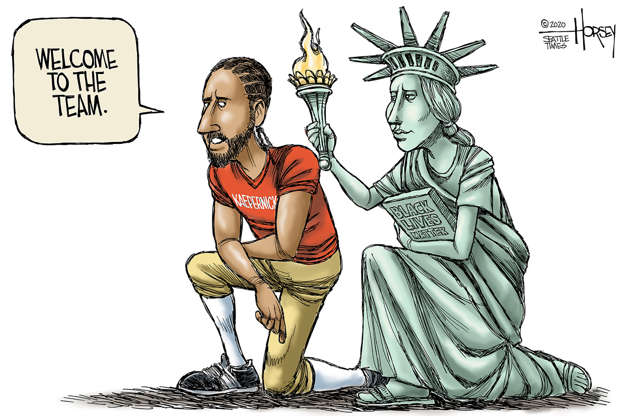
During Friday’s PFT Live draft, Washington came up as one of the teams that should consider signing Colin Kaepernick.

Washington, though, has never discussed the former 49ers quarterback.Doug Williams, the first black quarterback to win a Super Bowl who now serves as Washington’s vice president for player development, explained it’s because of the city the team represents.

“I think what happened here, we’re in a heavily, heavily military area,” Williams said on The Dan Patrick Show on Friday, via NBCSportsWashington.com. “And I think the guy that sits on Pennsylvania Avenue — 1600 Pennsylvania Avenue — made such a big stink of it, the fans in this area . . . might’ve been a tough situation for both the team and [Kaepernick].”

Williams, of course, was talking about President Donald Trump. In 2017, while talking about players who take a knee for the national anthem, the president called for NFL owners to “get that son of a b—- off the field.”

“You don’t want to bring people into a situation where nobody is going to be happy,” Williams said. “I think that’s probably what happened, why he didn’t come up during that time.”

Kaepernick has not played since 2016, parting ways with the 49ers in the 2017 offseason. The NFL has backballed him for being the first player to protest social injustice and police brutality during the national anthem.

Kaepernick has not gotten anything more than a visit to the Seahawks in 2017.

But the death of George Floyd in Minneapolis on May 25, and the protests that have followed, have given NFL players a bigger voice. And many are using that voice to call for Kaepernick to get a second chance.

Seahawks coach Pete Carroll said Thursday a team interested in Kaepernick had called him.

Patrick asked Williams about the Chiefs as a potential landing spot for Kaepernick since Andy Reid gave Michael Vick a job when the quarterback got out of prison.

“[Reid] told me — he was as real as real can get — he had two sons, and they had gotten in a little trouble,” Williams said. “He said, ‘Hey, my son got in trouble.’ He said, ‘Everybody deserves a second chance.’ And you know what? That was good enough for me. And I think if anybody could stomach that and handle Kaepernick and mentor him and understand where he’s coming from.Slide 10 of 50: David Horsey/Seattle Times

btn_donateCC_LG

Please Donate


By Lydia O’Connor   06/11/2020 08:39 pm ET Updated 1 day ago

Huffpost

Trump Campaign Says You Can’t Sue If You Get COVID-19 At His Rally

The president won’t acknowledge that coronavirus is still a threat — unless it could get him sued.

Those registering for President Donald Trump’s massive rally in Tulsa, Oklahoma, next week will notice a message on his campaign website when they sign up: You may contract COVID-19 at the rally, but it’s not Trump’s fault.

The legal disclaimer is the closest Trump has come in weeks to acknowledging that the coronavirus is still rapidly spreading across much of the country. The number of cases leapt past 2 million this week while outbreaks grow in 21 states and more than a dozen see record surges.

But that isn’t stopping his return to holding rallies on June 19, a day recognized as the end of slavery in the U.S. The Tulsa rally venue ― an indoor arena with a 19,000-person capacity ― is a prime breeding ground for the virus to spread, especially if basic safety measures aren’t put into effect. In its message to registrants, the Trump campaign says catching the virus is “an inherent risk” of attending

By clicking register below, you are acknowledging that an inherent risk of exposure to COVID-19 exists in any public place where people are present. By attending the Rally, you and any guests voluntarily assume all risks related to exposure to COVID-19 and agree not to hold Donald J. Trump for President, Inc.; BOK Center; ASM Global; or any of their affiliates, directors, officers, employees, agents, contractors, or volunteers liable for any illness or injury.

By agreeing not to hold Trump or others involved in the event liable if they get sick, attendees waive their right to sue.

“We are looking forward to the tremendous crowds and enthusiasm behind President Trump,” Michael Glassner, the Trump campaign’s chief operating officer, said in a statement announcing the rally.

The registration page doesn’t note any social distancing guidelines that will be in effect at the rally and does not note that the federal Centers for Disease Control and Prevention recommends people wear masks indoors when it’s difficult to keep a safe distance from others. People at Trump’s rallies are generally packed shoulder to shoulder.

Though cases, hospitalizations and deaths continue to climb in many of the states that have reopened their economies, Trump hasn’t changed his tune on the dangers of the pandemic and insists that everything is under control. Bucking guidance from the CDC and those on his own coronavirus task force, Trump rarely wears a mask in public and has scheduled more rallies in states that are struggling to contain the virus.

btn_donateCC_LG

Please Donate