Skip navigation

Category Archives: My Opinion


TOTUS again running off with misinformation in order to give the impression of knowledge on a subject where he has none and to be the main topic of conversation. MA.


Kristen V Brown

and

Riley Griffin

March 21, 2020, 4:11 PM CDT Updated on March 21, 2020, 9:13 PM CDT

‘What do we have to lose?’ Trump asks, touting malaria drug

Experts raise doubts about small study of hydroxychloroquine

A tiny trial of a malaria drug may or may not have helped several patients in France fight off their coronavirus infections. The FDA has said it needs more study. Some expert doctors are skeptical. President Donald Trump is all for it.

On Saturday, Trump again promoted the drug at a White House briefing, and retweeted a post about a small scientific study that has been making the rounds for several days. It followed Trump’s comments Friday that the drug, hydroxychloroquine, was a “game changer,” that “we’re going to be able to make that drug available almost immediately,” and noting that patients could get it from their doctor.

“This miracle cure is based on six subjects, which does not give me a great deal of confidence,” said Hank Greely, a bioethicist at Stanford University, said of hydroxychloroquine. “This study is promising, provocative and worth following-up on, but it is nothing more than that.”

Hydroxychloroquine is part of an urgent effort to find treatments for the coronavirus that in just a few months has killed more than 10,000 people around the globe, and could well prove effective. But so far, there’s little proof of that. It does have two things going for it, however: it’s already on the market, and is available as a lower-cost generic medicine.

Trump is far from the only person of influence to tout the idea that a drug for malaria may offer a treatment for a virus that has infected more than 21,000 people in the United States. The same study had already attracted attention from Elon Musk. Musk’s initial tweet on the subject was liked more than 55,000 times.

Hydroxychloroquine has, in essence, gone viral.

It’s one of a number of drugs being tested for treatment of patients with Covid-19. But since the virus is a new pathogen, there are no ready-made drugs on offer. Instead, scientists have pulled from their existing armory, throwing everything at it, and hoping something works.

“What do we have to lose?” Trump said Saturday at the White House briefing, also acknowledging that scientists in his administration have called for more study. “We’re going to find out very shortly whether or not it is going to work. I feel very confident.”

Hospitals, anticipating a surge in demand, are stockpiling the drug, and some are already treating patients with it on an off-label basis. Medical institutions are gearing up to conduct further studies. Urgent-care centers and tele-health companies have seen increasing numbers of patients requesting hydroxychloroquine as they read about it online, and patients who actually require the drugs have at times not been able to obtain them.

But as attention and demand for hydroxychloroquine mounts, there’s one thing desperately missing — solid proof it actually helps, and that it doesn’t harm patients.

“The president is talking about hope for people, and it’s not an unreasonable thing,” Fauci said at the same briefing, speaking shortly after Trump. “My job is to ultimately prove, without a doubt, that a drug is not only safe but that it actually works.”

The study tweeted out by President Trump looked at 26 patients who had been hospitalized with Covid-19 in France, and compared them to 16 patients at another facility who did not receive the treatment. Of all 26 patients that got hydroxychloroquine, six also received azithromycin, an antibiotic. The six patients who got the antibiotic appeared to clear the virus from their bodies.

“Many of the things that you hear out there are what I had called anecdotal reports,” Fauci said. “They may be true, but they’re anecdotal.”

Scientists are eager to explore any avenue that may lead to a potential treatment, and so larger studies of the drug are gearing up. Hydroxychloroquine and the more-toxic drug it is derived from, chloroquine, are also commonly used to treat rheumatoid arthritis and lupus. Neither drug has been approved by the U.S. Food and Drug Administration to treat Covid-19.

David Ho, a famed AIDS researcher based at Columbia University, said that in the study the treatment didn’t appear to actually make a difference in whether patients lived or got better. And it’s possible that the decreases in the amount of virus found were because of flaws in how samples were collected, or patients may have simply recovered on their own — as most do.

Ho has given his laboratory over to studying Covid-19 and the virus that causes it, SARS-CoV-2.

“In a crisis like this, we need clarity,” Ho said. “Trump is doing just the opposite.”

The post retweeted by Trump on Saturday was authored by a little-known investor, entrepreneur and former biopharmaceutical analyst named Michael Coudrey, who also touted the same drug’s ability to fight HIV.

Reached on Twitter, Coudrey said he thought the study was promising but wasn’t strong enough to justify the drug’s wide use.

Fauci, asked whether the drug might be used preventatively against Covid-19, as it is with malaria, replied, “no.”

Long History

David Goldman, a pediatric infectious disease specialist at the Children’s Hospital at Montefiore, said though the French study “isn’t optimal and doesn’t constitute enough data to validate the new indication for that drug,” it still builds on years of research of hydroxychloroquine use in outbreaks of two related diseases, SARS and MERS.

For decades, researchers across the globe have investigated the effects of chloroquine on viral infections and against HIV. In the early 2000s, some found that it had the potential to inhibit the replication of the virus that causes SARS in mice, but other research subsequently cast doubt on that finding.

Goldman is currently working with stakeholders at Montefiore and the Albert Einstein College of Medicine at Yeshiva University to design a clinical trial that would evaluate hydroxychloroquine as a preventive treatment in more than 600 elderly residents living in nursing homes. He said Montefiore is already treating patients infected by the new coronavirus with hydroxychloroquine.

“Nobody really knows what will work, so let’s try everything: multiple different approaches, multiple different agents, based on the limited data that we have,” he said.

Drugmakers, too, are gearing up for the potential that the drug may work. Novartis AG, Teva Pharmaceutical Industries Ltd and Bayer AG have plans to ramp up production and donate millions of tablets for U.S. pandemic response, while Mylan NV is re-starting manufacturing.

Patient Demand

Some patients, with no treatment currently approved to treat the virus, seem less interested in waiting.

Caesar Djavaherian, co-founder and medical director of Carbon Health, a tele-health company and group of 16 clinics in the Bay Area, said that every day over the past week, patients have come in requesting to try the drug.

“The president and others that have publicized this drug have really put us in a tough spot,” he said.

Chloroquine phosphate prescriptions tripled in the U.S. between Feb. 14 and March 13, according to data compiled by Bloomberg and Symphony Health, while hydroxychloroquine sulfate prescriptions, which are issued at a much greater volume in the U.S., jumped more than 12% over the same period.

Data compiled by the drug shopping website GoodRx showed that between March 1 and March 16, there was a 57% surge in demand for hydroxychloroquine and a 90% increase in chloroquine.

Doctors, Djavaherian said, are now being pressured to prescribe a drug that also risks causing significant side effects. Those can range from dizziness to life-threatening allergic reactions and eye damage. When used in combination with azithromycin, there is also some evidence it can cause heart problems.

“If someone has significant risk factors to become very ill from the coronavirus, like they are older with multiple comorbidities, the thinking is why not prescribe it?” Djavaherian said. “The studies so far have not been sufficient, but if someone were to have a bad outcome, now the question would be, ‘Why didn’t you treat them with this?’”

At this point, the drug should only be regarded as a last resort, Djavaherian said.

Dave Burke, owner of Dave’s Pharmacy in Marysville, Ohio and a state senator, estimated four doctors have tried filling hydroxychloroquine prescriptions for themselves or their family members within the past week at his pharmacy.

Burke was surprised by the first prescription he saw. When he received the second, he realized it was a trend. Then he read about Trump touting hydroxychloroquine. He has since stopped filling prescriptions for people he does not know to be taking the drug for conditions like lupus or rheumatoid arthritis.

“This is like the captain of the ship taking the only lifeboat where passengers are forced to drown,” Burke said.

— With assistance by Robert Langreth, and Angelica LaVito

btn_donateCC_LG

Please Donate


*Dr. Fauci’s demeanor speaks volumes in photo below. MA

  • Deborah Birx, Anthony S. Fauci are posing for a picture: Deborah Birx, White House coronavirus response coordinator, and Anthony S. Fauci, National Institute of Allergy and Infectious Diseases director, listen as President Trump speaks at a news conference Friday.
    Deborah Birx, Anthony S. Fauci are posing for a picture: Deborah Birx, White House coronavirus response coordinator, and Anthony S. Fauci, National Institute of Allergy and Infectious Diseases director, listen as President Trump speaks at a news conference Friday.
Philip Rucker, Ashley Parker

President Trump was reeling from one of his worst weeks ever: The novel coronavirus was killing Americans, wrecking the economy and subsuming him and his presidency.

But in the pandemic, Trump saw an opportunity to cast himself in a new role: “Wartime president,” as he later dubbed it. Aides noted that Trump was punctual for last Saturday’s White House task force meeting, donning a navy “USA” cap and — instead of simply watching as Vice President Pence and the assembled health officials briefed the public that afternoon, as he’d initially planned — joining them at the rostrum.

All week, Trump reveled in his newfound character — that of a crisis commander steering his skittish nation through battle with what he called an “invisible enemy.” He parried questions, barked orders and stood stoically by as he accepted praise, day after day, from his underlings for his “strong leadership” and “decisive actions.”

But on Friday, Trump faltered. He argued based on “just a feeling” that, despite no scientific evidence yet, an anti-malaria drug could cure the coronavirus. He complained that he has not been credited for fixing a nationwide testing system that clearly is still broken. And when asked what message he had for Americans who were scared, he lashed out.

“I say that you’re a terrible reporter,” Trump answered to NBC News correspondent Peter Alexander. “That’s what I say.”

Trump’s past seven days at the helm of the coronavirus effort illuminated his mercurial nature and underscored his difficulty overseeing the national response to a global catastrophe largely out of his — or any other leader’s — control.

Trump — whose moods often determine policy and are almost directly correlated to the vagaries of 24-hour news cycles — has been lapsing into his self-destructive ways even when aides stress the importance of steady leadership during a national emergency.

Fixated on his portrayal in the media, Trump has used this past week to try to rewrite history in hopes of erasing the public’s memory of him dismissing the severity of threat and bungling the early weeks of the administration’s response.

“I’ve felt that it was a pandemic long before it was called a pandemic,” Trump said Tuesday. Only five days earlier he had declared, “It’s going to go away,” and two days before that he had said, “It will go away. Just stay calm.

After the coronavirus was first detected in China and swept across Europe, and even after the first reported case in the United States on Jan. 21, Trump tried to wave off the danger. He was then in the throes of the impeachment battle and distracted by the Democratic presidential primaries. The president accused the media of perpetuating a hoax, arguing that news organizations were drumming up hysteria over the growing public health crisis as a way to hurt his presidency.

The nadir for Trump came March 6, when he visited the Centers for Disease Control and Prevention headquarters in Atlanta and appeared to make a mockery of the scientists’ warnings. He then decamped for the extended weekend to Palm Beach, Fla., where he played golf and hung out with friends at his Mar-a-Lago Club, which itself turned into a coronavirus petri dish.

Trump’s public posture began to shift, however, once the financial markets started to plummet. He was particularly taken with the numbers — not just the cratering Dow Jones industrial average but also the briefings he received from Vice President Pence, multiple times a day, with fresh data and figures showing how the virus could devastate the nation if left unchecked.

A new study released earlier this week by the Imperial College London — which projected that 2.2 million would die in the United States alone if no steps were taken to curb the outbreak — was particularly influential among Trump’s inner circle.

Trump also was influenced by his conversations with business leaders and wealthy supporters, who lit up the presidential phone line with angst and alarm over the Wall Street meltdown. Their message: Get it together. The world’s collapsing and you’re flaunting that you don’t care.

Trump then took a series of steps in quick succession to try to gain control over the spiraling crisis. He delivered a prime-time address to the nation. He banned travel from Europe. And he declared a national emergency.

Though Trump claims his Jan. 31 restrictions on travel from China as evidence that he always has taken the coronavirus seriously, one senior White House official said his March 11 announcement prohibiting most travel from countries in the European Union — a critical diplomatic ally and trade partner — helped truly underscore for Trump the severity of the crisis.

Trump was angry that his error-riddled prime-time Oval Office address to the nation, in which he announced the Europe ban, was widely panned, and frustrated that so few allies defended him on television the next day. But on March 13, a news conference in the Rose Garden — at which he announced a new testing website and new testing locations, both of which were half-baked at best — buoyed his spirits because he finally felt he had at least the illusion of control, aides said.

Officials also pointed to Hope Hicks — Trump’s former communications director and close confidante who recently returned to the White House after a stint in Los Angeles — as a calming presence who helped focus Trump.

Each day after the task force meets and before members present their latest message to the public, a small group retreats to the Oval Office to strategize about the news conference. The group includes whatever officials are speaking that day, as well as Pence, Hicks, White House chief of staff Mark Meadows, the vice president’s chief of staff Marc Short, and Trump’s son-in-law and senior adviser Jared Kushner. Hicks often offers tonal suggestions, helping steer Trump toward the sort of more measured language that his advisers have long been pushing.

On Monday, Trump adopted the far more serious tone that his advisers had encouraged. He echoed the guidance of infectious disease experts and offered direction about what people should and shouldn’t do. He advised against gatherings of more than 10 people, as well as discretionary travel, and urged whoever could work from home to do so. He even hit the pause button on his various feuds with Democrats and the media.

“My focus is really on getting rid of this problem — this virus problem,” he said Monday. “Once we do that, everything else is going to fall into place.”

Trump spoke of the coronavirus as if it were a foreign adversary at war, drawing parallels between the ways Americans are adapting their lives to adhere to social distancing guidelines to the sacrifices citizens made during World War II. Speaking about his own leadership, Trump said Wednesday, “I view it as, in a sense, a wartime president.”

Historian Michael Beschloss said Trump’s conception of himself as a wartime leader is potentially apt.

“The war metaphor is actually a good one if what it means is that the president is acting as a commander in chief does, which is trying to orchestrate all of the power of the federal government to solve the problem and to level with the American people,” Beschloss said. “But this is not a war against a foreign enemy. It is not military. Waging a war is not the same thing as fighting an illness.”

The president’s resolve, however, did not last. Trump has never demonstrated the ability to sustain discipline or message control over an extended period — frequently following fleeting periods of calm with bursts of seeming self-sabotage — and this week was no different.

On Thursday, Trump snapped at a reporter who began a question by stating that “the economy is essentially ground to a halt.”

“Thanks for telling us — we appreciate it,” Trump said, before adding, “Everybody in the room knows that.”

By Friday, Trump was in full tirade mode. Seemingly desperate for a miracle medicine, he kept on pushing an anti-malarial drug as a potential cure-all, prompting Anthony S. Fauci, the director for the National Institute of Allergy and Infectious Diseases, to gently offer a more nuanced view.

But even the normally placid-faced Fauci could barely contain himself when Trump referred to “the State Department or, as they call it, the ‘Deep State’ Department.” Fauci, standing just behind Trump’s left shoulder but still on camera, smirked and touched his fingertips to his brow to cover his face as he struggled to suppress a chuckle.

Other moments were less humorous. When Alexander, the NBC reporter, asked Trump what message he had for “Americans who are watching you right now who are scared,” Trump angrily attacked him as “a terrible reporter” and called it “a very nasty question.”

When Alexander later posed the same question to Pence, it was Trump’s No. 2 who offered the words one might ordinarily expect from a wartime president: “Don’t be afraid. Be vigilant.”


By Mary Papenfuss

The president’s transcript changes “corona” to the dog-whistle misnomer as he dodges criticism of his administration’s failures in addressing COVID-19.

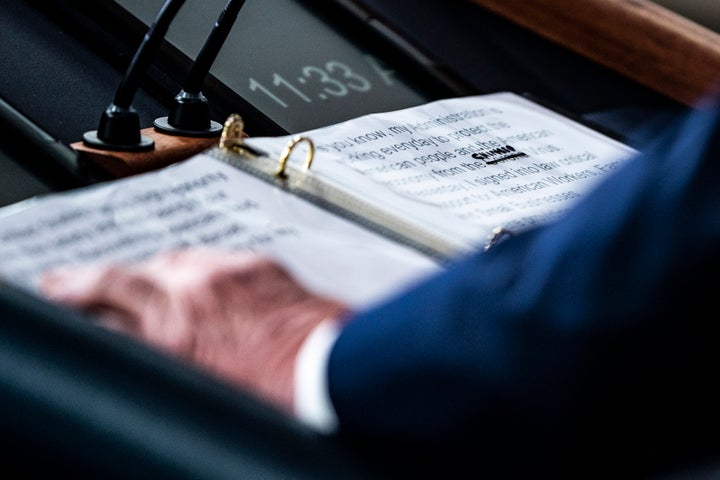
Trump’s news conference statement Thursday shows where the word “corona” was crossed out and replaced with “Chinese” virus as he speaks to reporters. An enterprising Washington Post photographer captured a startling image of President Donald Trump’s altered news conference script Thursday showing what appeared to be his own handwritten change from “corona” to “Chinese” to form “Chinese virus.”

It appeared he used his favorite reality-altering tool: a black Sharpie.

Photographer Jabin Botsford posted the close-up on Twitter amid raging criticism of Trump over his repeated insistence this week on incorrectly calling coronavirus the “Chinese virus.” Critics have slammed the implied racism of his tactic, which they say is aimed at blaming a nation and a race of people for the pandemic to distract the American public from the dangerous failings of his own administration to battle the virus

Close up of President @realDonaldTrump notes is seen where he crossed out “Corona” and replaced it with “Chinese” Virus as he speaks with his coronavirus task force today at the White House. #trump #trumpnotes  

A closeup of Donald Trump's news conference statement Thursday shows where the word "corona" was crossed out and replaced witJabin Botsford/The Washington Post via Getty Images

Trump on Wednesday dismissed the idea that the term “Chinese virus” was in any way racist. “It comes from China,” he said. “It’s not racist at all. I want to be accurate.”

It’s not accurate. Trump’s own top health advisers, Health and Human Services Secretary Alex Azar and Centers for Disease Control and Prevention Director Robert Redfield have said it is inappropriate and inaccurate to label the novel coronavirus as the “Chinese virus.”

The correct term is coronavirus (officially SARS-CoV-2), which causes the disease COVID-19. Those are the terms international scientists, the World Health Organization, U.S. health officials, physicians and much of the general public use.

A report by Human Rights Watch on Thursday linked Trump’s use of his term Chinese virus to the fueling of “anti-Chinese sentiment” as anti-Asian hate crimes soar in the U.S.

Rep. Ted Lieu (D-Calif.), in an opinion article in The Washington Post on Wednesday, slammed Trump for “stoking xenophobic panic in a time of crisis” and shrugging off blame instead of doing his job to help Americans survive the pandemic.

Ted Lieu

✔@tedlieu

US House candidate, CA-33

Dear @WhiteHouse: This virus has an official name, Covid-19 and an unofficial name, Coronavirus. Your language will cause more discrimination against Asian Americans.

What would help is if you can get hospitals & first responders much more test kits & protective equipment. https://twitter.com/whitehouse/status/1240345890159824901 …

The White House

✔@WhiteHouse

Spanish Flu. West Nile Virus. Zika. Ebola. All named for places.
Before the media’s fake outrage, even CNN called it “Chinese Coronavirus.”
Those trying to divide us must stop rooting for America to fail and give Americans real info they need to get through the crisis.


Trump complained on Thursday that China “could have given us a lot earlier notice” about the spread of the disease there, which began in early December. Chinese officials informed the World Health Organization on Dec. 31. It wasn’t until this week that Trump first pledged to ramp up testing in the U.S., which remains far behind other nations and the current demand.

Trump actually thanked the Chinese in January for their efforts against the illness and for their “transparency.”

Akshaya Kumar

✔@AkshayaSays

Replying to @jabinbotsford @realDonaldTrump

Words matter!@hrw found COVID19 motivated anti-Asian hate crimes including physical attacks & beatings, violent bullying in schools, angry threats & discrimination in workplaces.

Instead of warning against that, our president is stoking those fireshttps://www.hrw.org/news/2020/03/19/human-rights-dimensions-covid-19-response# …

Steve Herzfeld @american2084

Replying to @jabinbotsford and 2 others

Perhaps it’s now time for someone to use a Sharpie to cross that out and write ‘Trump’.#TrumpVirus
Trump’s exceptional incompetence is making this pandemic far worse.

268

2:21 PM – Mar 19, 2020

No matter how many times we mention or speak his name with facts, TOTUS will continue to invent what ever he believes will benefit his image (which by the way is that of an inept leader whose shortsightedness was legend before he became (gag) President).

btn_donateCC_LG

Please Donate


The administration again fails to look after the voters. Perhaps we (voters) aren’t as well informed as we need to be. Voters are smart enough to sort out B.S. from fact and we just haven’t decided to do it. WE should not let the administration, Faux news and the political parties TELL us what we want and need. It is our (voters) place to reject what we consider wrong and tell the electeds how we feel about it. MA.

Max Zahn  Reporter

Yahoo Finance March 16, 2020

As the coronavirus outbreak highlights the need for social distancing, policymakers and public health experts want to make sure that sick workers can stay home without fear of going broke.

To that end, the Senate is set to take up on Monday a coronavirus relief bill, passed by the House and backed by President Donald Trump, that could allay the fears of workers and the public alike, requiring businesses to provide employees with paid sick and medical leave.

But the law does not apply to companies with 500 or more employees, meaning about 59 million people who work for such businesses will not receive its protections.

Workers at major corporations and top union officials said they support many of the emergency relief measures in the bill but condemned what they consider a carve-out for big corporations with outsize influence in Washington D.C — one that undermines a measure intended not only to protect employees but the public endangered by sick people forced to go to work.

To be sure, many large companies already provide workers with paid sick days, and a host of major corporations like Walmart (WMT) and McDonald’s (MCD) have recently announced additional paid leave for workers affected by the outbreak.

While the paid sick leave in these voluntary benefit packages from large companies roughly matches that mandated for smaller companies by the House bill, many of the voluntary packages fall short of guaranteeing paid family and medical leave for workers affected by the coronavirus, which the House bill also includes.

In addition, the benefits made available by large companies are revocable at any time, while the government-mandated benefits provided by smaller companies — if passed by the Senate and signed into law — will be in place for the next year. The large companies excluded from the bill, however, will have to pay for their own benefits, whereas a government tax credit will cover the benefits provided by smaller companies.

“The virus doesn’t distinguish — it doesn’t ask who you work for and neither should we,” says Dania Rajendra, the executive director of an anti-Amazon coalition group called Athena, who sharply criticized the exemption for large companies.

The coronavirus relief bill, passed by a bipartisan 363-40 vote in the House on Saturday, requires some companies to provide workers with two weeks of paid sick leave, as well as three months of paid family and medical leave totaling at least two-thirds of their pay. The benefits of the measure are limited to workers who are infected with the virus or are quarantined, as well as those either with a sick family member or forced to stay home due to school closure.

In addition to its exemption for large companies, the bill allows the Labor Department to exclude workers at any company with 50 or fewer employees from some of the provisions. In all, about 80% of American workers could lose out on the benefits, The New York Times Editorial Board recently pointed out. The bill includes a tax credit to cover the cost of the additional paid leave.

“If you are sick, stay home,” Vice President Mike Pence said on Saturday about the Trump administration’s support legislation. “You’re not going to miss a pay check.” At a news conference on Sunday, Pence did not respond directly to a question about the exclusion of workers at large companies.


At a Walmart store in northwest Wisconsin, Brittney Legowski has helped hundreds of panicked shoppers find food and cleaning supplies each day, she says, but she’s afraid that one of them will give her the coronavirus.

Legowski, 21, a part-time worker who lives in Menomonie, Wisc., suffers from a chronic sinus infection and recovered from the flu only two weeks ago, using up nearly all of her accrued sick leave, she says.

“With both of these things working against me, it makes me worried,” says Legowski, who attends college full-time at nearby University of Wisconsin—Stout. “It doesn’t really feel like there’s anything I can do now, or if I were to get sick.”

“It’s extremely frustrating knowing that Walmart could be a part of this bill,” adds Legowski, who is among the 1.5 million people nationwide who work for the country’s largest employer. “It doesn’t seem like they [Walmart] care about their workers.”

Walmart, which did not respond to a request for comment, announced last Tuesday that it would provide up to two weeks of pay for employees required to quarantine by the government or the company, or for those diagnosed with the coronavirus — and the company made up to 26 weeks of payment available for employees diagnosed with coronavirus who cannot return to work after 14 days. A worker at a Walmart store in Kentucky was diagnosed with coronavirus but is improving under medical care.

“We want any associate who is not feeling well to stay home,” the company said in a statement released upon the announcement of the paid sick leave.

Similar policies were put in place in recent days by McDonald’sAmazonChipotle, and other large companies. On average, workers with one year of experience at companies with 500 or more employees receive eight sick days per year, according to a March 2019 report from Bureau of Labor Statistics (BLS). Eighty-nine percent of workers at companies with more than 500 employees receive paid sick leave, according to a September 2019 report from the BLS.

Some large companies that did not provide paid sick leave prior to the outbreak have yet to bolster their policies in light of it, including food chains like Burger King, Wendy’s, and Panera Bread. Only 45% of workers in the food service industry receive paid sick leave, according to BLS data from March 2019.

In general, workers must be diagnosed with coronavirus or be officially quarantined in order to secure paid sick leave under the potential government-mandated plans or voluntary ones from large corporations, but it has so far proven difficult for Americans to get tested for the illness.

Democratic Rep. Nancy Pelosi, the speaker of the House who fought to secure the coronavirus relief bill’s passage, on Saturday appeared to acknowledge the exemption for big companies. “Large employers and corporations must step up to the plate and offer paid sick leave and paid family & medical leave to their workers,” she tweeted.

The country’s most powerful labor organizations sharply criticized the exemption, blaming Trump and lawmakers for succumbing to the influence of wealthy corporations.

“In the face of this unprecedented coronavirus threat, President Trump and his allies are playing politics with our lives,” says Tim Schlittner, the communications director at AFL-CIO, the largest union federation in the U.S. with about 12.5 million members. “Every worker should have paid sick leave — no questions asked.”

Mary Kay Henry, the president of the 2-million member Service Employees International Union, backed the legislation but also criticized the exemption for big companies.

“Large corporations like @McDonalds are using their power and influence to get loopholes written into COVID-19 response so they don’t have to offer paid sick leave,” she tweeted on Saturday.

As of Monday afternoon, the U.S. had 3,813 confirmed cases of coronavirus with 70 deaths, according to Johns Hopkins. The number of recorded deaths worldwide from the outbreak surpassed 6,500 on Monday.

btn_donateCC_LG

Please Donate


It is apparent that our expectations of this administrations ability have been met. We have arrived at a lower point than we imagined. TOTUS has dismantled many programs that provided us with the ability to address climate change, health issues (coronavirus) and the ravages of financial mismanagement and predatory practices. We are now in the grips of a health crisis which was dismissed by TOTUS (like anything he deems colors his image). As I have written before: “Dude, it is not about you!”. Until we (voters) pull the plug, this miscreant behavior will continue to push us downwards as a country. Except for those who support him through ignorance or their own personal gain, there is no broad support for this administration. Political parties are as much a part of this debacle as TOTUS as they have allowed them selves to be split over whats good for the voters or their re election. TOTUS has shown his ineptitude since day one of his residency amid the cheers of folks who refuse to extend their gaze beyond now and consider what the end result of these poor policies will be. With the aggregated abilities of his cabinet ministers we have a net of Zero good accomplished for the people.

Our Losses:    Huge tracts of public lands that will be devastated by commercial drilling                              and mining.

Theft (yet again) of native American lands

Economic downturn due to poor fiscal policies

Cooperative  partnerships with long time allies

An Impartial Federal Judiciary from local to the high court

Disruption of normalcy (such as it is) in the Federal Government

Just to name a few. The remedy is  intelligent and well informed voters no matter the party preference (given the polarization, this may not be best practice).

btn_donateCC_LG

Please Donate


Jesse Drucker and Jessica Silver-Greenberg
The Trump administration has been working to relax regulations governing America’s nursing homes, including rules meant to curb deadly infections among elderly residents.a train cake sitting on top of a building: Thirteen residents of the Life Care Center of Kirkland, Wash., have died from the coronavirus.© Ted S. Warren/Associated Press Thirteen residents of the Life Care Center of Kirkland, Wash., have died from the coronavirus.The main federal regulator overseeing nursing homes proposed the rule changes last summer, before the coronavirus pandemic highlighted the vulnerability of nursing homes to fast-spreading diseases. The push followed a spate of lobbying and campaign contributions by people in the nursing-home industry, according to public records and interviews. 

The coronavirus has killed 13 residents at a nursing home in Washington State; dozens more residents and employees there have fallen ill. Seeking to prevent further contagion, some states, including New York, have banned most nonmedical personnel from setting foot inside nursing homes and other long-term care facilities, which nationally have about 2.5 million residents.

Last July, the federal Centers for Medicare and Medicaid Services, or C.M.S., set in motion a plan to weaken rules imposed by the Obama administration that required every nursing home to employ at least one specialist in preventing infections. The proposed rules — which the agency is completing and has the power to enact — eliminate the requirement to have even a part-time infection specialist on staff. Instead, the Trump administration would require that anti-infection specialists spend “sufficient time at the facility.”

a person wearing a suit and tie talking on a cell phone: Seema Verma, administrator of the Centers for Medicare and Medicaid Services.© Erin Schaff/The New York Times Seema Verma, administrator of the Centers for Medicare and Medicaid Services.Critics say the proposed requirement is so vague that it would be essentially meaningless — and dangerous.

“It adds up to less time, less infection control,” said Anthony Chicotel, a staff lawyer for California Advocates for Nursing Home Reform. He said the proposed change was “alarming.”

Attorneys general in 17 states have called the proposed rules a threat to “the mental and physical security of some of the most vulnerable residents of our states.”

The White House referred questions to the Medicare and Medicaid agency. In an interview on Saturday, the agency’s administrator, Seema Verma, said the proposed rule changes were not about easing up on nursing homes but “about not micromanaging the process.” The proposed changes to the infection-prevention rules, she said, could actually result in a “higher level of staffing.”

“We have to make sure that our regulations are not so burdensome that they hurt the industry,” she said.

Ms. Verma emphasized that the rules were still in the proposal stage and not yet complete. “We have to make sure that we get it right for the sake of patients,” she said.

Infection-prevention specialists are supposed to ensure that employees at nursing homes properly wash their hands and follow other safety protocols. They are widely considered the front line for stopping infections, among the leading causes of deaths in nursing homes.

Each year, about 380,000 residents are killed by infections, according to the Medicare agency. Failure to prevent them is also the leading cause of citations that state inspectors bring against nursing homes.

The coronavirus has laid bare such problems, most starkly at the Life Care Center of Kirkland, Wash., where 13 residents have died after being infected with the virus, and more than a third of the facility’s roughly 180 employees have contracted the illness.

The Kirkland facility, which scored a top quality rating of five stars from the federal government, has had problems before. In April 2019, the Medicare agency wrote it up for failing to “consistently implement an effective infection control program.” In its report, the agency described the concerns of a resident’s daughter, who said that nurses allowed her mother’s heel, which had an open wound, to touch the ground, calling the practice “unhygienic.” The agency found that the facility’s shortcomings put residents “at risk for harm and transmitting/acquiring infections.” The agency, which levied a $67,000 fine, said the problems were quickly fixed.

In recent weeks, nursing home operators nationwide have been cracking down on visitors. Ronald Silva, whose company manages two dozen nursing homes in Indiana and Georgia, said his facilities began screening all workers and vendors three weeks ago.

The Centers for Medicare and Medicaid Services provided new guidance for nursing homes this month, telling inspectors to scrutinize whether employees were following key safety precautions, like regularly washing their hands. Vice President Mike Pence echoed that guidance, emphasizing that all federal inspectors should focus, at least for now, on making sure that facilities are working to prevent and control infections.

“We’re going to put all inspection resources, at the state level, focused on infectious disease, looking at nursing homes being a focal point of vulnerability and a vulnerable population,” Mr. Pence said at a press briefing on March 3.

Mr. Pence did not mention the Trump administration’s proposals to relax the Obama-era rules. The proposed changes are part of a broader effort by the Trump administration to unfetter businesses from regulations. In the case of nursing homes, relaxed regulations are projected to save the industry about $640 million a year, according to estimates from the Centers for Medicare and Medicaid.

In its first year, the Trump administration changed how nursing homes were fined when they violated rules. Previously, they were typically penalized for every day in which a violation persisted. But the agency changed the guidance for inspectors, encouraging them to hand out a single fine — rather than a series of daily penalties — for most infractions. Under the Trump administration, the average fine imposed on a nursing home has dropped more than 30 percent from $41,260 to $28,405, according to an analysis of federal data by Kaiser Health News.

Ms. Verma said the changes to how nursing homes are fined were meant to increase consistency across the industry.

The agency also weakened a rule that would have made it easier for nursing home residents and their families to sue over claims of elder abuse, sexual harassment and wrongful death.

“Together these changes gut enforcement,” said Toby Edelman, a senior lawyer at the Center for Medicare Advocacy, a nonprofit legal assistance group for the elderly. “They are a gift to the industry.”

The administration’s moves came after intense lobbying by the nursing home industry, including by the firm run by Brian Ballard, Mr. Trump’s friend and a fund-raiser. Parlaying his personal connections to Mr. Trump, Mr. Ballard has become one of the most powerful lobbyists in Washington, with the most clients of any registered lobbyist last year, according to an analysis by the Center for Responsive Politics. His firm has lobbied on behalf of nursing homes in his home state, Florida, for years, according to public records. (He was also a lobbyist for Mr. Trump’s Florida golf course, the Doral.)

After Mr. Trump was elected, Mr. Ballard was retained by a leading trade group for the nursing home industry, the American Health Care Association. His firm, Ballard Partners, has earned $930,000 in lobbying fees from the group since Mr. Trump took office, records show.

Ms. Verma, who emphasized that she didn’t even know Mr. Ballard, said she didn’t like to hear from lobbyists. “I tell folks I am not going to meet with D.C. insiders,” she said. “I want to meet with people on the front lines.”

A spokeswoman for the nursing home trade group said that loosening the requirement to have an infections specialist on staff would allow facilities to “provide greater flexibility to meet” to thwart infections.

In November, Mr. Trump was honored by a group of nursing home operators at a fund-raising event at a packed ballroom at the InterContinental hotel in Midtown Manhattan. The event drummed up more than $3 million for his re-election campaign through a political action committee called America First Action.

Flanked by two American flags onstage, Mr. Trump singled out one of the executives, Eliezer Scheiner, who donated $750,000, the most of any attendee.

“I want to thank Eli Scheiner for doing such an incredible job,” Mr. Trump said.

Mr. Scheiner, who owns 22 nursing homes across the country, received a round of applause.

Mr. Scheiner’s nursing homes have received subpar ratings from federal regulators. Since 2017, they have been cited more than 40 times for slipshod infection control. In 2018, inspectors at one of Mr. Scheiner’s nursing homes in Balch Springs, Texas, spotted a staff member who failed to wash or sanitize her hands before cleaning a resident’s anal area. During the same inspection, another staff member was written up for allowing a resident’s feeding tube to touch the inside of a bathroom trash can.

Two years ago, Mr. Scheiner was accused of fraud by a federally appointed bankruptcy court trustee in Connecticut. The trustee accused Mr. Scheiner and his partner of transferring more than $1 million of assets out of one of their nursing home companies into other entities they controlled, a few months before the nursing home company filed for bankruptcy.

Mr. Scheiner didn’t respond to requests for comment. He and the bankruptcy trustee agreed to a settlement this year.

In addition to no longer requiring nursing homes to designate at least one part-time “infection preventionist,” the Trump administration also has proposed adjusting a requirement that facilities must assess what they might need for patient care, from staffing levels to medical equipment. Under the proposal, facilities would have to do such assessments every two years instead of every year.

Matthew Goldstein and Robert Gebeloff contributed reporting.

btn_donateCC_LG

Please Donate


I don’t see TOILET PAPER-so the hoarders are wrong, stupid or uninformed? MA.

Stefani Sassos, MS, RDN, CSO, CDN

Harper’s BazaarMarch 12, 2020, 4:24 PM CDT

From Harper’s BAZAAR

As the coronavirus continues to spread throughout the world and more people are being advised to self-isolate or to quarantine, the Centers for Disease and Control and Prevention has advised people to create a household plan in case there’s an outbreak in their community. Keep in mind that while the virus is a serious health concern, especially for older adults or people who have chronic medical conditions such as heart disease, lung disease, and diabetes, it’s important not to panic (as of March 12, there have been 127,863 confirmed cases of COVID-19 around the globe, with 68,310 recoveries).

What you should do, however, is make some preparations. That means having basic essentials on hand such as food, medicine, and cleaning supplies. But being prepared does not mean stockpiling or hoarding. While the CDC states that people should have sufficient quantities of household items and groceries in the event that they need to stay home “for a period of time,” the U.S. Department of Homeland Security is recommending two weeks’ worth of supplies.

It’s also important to remember that while you may want to keep a supply of bottled water in your house, water supply should not be affected by the COVID-19 outbreak, Dr. Keith Roach, an internist at New York-Presbyterian Hospital, told Men’s Health.

You also probably do not need to stock up on face masks, as health professionals and people who are already sick should be the only ones wearing themsays Dr. Jonathan Fielding, M.D., a professor of health policy and management at the University of California Los Angeles‘ Schools of Public Health and Medicine. Face masks are not thought to provide any additional benefits for healthy people in the general population, according to the Mayo Clinic. Health workers need access to face masks and other medical supplies, and a shortage could pose an even greater health risk to communities

We know this is a lot of information, and that can feel overwhelming, so we’ve complied a list of what to do and buy if you think you may be stuck at home due to the coronavirus.

First, you’ll want to scan your pantry.

Take a quick look at what you already have on hand to make sure you don’t overbuy. You don’t need to go crazy with purchasing canned goods if you already have the recommended two-weeks’ worth. The same goes for cleaning supplies.

Then add frozen fruits and canned vegetables, as well as non-perishables, to your grocery list.

If you have fresh produce in your home, use that up first to minimize any waste. Then, look for canned, boxed, and shelf-stable items to have on hand. When it comes to canned goods, it’s always preferable to look for low-sodium versions, and cans that say they don’t have BPA lining, if you can find them. Frozen foods are excellent to have on hand, as well.

Below are items to use as a starting point for your shopping, but keep in mind you should be buying foods you would normally eat. And of course, pick up food and drinks you just plain enjoy, such as coffee, tea, chocolate, and chips. Also, if you have a baby or toddler in the house, you’re going to want to add the essentials they need to your list as well.

Fruit

  • Applesauce and other fruit purees
  • Canned fruit in water
  • Frozen fruit
  • Dried fruit

Vegetables

  • Canned vegetables (i.e., green beans, carrots, peas, diced tomatoes, pumpkin puree), low-sodium if possible
  • Canned vegetable-based soups and chilis, low-sodium if possible
  • Frozen vegetables (i.e, broccoli, cauliflower, asparagus)
  • Jarred tomato sauce

Protein

  • Tuna or salmon, canned or in a pouch
  • Chicken or turkey, canned or in a pouch
  • Frozen fish, such as shrimp or individually portioned pieces of salmon
  • Shelf-stable silken tofu
  • Lentils, canned or vacuum-sealed
  • Eggs and egg beaters
  • Nut/seed butter
  • Nuts and seeds
  • Trail mix
  • Dry or canned beans

Grains

  • Whole wheat pasta or chickpea pasta
  • Brown rice
  • Ancient grains (i.e., quinoa, farro)
  • Oats
  • Instant oatmeal packets/cups
  • Whole wheat or seed crackers
  • Whole wheat or sprouted bread (can keep in freezer and toast when ready to eat)

Dairy

  • Shelf-stable boxes of milk (shelf-stable varieties are available for regular and non-dairy milks)
  • Powdered milk

Healthy Fats

  • Olive oil
  • Avocado oil
  • Flax seeds
  • Chia seeds

Beverages

  • Water (if you’re unable to or prefer not to drink tap)
  • Low-sugar electrolyte drinks
  • Pre-made protein-shakes or meal-replacement shakes (in case you get sick and lose your appetite)
  • Canned or boxed low-sodium broth

Take note of what toiletries and cleaning supplies you need.

Basic toiletries include toothpaste, floss, face wash, moisturizer, shampoo, conditioner, razors, shaving cream, and hand sanitizer with at least 60% alcohol. Extra laundry detergent and hand soap are also important to have at home. As for household disinfectants, the CDC recommends diluted household bleach solutions, alcohol solutions with at least 70% alcohol, and most common EPA-registered household disinfectants.

It also says: “Diluted household bleach solutions can be used if appropriate for the surface. Follow manufacturer’s instructions for application and proper ventilation. Check to ensure the product is not past its expiration date. Never mix household bleach with ammonia or any other cleanser. Unexpired household bleach will be effective against coronaviruses when properly diluted.”

Prepare a bleach solution by mixing:

  • 5 tablespoons (1/3 of a cup) bleach per gallon of water or 4 teaspoons bleach per quart of water

Be sure to check your medicine cabinet.

For those on prescription medications, consider calling ahead for an extra month or two of medicine just in case. The American Red Cross recommends having at least a 30-day supply of any prescription medications for those in your home. (CVS is now delivering prescribed medications to customers for free.) They also advise at least a one month’s supply of over-the-counter medicines such as pain relievers, stomach remedies, cough and cold medicines, and throat lozenges. A daily multivitamin is also a good idea to stock up on so you’re able to get those essential vitamins and minerals if your food choices are limited.

And don’t forget about your pets.

Pick up extra animal supplies, including medications and food. Wee-wee absorbent pads can come in handy as well if you can’t get out to walk your dog. Remember: Having a pet is like having another human being inside the house — they require just as much care and supplies as any of us do, if not more.

Other helpful resources regarding coronavirus


Forked tongue speaks again about subject he knows nothing about based on his lack of comprehension and refusal to be corrected on. MA

Frederic Lardinois@fredericl / 6:06 pm CDT • March 13, 2020

In a press conference at the White House, President Trump today announced that 1,700 Google engineers were working on a coronavirus screening site. That site was supposedly the first step in a new screening process that would lead people from figuring out if their symptoms warranted more testing to the location of new “drive through” testing stations. But Trump was wrong. This screening site isn’t being developed by Google . Instead, it’s being built by Verily, Alphabet’s life science division — and it’s not ready to launch yet either.

While both share the same parent company in Alphabet,  these are two very different companies. In addition, as Verily  noted in a statement it provided almost three hours after Trump made the announcement, this site isn’t quite ready yet.

“Verily is developing a tool to help triage individuals for COVID-19 testing. We are in the early stages of development, and planning to roll testing out in the Bay Area, with the hope of expanding more broadly over time,” the company said in its statement. “We appreciate the support of government officials and industry partners and thank the Google engineers who have volunteered to be part of this effort.”

Verily specifically mentions that the site is in its “early stages.” Debbie Birx, the White House Coronavirus Response Coordinator, as well as Trump, made no mention of the fact that this site wasn’t ready yet or that it would only roll out in the Bay Area at first.

Instead, anybody watching the press conference surely came away with the impression that the site was essentially ready, especially given its pivotal role in the overall screening process.

“I want to thank Google. Google is helping to develop a website,” Trump said. “It’s gonna be very quickly done — unlike websites of the past — to determine whether a test is warranted and to facilitate testing at a nearby convenient location. We have many, many locations behind us, by the way. We cover this country and large parts of the world, by the way. We’re not gonna be talking about the world right now, but we cover very, very strongly our country. Stores in virtually every location. Google has 1,700 engineers working on this right now. They have made tremendous progress.”

Similarly, when Birx presented the new screening approach, she specifically noted that the process will start with the screening website. Given some of Trump’s earlier comments in the press conference, a number of pundits believed that the site would be ready by Sunday night.

Here is Verily’s statement about its plans for its site, according to a spokesperson: “What I can share at this time is that our aspiration is for the triage tool to be used much more broadly. Initially, we’re linking it with several sites in the Bay Area to test and iterate, and collaborating closely with organizations like Quest Diagnostics and LabCorp who are also working on additional approaches to making testing more accessible and expedient in other areas.”

In a different statement to The Verge, Verily said the tool was originally meant for healthcare workers and that the presidential announcement changed its course to becoming a public site. Whatever the original intent of the project, it seems quite clear that Verily was taken somewhat aback by the announcement.

Now, it’s not uncommon for anybody outside of the tech world to use Alphabet and Google interchangeably. Still, Verily is not Google and the Bay Area is not the whole country. Those are important facts

btn_donateCC_LG

Please Donate


The Administrations boot lickers are putting us all at risk with their unfaltering faith in an inept megalomaniac. MA

For the Love of God, Why Is the Trump Administration Blocking Medicaid Access to Fight Coronavirus?

Luke Darby

GQMarch 13, 2020, 11:46 AM CDT

Early Friday morning, Donald Trump took to Twitter to let the world know exactly who was responsible for the U.S.’s disastrous response to the on-going coronavirus outbreak—the Centers for Disease Control and former president Barack Obama. He claimed that the CDC knew it “would always be inadequate and slow for a large scale pandemic” and that Obama “made changes that only complicated things further.” This is after, in 2018, his administration dismantled the global health security team left in place by the Obama administration to confront pandemics like this, and cut 80 percent of the CDC’s efforts to prevent global outbreaks.

But Trump claims that under his leadership, the CDC is now in shipshape: “Their response to H1N1 Swine Flu was a full scale disaster, with thousands dying, and nothing meaningful done to fix the testing problem, until now. The changes have been made and testing will soon happen on a very large scale basis. All Red Tape has been cut, ready to go!”

Like many of Trump’s statements about how his administration is handling the COVID-19 outbreak, this isn’t accurate. The Department of Health and Human Services, for example, has been imposing extremely strict guidelines for who can and can’t access the limited coronavirus tests available, essentially guaranteeing that people only get tested once they’ve already developed symptoms and causing delays that likely resulted in hundreds more people getting infected.

It’s particularly ironic that Trump brings up the H1N1 outbreak of 2009 though, which the Obama administration declared a national emergency. Commonly called swine flu, it was a kind of influenza that resulted in 12,000 deaths in the U.S. alone. As states struggled to deal with the spread of the disease, the federal government loosened restrictions so that state governments could use Medicaid funds to help with testing. Right now, the Trump administration is stonewalling that same process for the coronavirus, according to the Los Angeles Times.

Medicaid is the federal and state program that helps poor people get health care, and it’s a massive safety net with tough restrictions for how it can be used. The Trump administration hasn’t taken any steps to help states access the funds for the coronavirus outbreak, despite the fact that it’s been made available in the past for other disasters, like after the 9/11 terrorist attacks, Hurricane Katrina, and the H1N1 outbreak. Per the Times:

One reason federal health officials have not acted appears to be President Trump’s reluctance to declare a national emergency. That’s a key step that would clear the way for states to get Medicaid waivers to more nimbly tackle coronavirus, but it would conflict with Trump’s repeated efforts to downplay the seriousness of the epidemic. Another element may be ideological: The administration official who oversees Medicaid, Seema Verma, head of the government’s Centers for Medicare and Medicaid Services, has been a champion of efforts by conservative states to trim the number of people enrolled in Medicaid.

Seema Verma was appointed to head the Centers for Medicare & Medicaid Services (CMS) after a stint working as a consultant for vice president Mike Pence back when he was governor of Indiana. In Pence’s Indiana, she helped push a plan that expanded access to Medicaid for childless adults, but only under a waiver that allowed the state to start charging premiums. Verma has spent years helping conservatives find ways to undermine public health programs like Medicaid, as Mother Jones exhaustively detailed last year. Her work at CMS so far has consisted largely of finding ways to let states avoid using Medicaid money, like inventing state-imposed spending caps, which constrict the flow of funds without the administration explicitly cutting the budget for Medicaid. Under her leadership, CMS has approved multiple requests by Republican-led states to start imposing work requirements for Medicaid, and in Arkansas alone that’s expected to strip health care from 30,700 to 48,300 people.

Speaking to Fox News on Thursday night, Verma repeatedly refused to answer whether or not America would be facing a shortage of ventilators and intensive care units as the current outbreak escalates. Health professionals coordinating the outbreak response in Italy recently published a letter saying that hospitals there were overwhelmed due to “a very high number of ICU admissions, almost entirely due to severe hypoxic respiratory failure requiring mechanical ventilation.” Each time Verma was explicitly asked about equipment shortages, she responded instead by praising Trump.  

According to the Times, state leaders are likely unwilling to criticize Trump’s coronavirus response out of fear that he’ll lash out at them personally or even deny their state funds in the future. In February, Washington state governor Jay Inslee, a Democrat, tweeted, “I just received a call from @VP Mike Pence, thanking Washington state for our efforts to combat the coronavirus. I told him our work would be more successful if the Trump administration stuck to the science and told the truth.” Speaking to reporters later at the CDC in Atlanta, Trump said, “I told [Mike Pence] not to be complimentary of that governor because that governor is a snake. So Mike may be happy with him but I’m not, OK?”


TOTUS refuses to meet with Speaker Pelosi regarding a potentially National Health issue. Apparently the miscreant child can’t get over his easily bruised ego. This action clearly shows that his focus is on his own self aggrandizement and not on the best actions for the country- you know the people and Nation he took an oath to protect and serve. MA


Trump reportedly won’t meet with Pelosi on a coronavirus bill, or for any reason, because he’s mad at her

Peter Weber
The Week

President Trump traveled to Capitol Hill on Tuesday to discuss a coronavirus economic stimulus package with Senate Republicans. Any bill would have to be approved by the Democratic-led House, where Trump’s big idea, a payroll tax cut, is a nonstarter. So why didn’t he also meet with House Speaker Nancy Pelosi (D-Calif.)? “Trump and Nancy Pelosi aren’t exactly on speaking terms,” Politico reports, “so he’s deputized Treasury Secretary Steven Mnuchin to handle talks with the speaker.”

Senate Republicans are also leery of the payroll tax cut, especially as Trump gave the impression he wants the taxes used to fund Social Security and Medicare slashed to zero, permanently, The Washington Post reports. Pelosi’s caucus is already putting together its own bill funding paid sick leave for workers and lunches for students whose schools are closed during the outbreak. Mnuchin “is going to have ball control for the administration, and I expect that will speak for us as well,” Senate Majority Leader Mitch McConnell (R-Ky) said after meeting with Trump. “We’re hoping that he and the speaker can pull this together.”

On MSNBC Tuesday, CNBC’s Eamon Javers said the White House doesn’t think it “would end well” if Trump met with Pelosi. “It’s a tragic statement that because he’s so wounded — I mean, we’re in the middle of a national crisis, and he can’t get in a room with the speaker of the House?” host Nicole Wallace asked. “What the White House would say is, that’s Pelosi’s fault,” Javers said. “Because she ripped up his speech, she’s been tough on him, she impeached him, and therefore the president has every right to not want to be in a room with her.”

In fact, White House spokesman Judd Deere said Monday that Trump had declined Pelosi’s invitation to attend the annual St. Patrick’s Day lunch — a bipartisan tradition that started in 1983 as a fence-mending gathering hosted by House Speaker Thomas “Tip” O’Neill (D-Mass) for President Ronald Reagan — because “the speaker has chosen to tear this nation apart with her actions and her rhetoric.”

“You know, Bill Clinton built part of his political narrative by saying ‘I feel your pain,'” former Rep. David Jolly (R-Fla.) told Wallace on Tuesday. “Donald Trump is asking the nation to feel his, and it is a weird leadership quality in a moment of crisis.”

btn_donateCC_LG

Please Donate